Hi.
My understanding is that a value of 1 represents total absorption, and a value of 0 represents total reflection. Some materials, such as 4" 703 fibreglass have an absorption coefficient of, for example, 1.24 at 250Hz and 500Hz.
What is this excess representing?
Thanks,
onlyone-jc.
When absorption coefficents are measured in a reverberation room, the total absorption is divided by the surface area of the test subject. Since the test subjects are not two dimensional and are in fact three dimensional with a significant amount of extra surface area, values greater than one are not uncommon.
Take absorption coefficients with a grain of salt.
> What is this excess representing? <
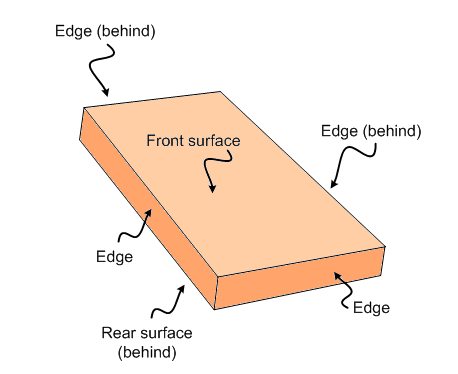
The panel's edges. The calculation to derive Absorption Coefficient from Sabins, which is what's actually measured, uses only the front surface area. But a panel four inches thick has 50 percent more surface just from the edges. The drawing below shows this in context.
--Ethan
Recovered from web.archive.org — originally hosted at http://www.realtraps.com/foam_panel.gif
Ethan’s explanation is wrong,
I try to alter this misconception for years already without any succes (trying to correct things is often referred to as causing trouble).
There is no linear relation with the edge surface.
This is a complicated business and related to diffraction and diffusion.
At the edge of a sample the sound field gets scrambled.
Just see it as the Sabine method with difficult to quantify an accepted uncertainties.
Those absorption coefficients, while meant by Sabine as energetic absorption values, which indeed means that 100% should be the maximum, are influenced by a number of 'not so simple' parameters.
This is mostly/often referred to as the edge effect.
But this effect also occurs when those edges are 100% reflective, hence no increase of absorptive surface occurs.
This picture is Copyrighted, leave it where it is.
Important to note is that those boards are framed with a very stable closed metal frame, hence the free edges, when spreading them out, DID NOT increase whatever edge absorptive surface on those absorbers.
What you see here is that by spreading absorbers out on the floor, hence changing the parameter of the ratio of the perimeter versus the horizontal surface, the absorption increases, but this is a frequency dependent phenomenon.
This picture based on real lab measurements in itself proves the explanation, that it is edge surface related, wrong, because that's a frequency independent constant, and secondly the absorber edges in those measurements aren't absorptive at all.
Also just increasing the diffusity of a room will increase the absorption values. Hence such absorption values are no real fixed constant but dependent on the sound field.
Just accept that those deviations can occur when measuring material in a reverberation room using the Sabine method.
This is really complicated business. Even the ASTM standard does not give exact formulas to calculate from one to the other, and for good reasons.
The most recent ISO standard does apply such calculation if the sample is not screened at the edges, to sanction unjust comparisons between measurements.
A lot of measurements, you'll find on the net, should look quiet different when applying the most recent ISO methods.
But as David said, don't worry too much about it.
David: this isn't only the 3D behavior. Of course absorption is 3D, if it wasn't 3D but 2D it was infinite thin, :) which indeed shouldn't absorp very well.
But if I should make rectangular holes in the ground and mount the absorption flush with the bottom, I still should measure edge effect of spread absorbers versus an adjacent patch with the same total surface.
It's the difference in impedance between the reflective and absorptive surface and the relation with the front behavior of waves which causes the soundfield to get scrambled and diffract. And more absorption will help, but is not the main cause and is frequency related.
Don't assume you can extract a formula from this picture. Other comparisons can show a different behavior (depend on wavelengths versus spread etc.). There is a lot written about this, and it shouldn't if the relation was that simple.
Eric,
Nice to see you here! 8)
> this effect also occurs when those edges are 100% reflective, hence no increase of absorptive surface occurs. <
Your explanation has too many holes in it for me to accept without further evidence. Especially since it defies common sense.
How thick is the metal and what type? Were the panels flat on the floor or raised up? If raised, by how much? What do the percent numbers along the left edge mean? Did you measure at many different spacings or just one spacing in addition to the panels adjacent? Why does the disparity peak at 200 Hz rather than falling off linearly as you'd expect? What are "baffles with metal center core?" Is this not plain rigid fiberglass or mineral wool? When was this test done? In what lab? And by whom? You?
Most important of all - do you have any photos?
--Ethan
Play nonsense with someone else.
Before asking anything to others show your very first official RealTraps reports.
And don't look surpriced since you know this picture, and what it stands for very well. I explained this concept for years already, and wrote something about it in a private email to you years ago.
This VERY picture is shown and its context discussed at SOS with you, hence this is nothing new to you.
And read your FIRST articles in your live about the edge effect and related phenomena, before you write an article yourself, entered and referred a million times in groups, via press releases, reviews, your site, whatever to your "number games" article which is based on NOTHING, NADA, ZERO, 0.
(you just added some nice worths as diffraction after previous incredible efforts to get it right)
And which you use to prove that foam absorber measurements are inflated versus real absorption, to enhance your own products.
Foam blocks like this are meant to be mounted in a corner, stacked one above the other from floor to ceiling. When measured for absorption four of the five surfaces are exposed, but when installed as intended only the front surface absorbs. So in practice, a two-foot corner wedge like this provides only 65 percent of the absorption claimed. The shorter the wedge, the larger the disparity between the published and actual absorption.
And my measurements are done, as almost all measurements I shared on the net, as per official standard in an official University Lab, in function of real studies, not non-substanciated fantasized articles, for pseudo scientific (ab)use.
This measurement is done for an academic assignment IN FUNCTION OF THE EDGE EFFECT under control of a Prof.
Whether it defies your common sense or not, has little to do with it, as do most of your questions here.
Which Lab, which individual, size of stockings, how thick the steel, how large the spacing, whether I did it of someone else does NOT matter.
I know how to measure and what a lab is about. And I entered those measurements (WHICH YOU ALREADY KNEW and SAW) because they are representative for, and substantiate the context in which I use them.
Show the measurements and research substanciating your article read by tens of thousands already, and above quote, rather than obfuscating and diverting my SUBSTANCIATED message.
Eric:
Too bad you you haven't learned anything over the years.
If you decide to explain more about that test, I'll be glad to read it. Until then your statements are even more unsubstantiated than mine.
--Ethan
Ethan,
Thanks for showing yourself.
There is nothing to explain. Both tests are executed in the same accredited lab, as per the same official reverb room procedure/standard on exactly the same absorbers lying on the ground.
The only variable is the positioning of the absorbers on the ground which is shown in the picture.
And you writing an article referred to countless times and read by tens of thousands, must depend on YOUR research and responsibility, neither the name of a lab used by someone else, nor my size of stockings.
YOU wrote that article, YOU link to it direct and indirect, YOU mislead people, YOU are responsible, DON'T hide behind me now.
And there is literature available, of which part is referred in the Standard itself of which you have copy, articles appeared in JASA and on other places.
Not anyone is blind.
Eric
Edit:
You wisely removed that Large Greamlin, after your first sentence laughing at me didn't you? You found it yourself too obvious?
Hence this is how your reply exactly looked:
Ethan Winer wrote:
Eric:
Too bad you you haven't learned anything over the years.
Eric,
You slay me man, you really do.
Recovered from web.archive.org — originally hosted at http://www.ethanwiner.com/emoticons/rofl3dbig.gifHave you nothing better to do than sit in front of your screen pressing refresh continually? That ROFL icon was in my post for all of five seconds. You're correct though, and I decided immediately after posting not to be immature. We already have you for that.
So are you going to answer even one of my questions? You're big on documenting everything, right? So how thick was the metal? That's probably the most important question. Then we can go on to all my other absolutely valid questions.
--Ethan
I stop this here.
I know you won't change a thing.
That's as the RAL measurements you even dispute and question the validity of official Riverbank Acoustical Lab reports, for HUNDREDS of messages anywhere, just because you don't like the results.
So I summarize:
1) YOU ARE AND WERE WRONG and are not ashamed to write about whatever, without bothering science, nor the lack of respect for your readers by doing so.
And you're informed about this for years already, not once but often.
2) THOSE MEASUREMENTS ARE VALID and not open for 200 posts of diversion by you, obfuscating the topic.
3) LITERATURE IS AVAILABLE. even with some references in your possession.
4) I ENTERED A SUBSTANCIATED MESSAGE5) I ENTERED RELATED MEASUREMENTS6) YOU HAVEN'T TOLD A THING but instead try to ridicule me and diffuse the topic.
7) IF I GIVE YOU THE FRAME THICKNESS, YOU EVEN SCHOULDN'T KNOW WHAT TO DO WITH IT. unless diverting further (and I know exactly were you want to go with this, it guarantees you > 20 more chaotic posts, hence nobody knows anymore what the topic was all about, and you still have the other questions to go then).
8 ) THIS MEASUREMENT IS EXECUTED WITH THE PURPOSE TO INVESTIGATE THE EDGE EFFECT IN A UNIV WHERE NOBODY IN THE RELATED DEPARTMENT UNDERSTANDS THAT LITTLE ABOUT ACOUSTICS THAN YOU.9) ONCE MORE YOU TRY TO HIDE YOUR OWN RESPONSIBILITY BEHIND SOMEONE ELSE'S BACK.
And while not easy and acoustics on the net often looks as a cult rather than science, there are people seeing through your diversion tactics.
Once more you try to ridicule people, not confirming you, as a substitute for insight/knowledge.
END THREAD FOR ME.
> So I summarize: <
Wow, that's an awfully long summary! Here's mine:
Recovered from web.archive.org — originally hosted at http://www.ethanwiner.com/Smiley%20Land/Sad03.gif
> So I summarize: <
Wow, that's an awfully long summary! Here's mine:
Recovered from web.archive.org — originally hosted at http://www.ethanwiner.com/Smiley%20Land/Sad03.gifwww.realtraps.com
The acoustic treatment experts
Yep,
This is one of those threads you recently (last couple of days) described at AVS, I always loose on Merits?
With you as the intelligent mature guy?
I tell you are wittingly misleading people with a purpose.
I substantiate it (as so often already).
And this childish immature behavior is your only and best comment?
At least you become more transparent.
What do the percent numbers along the left edge mean?
The change in sabins between having them together and apart.
Did you measure at many different spacings or just one spacing in addition to the panels adjacent?
There were 13 tests performed not counting the empty room test.
But for the purposes of that chart above, just the two measurements are compared.
Why does the disparity peak at 200 Hz rather than falling off linearly as you'd expect?
I don't know.
What are "baffles with metal center core?" Is this not plain rigid fiberglass or mineral wool?
The aborbers (aka baffles) are 32kg/m^3 polyester 65mm thick with a 35 mm air cavity behind them, enclosed in a five sided steel box, leaving only one surface of the polyester exposed (the top).
When was this test done?
In or before 2003
In what lab?
The Reverberation lab of the Catholic University of Leuven
And by whom? You?
Eric and Professor Dr. Lr. Gerrit Vermeir.
Measurements included T10, T20, T30 from 80hz to 6300hz. The T30 is the most useful of these. The report includes the times for the empty room, and the calculations for Sabin values as a result of adding the treatments under test.
Did you measure at many different spacings or just one spacing in addition to the panels adjacent?
There were 13 tests performed not counting the empty room test.
I only showed 13.
z60611 wrote:
What are "baffles with metal center core?" Is this not plain rigid fiberglass or mineral wool?
The aborbers (aka baffles) are 32kg/m^3 polyester 65mm thick with a 35 mm air cavity behind them, enclosed in a five sided steel box, leaving only one surface of the polyester exposed (the top).
Bob,
Thanks!
Do we know why Eric couldn't say that for himself? :)
Also, that data would be much more compelling if it included identical tests where the same panels were not enclosed in the steel cases. Especially since the metal is so thin it's not much more than foil.
--Ethan
You know this thread is linked elsewhere now he? Let's play innocent again.
This thread was about YOUR info, and this is discussed before.
There's nothing foil about that frame, you even have no idea how it is made.
Expected diversion starts. Again another escape route.
Thanks Bob. I'll try for another 3 years to protect people against misinformation.
z60611 wrote:
Quote:
What are "baffles with metal center core?" Is this not plain rigid fiberglass or mineral wool?
The aborbers (aka baffles) are 32kg/m^3 polyester 65mm thick with a 35 mm air cavity behind them, enclosed in a five sided steel box, leaving only one surface of the polyester exposed (the top).
?????????????????????
That was my interpretation of what the word document said.
In the header of the chart on page 2. The headers are
"Polyester 32kg/m^3 - 65mm + air cavity 35mm (Tot 100mm)"
"Empty Reference Reverberation Room"
"Sabine & Stand Dev"
What were the baffles?
(not that it makes any difference for the purpose of the chart is trying to explain -- you could be measuring with dead mice in a boxes and that would be fine too)
z60611 wrote:
Quote:
What are "baffles with metal center core?" Is this not plain rigid fiberglass or mineral wool?
The aborbers (aka baffles) are 32kg/m^3 polyester 65mm thick with a 35 mm air cavity behind them, enclosed in a five sided steel box, leaving only one surface of the polyester exposed (the top).
?????????????????????
That was my interpretation of what the word document said.
In the header of the chart on page 2. The headers are
"Polyester 32kg/m^3 - 65mm + air cavity 35mm (Tot 100mm)"
"Empty Reference Reverberation Room"
"Sabine & Stand Dev"
What were the baffles?
(not that it makes any difference for the purpose of the chart is trying to explain -- you could be measuring with dead mice in a boxes and that would be fine too)
BOB I REFUSE TO GO INTO THOSE BAFFELS HERE. Whatever you read here is not related to those absorbers. This description does not fit.
And this has nothing to do with what the measurements I entered represent. I described exactly what they stand for.
This is just an escape route from the hart of this thread.
In deference to the true acoustical scientist (Eric Desart) on this thread, I have deleted this and another post. By chance, Ethan Winer is right for once; my contribution to THIS thread did not help the argument.
However, I still expect that weekly letter from ETHAN WINER'S attorney.
Sorry for any incovenience, please continue.
Joel DuBay
Just so it's perfectly clear, our friend powerjoe is none other than Joel DuBay, who fancies himself a competitor to my company. Since Joel has nothing technical to contribute to this discussion, and certainly doesn't have a better product, I guess he feels this is the only way he can compete. Wow, both of you guys are pathetic. I think it's time for Steve or John to lock up this puppy. Way to go guys. Yet another potentially interesting technical discussion flushed down the toilet.
BTW Joel, I plan to "out" you at AVS very soon. I'm just waiting for the ideal opportunity.
--Ethan
Just so it's perfectly clear, our friend powerjoe is none other than Joel DuBay, who fancies himself a competitor to my company. Since Joel has nothing technical to contribute to this discussion, and certainly doesn't have a better product, I guess he feels this is the only way he can compete. Wow, both of you guys are pathetic. I think it's time for Steve or John to lock up this puppy. Way to go guys. Yet another potentially interesting technical discussion flushed down the toilet.
BTW Joel, I plan to "out" you at AVS very soon. I'm just waiting for the ideal opportunity.
--Ethan
Methaphorical:
Please .........
Steve ............... John ....................
Lock it .......................... please ..................
Then it looks that others are responsible for:
Ethan Winer wrote:
Yet another potentially interesting technical discussion flushed down the toilet
And I, Ethan Winer, can hide behind someone/something else ......
I don't like responsibility for my own actions ...., hate it ......
This stupid pathetic Eric, forces me to stay on topic, prevents me to divert and diffuse stuff. I'm not use to that ...., I'm used I can wrap guys.....
I write what I see fit, I make it look like science, and it supports my goals ....
And this pathetic Joel, thinking he means something, I'll deal with him in my own manner. I'll just "out" him first chance I get.
If you please ??????
End Methaphorical
Not methaphorical:
Thanks for being more transparent
A quote from an Academic who publically states he does like you:
<snip> Many of us on the forum with better science backgrounds have tried to teach him things in the past, with only very limited success. We tend to get frustrated, and have largely given up trying. When he posts incorrect information as acoustical fact, it is pretty much useless to argue, at least on the basis of science.
I like Ethan. He is a nice guy. <snip>