Here’s a 3D model of my control room. It’s in my attic so you can see the pitched roof (with skylights) and a 4 ft knee wall. The room dimensions are 19’l x 12’w x 7’h. The floor is carpeted. The ceiling is plaster. I have access to 2” insulation with nearly identical SAC as OC 705. The corner traps (yellow) will be based on the ones described here: http://www.ethanwiner.com/acoustics.html
The rest (orange) will be like these:
http://www.ethanwiner.com/BTPlans.gif
The problem in this room has been muddy mixes. I have had to compensate by eq’ing out low mids. I hope this helps and welcome any suggestions with respect to number, placement and type of trap.
You might try laying a few sheets of plywood or MDF around on some of that carpet and doing a few mixes over; usually carpet will suck out the highs and high mids and just leave the "Mud".
IF that works for you, you should remove the carpet - just leaving the plywood on top of carpet is an open invitation to all the pests in your locale - dust mites, mold, spoors, funguses, fleas, etc... Steve
I didn't draw the plywood :lol: I do have a plywood assembly I rigged up that's 8'x8'. It's smack in the center of the room, flush with the wall in front of the mixing desk. I thought about ripping up the rug (at least in that area) and putting down parquet. To tell the truth the plywood's not doing anything I can audibly detect so I didn't see the point of the exercise. Maybe pulling out all the rug in favor of a wood floor is the way to go, but that's a drastic step at this juncture and I bet I'd still need some treatments, no?
That being said, the heart of my question is/was "are the types and locations of the traps I have indicated in the drawings appropriate for the size and shape of my room given the concerns I noted."
Which of the three traps shown in your second link is what you intend? And, if they're panel traps have you calculated which modes you're treating yet?
Just generally, you're on the right track - one thing you may want to keep in mind is that if your absorbent type traps pull too much of the highs out of the room, you can get some of them back (and improve bass trapping a bit as well) by placing a light membrane across the faces of your corner absorbers - the use of thin plastic (like painter's drop cloths) will brighten the room a bit without affecting much else - a heavier plastic will do more. These can be put on just before you cover with cloth...
The angled ceiling down to the knee wall will reflect right back at you, so the absorbent you show there should be MINIMUM of 2" spaced off the wall by that amount - thicker would be better. Sit in your chair and place the absorbent centered where you'd see either speaker if the absorbent were a mirror.
HTH... Steve
Chuck,
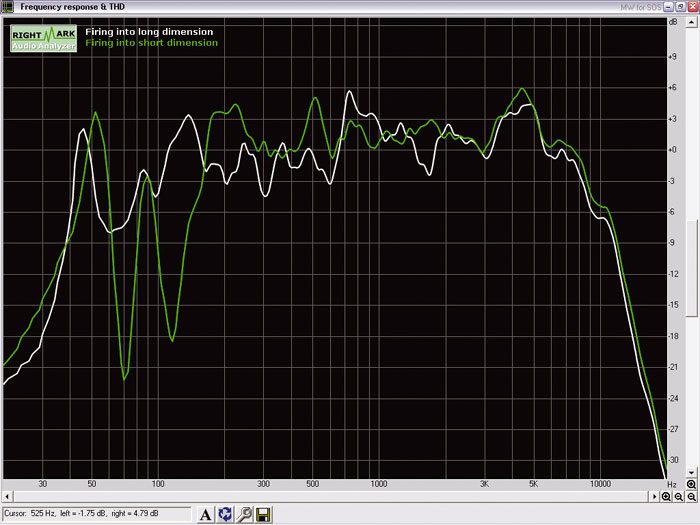
If possible you should rotate your setup so the speakers fire the longer way down the room. That will help the low end response quite a bit, aside from bass trapping.
--Ethan
Chuck,
If possible you should rotate your setup so the speakers fire the longer way down the room. That will help the low end response quite a bit, aside from bass trapping.
--Ethan
Oh, you're killing me :lol: ...I guess I could, but what about the asymmetry that I now incur? And what is the advantage? The room modes are the same regardless right? Is it about side reflections? If I do this, one side of the room will have the roof pitch, the other flat. Is there a trapping solution to that?
BTW, Ethan, I was up until 1a.m. watching your videos last night. You are the man! I have downloaded the Sonar file and recorded the tones with an omni mic. I am blown away with the discrepencies in volume. I don't know how to plot this, but my results show a 20db difference between 125-130hz and 140-160hz. This repeats at 220-230hz and 250.
I'm still going to do some treatments now that I have a baseline. I plan to do the corners as referred to above and maybe hang a couple of mid-bass or high-bass traps.
I did Modecalc also, showing me problems at 235hz and 325hz. Do I want to make Helmholtz resonators for these frequencies or are the traps broadband enough?
Thanks everybody.
Chuck,
> what about the asymmetry that I now incur? <
Symmetry is important, but mostly for the portion of the room between your ears and the speakers. Ideally everything would be perfectly symmetrical. Then again, ideally you'd have a room 25 by 40 feet with a 17 foot ceiling! :)
> what is the advantage? The room modes are the same regardless right? <
Yes, the modes are the same. The difference is the wall behind you is farther back, which makes the peaks and nulls less damaging. The drawing below is from a review by Sound on Sound magazine. The reviewer measured his room both ways, and you can easily see that the long way is much better.
> I was up until 1a.m. watching your videos last night. You are the man! <
Awesome, thanks!
> Do I want to make Helmholtz resonators for these frequencies or are the traps broadband enough? <
For a room that size I'd think broadband is perfect.
--Ethan
Recovered from web.archive.org — originally hosted at http://www.ethanwiner.com/misc-content/sos-long-short.jpg
I went ahead and trapped the corners of my room. I did a screen dump from Sonar to show the difference of the wav file produced at frequencies 40hz-300hz. The top wav file is a sample of the room untrapped. The bottom is with corner traps added. What's not shown is that I added 24"x24" traps in the tricorners where the pitched ceiling meets the flat ceiling. More work to do, looks like.
Chuck,
> The top wav file is a sample of the room untrapped. The bottom is with corner traps added. <
I would have expected a much larger improvement. Did you see the before / after results from my partner's 16 by 10 room shown in my article from Electronic Musician magazine? We used that same Sonar project and eight traps, and the response improved quite a bit more than what you achieved.
--Ethan
Ethan,
Thanks for sticking with me on this. Much appreciated. I am going to double the thickness of the insulation from 2"-4" despite the fact that I am using Roxul RHT which has sound absorption coefficients surpassing unfaced OC 703 at every reported frequency. This is the easiest quick fix.
I will probably rotate the room as suggested (I think it's feasible), but I'd like to take a scientific, methodical approach to this endeavor.
More graphics tomorrow :)
Chuck,
> I am going to double the thickness of the insulation from 2"-4" <
That will make a very big difference!
> I am using Roxul RHT which has sound absorption coefficients surpassing unfaced OC 703 at every reported frequency. <
Take small data differences with a big grain of salt. Having four inches matters more than almost anything else, assuming competent "absorbing" materials to begin with, of course.
> I will probably rotate the room as suggested <
That too will help a lot.
--Ethan
I have doubled the insulation thickness on all traps from 2"-4".
I made 2-2ftx4ft slot resonators based on the design from the Excel Helmholz Resonator spreadsheet on this site that calculates this stuff. :lol:
I did not make them floor-to-ceiling, but added a trap above it. Whatever. :roll: The design I used was based on caculations for 235hz and 325hz - two clashing room modes according to Modecalc. Maybe they don't have enough surface area to be effective, but they look cool, and I know they'll trap some freqs and reflect some.
Hopefully these pics from my CAD model relate this. I'm showing the plywood on the floor too.
I'm planning to add traps behind the monitors. Is this a good idea? What is an appropriate distance?
Lastly, I am planning to rerecord the wav file to check my progress. In the meantime I have played back some of my mixes and I can hear a lot more low end and it's clearer. I think I have made some improvement. Will post a new wav file graphic in a few days.
I am not an accoustic expert, but I had some problems in my room with flutter echo, which formed between the top sides of my closets (few of them) and ceiling. The gap was 44cm (foot and a half), and it was some high frequency sound. It was easy solvable by putting something to dumpen that sound.
So, whenever I see parallel surfaces like that, I try to worn about this. There is a reason why they cease to build speakers with parallel sides. And you have something like that where your monitors are. -- Mario
>I'm planning to add traps behind the monitors. Is this a good idea? What is an appropriate distance?<
IME treating the front wall is a good idea and will help out a lot. You want to use 4" panels spaced off the wall 4" because there is more low end then high end hitting the front wall.
Not sure if you listed it or not, but a cloud over top of your mix spot would help you out also.
Glenn
Thanks everybody. I added the traps behind the monitors and moved the monitors forward a bit.
The wav file is quite different now.
To review, the top is untreated, then just corner traps added, next insulation thickness increased from 2" to 4" . Last resonators and trap behind mix position and traps behind monitors added.
Finally, pictures....
In the first pic, a shot at the slot resonators and the trap above it on the sloped ceiling.
Next, one of the floor to ceiling jobs in the corner is visible. I just hung the french door so everyone in the control room can see the drummer (note drum kit set up outside).
Lastly traps hanging behind monitors