did some low end measurement, how to interpret the data?

Started by sillybird on 31 May 2006. 6 replies.

Originally posted at johnlsayers.com, topic 6344.

Hi all I record and mix as a hobby nearby my 100 percent IT job. I have a little garage studio, built 5 years ago when i had no plan at all what acoustic means :-) As i have troubles to get a good sounding mix in my mostly acoustically untreated control room, especially in the lows and low mids, i did some basic measurement and finally got the graph below. measure was done with my Event PS8 active monitors. some data of the control room: w/l/h: 4.80m/6.20m/2.30 walls: all concret except the wall against the recording room (single wall with 1 sheet drywall on each side and the pyramid foam) treatments: no traps, only what you see on the images below cloud: have a little cloud with same material as front wall over mix position (not on pics) monitors: are now placed standing (on the pics they are positioned horizontally) Questions: 1. Could someone please help me to interpret the data 2. Should I change monitor placement? 3. Should I do some more measurements, which?
External image, not preserved — original: http://www.birdstudios.ch/images/studio/Test_Graph.gif
External image, not preserved — original: http://www.birdstudios.ch/images/studio/regie1.JPG
External image, not preserved — original: http://www.birdstudios.ch/images/studio/regie2.JPG
thanx in advance Roman
Roman, > Could someone please help me to interpret the data < Since that looks like my graph paper and test tones, I'm glad to help. (Well, I'm glad to help anyway...) The correct interpetation is you have a huge amount of peaks and deep nulls due to a lack of bass trapping. :) > Should I change monitor placement? < Yes! > Should I do some more measurements, which? < The only other measurement that's useful is time-based, to see the modal ringing decay times. But really, it almost doesn't matter what you measure beause the solution is always the same: Bass trapping that works well to as low a frequency as possible, and as much of it as you can manage. The more bass trapping you have, the flatter and tighter the low end will be. It's that simple. Since you already found your way to the RealTraps site for those test tones, spend a bit of time on our Articles page too: www.realtraps.com/articles.htm You'll find a huge amount of general treatment advice, and a lot of specific advice too. Also, I just completed a new video that explains the basics of room layout and treatment. You'll find it first in the list on our Videos page: www.realtraps.com/videos.htm If you have more questions let me know. --Ethan
Ethan, Since that looks like my graph paper and test tones, I'm glad to help. (Well, I'm glad to help anyway...) The correct interpetation is you have a huge amount of peaks and deep nulls due to a lack of bass trapping. :) thanx a lot for your help. I didn't remember the test tones and graph were from your site, downloaded them a month ago and didn't find the time to do the measurement... blabla, however, have a new question concerning the graph: what is the highest acceptable tolerance range (in db) for peaks or nulls in measuring if you start at 85db? +/- 3db, 5db? could you post a "good" graph that I can see how it should look like? Since you already found your way to the RealTraps site for those test tones, spend a bit of time on our Articles page too. thanx for the resources, shure i'll crawl through :-) It's tuff for me because my English isn't that good and all the technical terms in architectures and acoustics don't make it easier obviously ;-) greez Roman
hi again... ok, found an answer myself regarding the question in my last post while reading through ethans damn nice collection of informations on his website. some of you may be also interested in: "if you get your nulls and peaks flatten in a range of 10db, you've done a good job" just bought the AcoustiSoft R+D (successor of ETF) and have now to study again for a while :shock: Besides this stuff i'm looking for another room to build up a bigger project studio from scratch. I'll start a thread when it becomes interesting for the Recording studio design community. cheers Roman
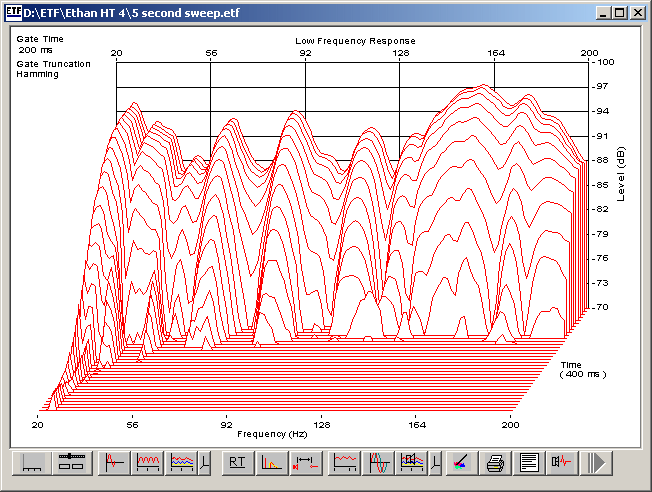
Roman, > could you post a "good" graph that I can see how it should look like? < The graph below shows the best (flattest, least modal ringing) room I've ever measured. It also happens to be my living room. The response may suck compared to a power amplifier, but it's amazingly flat for a normal sized living room. :) --Ethan
Recovered from web.archive.org — originally hosted at http://www.realtraps.com/ethan-ht.gif
Ethan, Thanx for posting this up. Indeed it looks really nice! I also watched the video from your living room yesterday, nice done! I like how you explain all the acoustic stuff, you make it very easy to get into, even my English is not that good... I saw that you still use ETF and not the newer RplusD, does this have a specific reason? cheers Roman
Roman, > you make it very easy to get into, even my English is not that good... Thanks, glad you enjoyed it. I like doing videos because they're easier for people to digest than a bunch of boring text. :) > I saw that you still use ETF and not the newer RplusD, does this have a specific reason? < I use both, but until the most recent version R+D had some problems with the signal to noise ratio. Now that Doug Plumb added a full range swept sine wave that problem is fixed. But the graph in my video was measured a few months ago, before R+D was fixed. I'm sure I'll use R+D more in the future for my published tests. --Ethan