The last studio I had, I used a lot of thick fibrglass and carpets to deal with bad sound, but it deadened the room too much. So, this time, I want to build some traps. But to tell you the truth I don't really know what a trap is or does, I don't know if it's the same thing as an absorber (I think it is), and I don't know if it's the same thing as a diffuser (I think it's different). Can somebody point me in the direction of a good introduction or summary to this topic? Or should I just launch myself into reading every thread on this site?
Hi, and welcome; there are only two of us (John and myself) running things these days, so we first ask all new members to read and FOLLOW this
http://www.johnlsayers.com/phpBB2/viewtopic.php?t=4062
including your general location, as well as any other bold topics that could possibly apply to your situation - this saves us a lot of time, which allows us to maybe help 2 or 3 more people in whatever limited spare time we may have. You'll find several links on that page, but most are related to construction. For a good start on acoustic treatment, you can check John's older site here
http://www.saecollege.de/reference_material/index.html
That is pretty much a complete recording education, but there are basic plans for acoustic treatment and some general trap sketches, etc - however, if/when you decide to build a slat resonator/helmholtz trap, do NOT use the calculator on that site; as with nearly every such calculator on the web, it has an error in the formula. Instead, use the corrected version available here in the acoustics forum.
Basically, you can still use fiberglass - it's knowing where, and when to stop, that's important. And if you forget the carpet, that will help liven up the room - as will wrapping your fiberglass or rockwool in thin plastic.
Check out those two links, update your profile with a location, read a bit and ask away... Steve
Hey, Steve - thanks *very* much. I don't hang out on sites like this, but I'm extremely grateful for their existence when I need them. Does that sound selfish? Guess it is. The gratitude's real, though.
"as with nearly every such calculator on the web, it has an error in the formula."
lol - a bold statement. I believe you.
Yeah, I've wrapped the fibreglass in plastic. The carpets have to stay though - for warmth - I'll die of hypothermia if there isn't carpet on the floor.
I really want to try my hand at building some traps though - if only for the satisfaction of being able to compare with the fibreglass treatment.
Thanks again.
Question time: somebody here linked me to these plans absorbers:
http://www.johnlsayers.com/HR/index1.htm
But they're not airtight, right? The reason I ask is that at the SAE site, they talk about Helmholtz resonators and panel absorbers, and stress the importance of the whole thing being completely airtight in order to work. I think I saw some plans for Ethan's traps as well, and as I recall, they're airtight. Is one approach any more effective than the other?
(I'm at the library typing this,by the way, so I haven't started putting together the measurements for my room etc.)
Dobro,
Besides the good links Steve posted, see my Acoustics FAQ:
www.ethanwiner.com/acoustics.html
> I saw some plans for Ethan's traps as well, and as I recall, they're airtight. Is one approach any more effective than the other? <
Most rooms benefit most from broadband bass trapping. The traps in my plans are fairly broadband, but technically they're a tuned design and they're more appropriate for larger rooms. Since you didn't mention the size of your room, it's difficult to suggest which approach might be better. In fact, using both types might make the most sense.
--Ethan
Thanks Ethan. That's a wealth of information.
My room's 10 ' by 14 ' by 7'. Concrete floor. Two walls are concrete up to a height of about 3', and then it's just studs and fibreglass insulation beyond that up to the ceiling. The other two walls are drywall over studs and fibreglass insulation. The ceiling's drywall over the joists and fibreglass insulation. Two small windows, one small doorway, which has no actual door in it.
Not a big room, in other words, plus the very, very low ceiling and concrete floor to contend with.
Doable? Or should I just move to Cuba? lol
Dobro,
> Doable? <
Sure! Problems from the low ceiling can be minimized with absorption, and the size may be small but it's not horribly small. The three main goals of acoustic treatment are:
* Bass traps in as many corners as you can manage, including the wall-ceiling corners.
* Mid/high frequency absorption at the first reflection points on the side walls and ceiling.
* Some additional amount of mid/high absorption on any large areas of bare parallel surfaces, such as opposing walls or the ceiling if the floor is reflective.
Once you've done this, you'll be in pretty good shape.
--Ethan
Okay, I've got the room together, and now I'm going to start treating it. The first generation of treatment is going to be with fibreglass. But before I begin, I've got a sort of general question. I've heard lots of advice about putting sheets of fibreglass across angles where walls and ceilings meet, and I've done that, and it helps. But nobody ever talks about putting fibreglass along the angle between the walls and the floor. Why not? Nobody ever thought of it?
More like, "thought of and rejected" - most people's rooms are small enough already without using valuable floor space for absorbers - but if you need more absorption, there's always the corners between ceiling and walls - very few people try to walk there... :wink: Steve
dobro,
> nobody ever talks about putting fibreglass along the angle between the walls and the floor. <
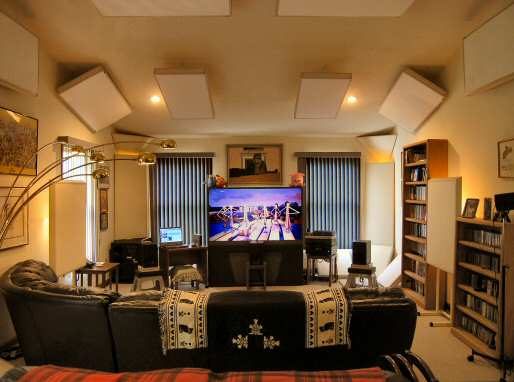
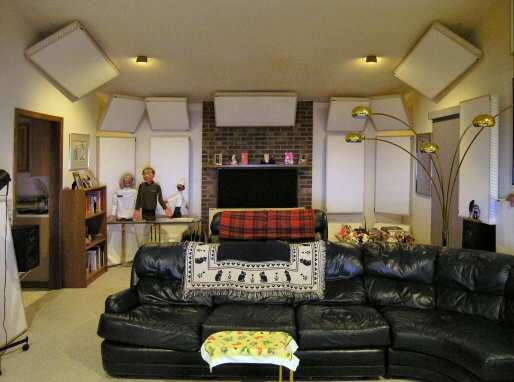
Saying "nobody" isn't quite right because I talk about that all the time and have exactly that arrangement in both my home studio and living room home theater. Those corners are every bit as good as any other corners. I recently took the photos below in my living room, and you can clearly see many of them resting on the floor. :)
--Ethan
Recovered from web.archive.org — originally hosted at http://www.realtraps.com/cust_ht5.jpgRecovered from web.archive.org — originally hosted at http://www.realtraps.com/cust_ht6.jpg
Steve, Ethan - okay, got it - thanks.
Ethan, in that top picture you posted, there are panels placed across the wall/ceiling angle, but there are also panels flush with the wall up near where it joins the ceiling. Why not have that flush panel cover the wall/ceiling angle? General principle, or a specific case?
dobro,
> Why not have that flush panel cover the wall/ceiling angle? General principle, or a specific case? <
Specific case, though I'd do it a little differently if I were adding those panels today. Note they are not flat on the wall, but spaced four inches away. This helps them absorb to a lower frequency, and also lets mids and highs get to the rear of the panel to be absorbed. Those portions of the walls are parallel and could foster flutter echo, so it's important that they absorb mids and highs as well as bass.
The ceiling is 11 feet high at the top of that peak, so for someone like me who hates being on ladders climbing up there is not an attractive option at this point. :) In the "Room setup" video I recently added to my company's web site I describe this room and its treatment in detail. I also show what I'd do differently in those corners if I were doing it again today. If you have high-speed Internet you'll probably enjoy the video because it explains a lot about this stuff in detail.
--Ethan
Okay, it's time for the fibreglass to start going up now - quick treatment now, traps later on.
I'm using 2'X4'X2" pieces of stiff fibreglass. If I put two pieces together, that'll make the sections I put up 4" thick. Will that make an appreciable difference to what they absorb compared to the slimmer 2" thickness of only one piece of the stuff?
> If I put two pieces together, that'll make the sections I put up 4" thick. Will that make an appreciable difference to what they absorb compared to the slimmer 2" thickness of only one piece of the stuff? <
For mid/high frequency absorption, two inches is thick enough. But for bass traps two inches thick is not enough. Even for "general purpose" absorption, thicker is better because it extends the absorption to a lower frequency. And that additional bass trapping is always welcome in any room.
--Ethan
Wow, I'm impressed. Way more information that I know how to make sense of. :shock: I don't even know what kind of fibreglass I've got aside from generic descriptions.
Which is appropriate I guess, cuz I was looking for generic advice. You know, what was on my mind when I asked that last question was the possibility of the law of diminishing returns applying to the situation. I saw myself lashing two thicknessess of the stuff together for more absorption, and then it not making much difference. If it didn't make much difference, then the thinner option would have been preferable. But if it *does* make a significant difference to the sound, then I'll sacrifice convenience and go for the double thickness.
So glad this site is still here.
Okay, I did double thicknesses of fibreglass wrapped in plastic (and kinda attractive cotton covers) - 2' X 4' sheets of the stuff and they're up and angled over where the walls meet the ceiling, with 2' X 2' pieces in the corners where two walls meet the ceiling. I've got a stack of mobile ones that I can prop up along the floor/wall if I have to as well.
My question's about the ceiling over where I'm going to sit. In my last studio, at Knightfly's suggestion, I suspended a cloud of three panels of fibreglass from the rather high ceiling I had there. But here, the ceiling's low - it's about 6 1/2' only - so if I put another cloud up, it's only going to be 6-12" from the ceiling. Is it worth it, do you think? If I make a cloud, it'll be only one thickness (2") of fibreglass.
The room's 10' X 14' X 6 1/2'. Concrete walls halfway up on two sides (it's in the basement), drywall for the rest, drywall ceiling, fibreglass insulation behind all the drywall, concrete floor covered with two layers of carpet. Two small windows that don't amount to much, and a door of course, which I close when I mix.
Even MORE necessary with a low ceiling, 'cause this makes the early reflections happen even closer to you, therefore LOUDER and more likely for your brain to "mix 'em" with the direct sound... Steve
Okay, in that case, I'll rig something on the ceiling so that I can put the panels up when I'm mixing and take them down the rest of the time so that I don't have to be ducking or bumping my head all the time.
Thanks, Steve.
When I get the fibreglass up, the next project will be bass trap construction. I've bought the table saw. Should be a piece of cake, yeah? lol