Hi, all. I have been reading everything I can find on the internet about home recording studio design and theory for several years now.
I guess I am coming to the conclusion that the goal of control room design is even attenuation of sound at all frequencies in the room while removing slap echos and non-diffused reflections. Am I close?
If I ever get the resources to actually purchase/build/install room treatment, I would really like to know what the differences are between the different styles of rooms I have seen. Has anyone actually experienced what the different types of rooms sound like that could give some sort of easy to understand explanation as to what the differences/pros/cons are?
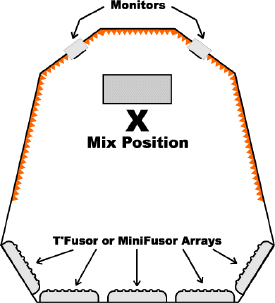
Here's John's:
Here's Auralex's:
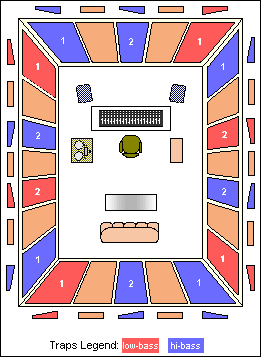
Recovered from web.archive.org — originally hosted at http://www.acoustics101.com/images/RFZ_Room.gifHere's Ethan's:
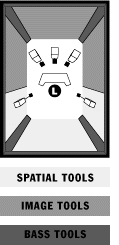
Recovered from web.archive.org — originally hosted at http://www.realtraps.com/control_room_tn.gifHere's RPG's:
Recovered from web.archive.org — originally hosted at http://www.rpginc.com/products/productimages/PSroom.gifYes, there is a lot of variety here. Obviously, it is time and money prohibitive to try to build one of each or even try to find someone who has one and visit.
Any opinions here?
Thanks :)
Beak
Hi Beak - yes it is confusing isn't it - firstly may I point out that my room treatment is a fixit for a rectangular room, and you know what I think about them, my control room designs are more definitive of my style.
Look - auralex is the live end dead end diffusor style with soffit mount.
Ethan's is a room full of his panels and free standing nearfields.
I've no idea what RPG is on about. :roll:
I know mine works, and I'm sure everyone else feels the same about theirs. :)
cheers
john
[/i]
Also keep in mind the designs you posted, besides johns, are all commercial companies that are trying to sell their products...a bit biased don`t you think?
Check out john`s studios under contruction page to see the control rooms he is designing....very cool.
I have experienced Auralex's
It's decent, but way to absorptive in the high end. My mixes were a tad dull.
Johns Room I am experiencing. I love it over auralex's
The room has a livlier feel and from the little quick 2 track mix I did, WYHIWYG
RPG's room I did back in 2001. I found the room to be way tooo midrangy oddly enough.
Bryan Giles
Don't want to be a snot, but if the material absorbed too much high end, your mixes would be too bright, wouldn't they? Maybe the treatments are too reflective.
:?
You can be a snot.
My statement is VERY accurate.
If there was phase cancellation the high end would have been boosted on my end, because I was compensating for the lack of heard high end in the room (to me)
This material absorbed so much high end I thought the mixes were right and I had to do a serious boost of high end in mastering 8 to 10db because I thought the high end was right and it was not.
I am not a physics major, and I can understand that theoretically that seems contrary.
So I thought till I compared my original Auralex room mix to a quick 2 track mix I did after I finished my work here in the room Johyn designed for me.
Bryan Giles
So i hate to debunk theory, but I am relaying what I hear.
Thanks for your insight Paul. I was hoping I would not have to explain that. Cuz it still makes no sense to me, but... the results are the results...
Beak,
> I would really like to know what the differences are between the different styles of rooms I have seen. <
That drawing from my RealTraps site is not intended as a guide for how to design an optimum room! It is merely meant to show where to place panel traps and fiberglass in an existing rectangular room. If I were building a new room from scratch it would not be rectangular, and I'd put the loudspeakers in the walls instead of on stands.
If you're looking for ideas for room shapes, John's designs are far superior to a typical rectangle! You should also look at the styles and shapes of successful commercial studios and control rooms for ideas.
--Ethan
Interesting discussion. Sorry about the apples/oranges comparison with Auralex's angled walls. I guess I included that one because of the LEDE approach.
I don't suppose I'll ever be able to design a room from the ground up, that's why I mainly used examples of rectangular rooms. I would most likely have to treat an existing room as it is with treatment that could be moved later and the effects of installation removed.
So, with that in mind, it would look like John's treatment could be built as individual units that would be easily removeable. What would be the noticeable differences between this rectangular room treatment and the angled-walls-built-from-the-ground-up design?
By the way, with the types of things I would be recording and the location where I live, I am not at all concerned about soundproofing or noise bleeding between rooms. Some of the recording would be done in the control room with other things recorded in a separate space.
I am a music director and completely enjoy reading this forum, complete with it's forays into math and physics. I miss Eric Desart's posts.
Thanks everyone for your replies. :)
Have a terrific day.
Beak
Beak.
The Auralex model is no different in theory than most major studios built in the 80's and 90's. They are not a certifiable LEDE room, but make use of the concept. They just make use of quick, removable treatments.
All that you need to do is splay your side walls 1' out for every 10' of length to be effective. So maybe the Auralex drawing, which is not to scale, is a bit exaggerated. If you cannot do that, then you should consider some type of diffussion, to minimize flutter and reduce/delay secondary reflections. Ideally the front wall should be angled forward so that it is not parrallel to the rear. Auralex instead puts their diffussors on the rear wall.
If you look at John's other designs, he is doing the same thing. He designs in a reflection free zone by splaying walls, etc. He traps the rear corners, etc.
Ethan sells FIY acoustic products too, and they could be used in place of foam or DIY traps in any of these designs.
Visit some of these sites to get some ideas, and remember that too much of anything is bad. Don't poo poo on Auralex or Ethan or ASC, etc., because they all have something to offer.
Designers:
http://www.fmdesign.com/http://www.rbdg.com/home/index.phphttp://www.wsdg.com/http://www.bobhodas.com/http://www.pelonissound.com/
Organizations:
http://asa.aip.org/index.htmlhttp://www.acs.psu.edu/OtherSites.htmlhttp://www.gmi.edu/~drussell/Demos.html
Materials/Products:
http://www.sysdevgrp.com/http://www.Acousticsystems.com/http://www.rpginc.com/http://www.acousticalsolutions.com/http://www.industrialacoustics.com/
:D
Beak I have been working on some of Johns treatments and they are all freestanding.
I will try to get some pics to John next week.
I am even working on a free standing soffit unit that I will probably fasten to the wall but they could just sit by themselves.
Lots of fun ( Not enough time )
Ryan
Ryan, that would be great! I'd love to see what they end up looking like and hear a report on how the treated room sounds. It looks like "LaptoPop's" studio is incorporating some of these units as well.
The soffit idea sounds interesting. If you like how it works, maybe you could upload some construction diagrams.
Studying the "wall units" construction diagrams, a couple of questions come to mind:
1. Is the insulation used in the slot resonators 3" thick, unfaced 703?
2. How is the insulation attached to the framework?
3. Since the units are to be freestanding and moveable, is it OK for them to not go completely floor to ceiling? If so, which would be better, leave the gap (between the top of the units and the ceiling) open or stuff it with insulation?
If it sounds like it's worth it, I may just save my pennies and build some myself.
Thanks for the discussion.
Beak
1. Is the insulation used in the slot resonators 3" thick, unfaced 703?
I am using a few layers of 1" 703 pushed into the cavity.
2. How is the insulation attached to the framework?
It is just wedged in and appears to be pretty well stuck there.
3. Since the units are to be freestanding and moveable, is it OK for them to not go completely floor to ceiling? If so, which would be better, leave the gap (between the top of the units and the ceiling) open or stuff it with insulation?
Mine are not completely floor to ceiling but there are a few reasons why that is the case.
The 1st is that I have a beem that runs the length of my room. I also will be putting a false celing of 703 that should bring it down closer to the unit.
I realize John is gone for a week then I am as well, but I will tryo to get some pictures of the wall units to you for reference.
Ryan
Ryan - it really doesn't matter how the insulation is mounted in the resonator - just so long as it's stable and wont all fall to the bottom - it's a good way of using up your offcuts. :)
cheers
john