I have 4 cm thick Isover Sonepanel insulation panels, which I initially wanted to glue together (because my initial designs had 9cm thick panels in mind, but I had to order a huge "minimal" amount to get those, way more than I needed. The 4 cm panels didn't have that minimal order amount), but then I realized I could try something different (see the designs at the bottom of this post).
The green stuff is MDF, the yellow stuff the insulation and the red line is fabric.
Design B is the "glue" method. Which design is the most effective?
Three variations on the absorber design. Which one is best?
Originally posted at johnlsayers.com, topic 3403.
'B' would be the most effective :)
cheers
john
OK! Thanx! (Why is it better?)'B' would be the most effective :) cheers john
correct me if I'm wrong but (B)
very thick isolation and lots of space between the isolation and wall.
1 thick isolation ( good to absorb low frequencies )
2 big air space to create a second isolation.
the panel ( second wall ) can move without being blocked by the isolation.
optimal setting so to speak.
( John , please correct me if I'm wrong still learning the facs here :) )
I think "B" would work best because the frabic plate (red) resonates at a frequency depending on it's thickness an the size of the sealed room behind it (green). The bigger the room and the thicker the plate the lower the resonating frequency. The isolation glued to the fabric plate then absorbs exactly that frequency. The thicker the isolation, the more of that frequency gets absorbed. - right?
ciao
Carsten
Thanx again John!
@Carsten: I actually thought you were my twin brother because his name's Carsten too and he's the biggest Steely Dan fan I know (I'm one too, btw). :D
Hi Pasz!
Yes they are two great old farts :wink:
Today I heard that we were going to to "The Goodbye Look" and "The Nightfly" on a friends eindexamen.
We even got our band's name from a Dan Song: Soul Synergy
groetjes
Carsten
Ah, from Gaslighting Abbie, right? :)Hi Pasz! Yes they are two great old farts :wink: Today I heard that we were going to to "The Goodbye Look" and "The Nightfly" on a friends eindexamen. We even got our band's name from a Dan Song: Soul Synergy groetjes Carsten
How are you supporting those insulation panels inside, are you using chicken wire?
Is it advisable to use chicken wire to support the insulation batts when you make the panels, so it doesnt collapse in the center. Will having a metal framework or chicken wire cause unwanted resonation or noise in your acoustic panels or traps.
With that overlapping of two insulations to get a thicker a one, do you glue them together or just sit it on top of each other. I guess gluing it together would prevent the sound to travel through, thus defeating teh purpose. Just checking to make sure.
Can someone answer my Bass trap question please. I'm in the middle of making it and kind of stuck. Its under my name if you do a search.
Ta
You can start by completeing your profile that we know what part of teh world you are from to help with mataerials in your area! AndreCan someone answer my Bass trap question please. I'm in the middle of making it and kind of stuck. Its under my name if you do a search. Ta
DanFanCazy, don't wanna upset a fellow "danfan", but I can't let this ride -
I think "B" would work best because the frabic plate (red) resonates at a frequency depending on it's thickness an the size of the sealed room behind it (green). The bigger the room and the thicker the plate the lower the resonating frequency. The isolation glued to the fabric plate then absorbs exactly that frequency. The thicker the isolation, the more of that frequency gets absorbed. - right?
The fabric is cloth; no real resonance there. This would NOT be a PANEL RESONATOR without a "panel".
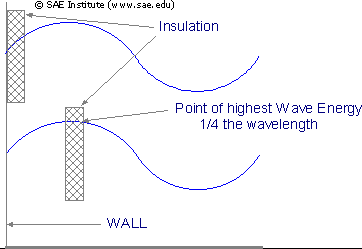
If this were a room, the only thing the size of the room would affect is lowest absorbed frequency and the total AMOUNT of absorption; the surface presented to the sound would determine the QUANTITY of absorption, and the DEPTH of the room (or trap) would determine the lowest usable FREQUENCY of the room(trap) - see John's drawing above, on 1/4 wave lengths.
If this were an actual PANEL trap, the front panel should NOT touch the insulation; otherwise, the panel will be DAMPED and very little absorption will happen. For that type trap, there needs to be a GAP of about 1/2" between panel and the absorbent material.
Ya got the LAST sentence pretty much right... :wink: Steve
Of cause you are completely right, Nightfly!
This was a very stupid post of mine. Indeed I mixed up everything I had just read for the first time. The moment I pushed the submit button I knew it was a mistake.
At least I learned something from it: Do NOT post anything if you don't know what you are talking about. It will just confuse others.
Anyway - Since then I read a lot and with the friendly aid of John I developed a design for my studio, which I have just started to build.
Carsten
P.S.:
By the way, tomorrow we will play "Nightfly" for a friends final exam on the conservatory. He made a very funny poster for it: