Has anyone had any experience with aerated autoclaved concrete? I read that a variation/competing product known as aerated lightweight concrete (tradename: Litebuilt) is popular in Australia.
It appears to be environmentally sound, easy to work with, energy efficient, and claims an STC of 50 or so. Also claims to be in line or cheaper than costs for standard concrete block or stud construction.
http://www.aacpa.org/http://www.litebuilt.com/
(I searched and didn't find any discussion of this. If I missed it, let me know...)
Has anyone had any experience with aerated autoclaved concrete?
It appears to be environmentally sound, easy to work with, energy efficient, and claims an STC of 50 or so. Also claims to be in line or cheaper than costs for standard concrete block or stud construction.
(I searched and didn't find any discussion of this. If I missed it, let me know...)
Thanks for the URLs! This stuff sounds (no pun) like lightweight concrete blocks. Warnock did a paper on the transmision loss of this stuff. The paper number is C35545. Sorry I don't have an URL directly to the paper, but you can enter the number in the search engine for NRC
http://irc.nrc-cnrc.gc.ca/ircsearch.html
Note figure 4. I never would have guessed that effect! It also implies that plaster-lwb-stud-gypsum, can be made with minimal M-A-M resonance dip.
Lightweight;
Andre
I couldn't find the report you're talking about. No rush at all, but if you get a chance to post the link, I'd really appreciate it.
Thanks!
My fault. I did not include the complete report name. The full number/name is nrcc-35545. Here is a link to it directly.
http://irc.nrc-cnrc.gc.ca/fulltext/nrcc35545.pdf
Thats why skydiving isn't for me.
Andre
Thanks, Andre. It's all in the details, right??? :lol:
I skimmed the report -- are we sure it's actually talking about aerated autoclaved concrete? Sounds like they're testing the lightweight blocks you can pick up at the lumberyard. Or are those lightweight blocks AAC? (I don't know what I'm talking about yet, which is why I'm trying to read up and ask questions... :roll: )
The devil is in the details, as you wrote.
From what I can understand, which isn't much, Warnock's report is on blocks made with different material. Hence, the "porous" in the titile of the report. Normal lightweight blocks, whatever that means, are made with a different pattern to reduce the amount of material in the block, as opposed to using a different material to reduce the weight of the block. I may very well be wrong on this.
Clarification from the knowing would be appreciated.
Yes, it looks like the report tests two different types of "porous" blocks: one being some type of wood fiber and the other being our mystery lightweight blocks.
Is there a mason among us???
Either way, I'm growing to enjoy typing "aerated autoclaved concrete!"
AAC has been recommended to me as a good outer wall solution. I begin my project this summer, if all goes well. I'm very interested in this stuff. From what I understand, the addition of aluminum powder in the mix causes the concrete to expand with lots of bubbles. The extra air pockets in the concrete supposedly increase the STC rating. Can ANYONE speak on this?
My guess is, no, it wouldn't help much for noise isolation, especially the pesky low end. There's just not enough MASS in it. (The air bubbles are "anti-mass.")
Put "STC" into perspective: it is a pretty meaningless/trivial number in the context of studio construction.
Welcome to the forum... Looking forward to seeing you start a thread of your own when the time is right for you to get detailed feedback on your own project. 8)
--Keith :mrgreen:
Thanks for the reply. I realize STC has nothing to do with the low end. I'm very much a greenhorn. Thanks for the welcome.
My home is in Topanga, CA, which, if you've never seen it, is a small little mountain town outside of LA. I was just reading your building codes thread and wondering what in the world I'm going to do. Pretty much everyone builds in Topanga without permits, because we are under the Coastal Commission here which is an insane, arduous process that very rarely ever yields ANY results. I am adding a bedroom and the studio to my house this summer, with or without their help. In fact, based on my neighbors advice, I probably will not inquire about permits, lest I tip my hand to their hounds. What has been advised, which makes since to me, is to make sure everything is built to code and photograph every aspect of the progress, in the event there ever is an inquiry. Rolling the dice, I know, but I kind of feel like I've got special circumstances. Do you have any stories about folks in this area?
Thanks for the welcome. I will certainly post pics of plans and building for everyone's perusal.
I wouldn't say I'm very familiar with your area, but I did have a friend whose mother lived in a strange house in the West Hills (not too far from you I think...?). The house was choc full of unpermitted construction: a six foot basement converted into a bedroom and a loft with 14" tall stairs are the most egregious examples that come to mind. :roll: When they sold the property and moved to Yosemite, the property was sold to someone who bulldozed the whole thing and built from scratch.
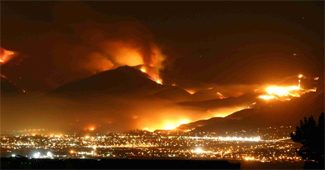
Let's just say that I would not even consider building sans permit in that area, for one main reason...
:evil:Wildfires.:evil:Recovered from web.archive.org — originally hosted at http://www.inman.com/images/public_space/So_Cal_fire_Nov_2003.jpgIn no particular order:
If a fire were to start in my home and spread to others, my unpermitted construction would be the "guilty until proven innocent" culprit.
If a fire were to start somewhere else and then claim my home, the insurance company could reduce the payout or even deny it altogether, claiming that the damage would not have been as severe if it had been permitted and/or built to code.
Is that fair? Of course not... So I suppose you could always sue to get them to pay up. What? More than $7,500? Small claims court isn't an option for that -- you'd have to go to superior court. That means you'd need an attorney. Got cash? You'll need it to get the retainer going... Unless you're lucky enough to find one desperate enough to do it on a contingency, and then you'll pay dearly at the end if you prevail at all, a few years later...
Sure, you can take lots of pictures as evidence, but you'd have the cards stacked against you from the start.
I think your neighbor's advice ("stay under the radar, don't even ask the building department any questions") is just terrible.
Have you read about my experiences with my building department? Granted, your mileage may vary... But mine was all to happy to help advise me how to come up with a design that would meet the constraints of building and planning codes in effect in my city.
My advice: If you can't build it legally, then change the plans so that you can build it legally, and if that's not possible... Then don't build or move somewhere you can.
You wouldn't be the first to be afraid of the big mean building department people, and you may eventually be added to the list of people who used to think that. I hope that becomes the case.
--Keith :mrgreen:
My fault. I did not include the complete report name. The full number/name is nrcc-35545. Here is a link to it directly.
http://irc.nrc-cnrc.gc.ca/fulltext/nrcc35545.pdf
Thats why skydiving isn't for me.
Andre