Hi Guys!
First a little background info:
My wife and I recently had our first child, and then her tenants that rent her downtown Seattle condo decided to buy that from us, so we are now looking for a bigger house (will use money from the condo and money from selling our current house).
We are being very particular, and it's going to take us a while to find the "perfect" house that fits my wife's designer tastes (she's a fashion designer) and has a space that's workable for my studio as well.
I worked at a major recording studio in the Seattle area as a staff engineer for several years, and then went indy. I run a professional project studio out of our current home with some pretty nice gear, but currently just have a small Whisper Room booth for doing vocals and overdubs.
I still use other studios around Seattle when I need the space for tracking drums or large groups, but would like to find a home with the space to be able to occasionally record drums or small groups on my own.
My wife has the much better paying job right now, but I have several product lines of my own out which I'm slowly growing and hopefully will be up to her income level in a few more years.
Now the questions:
1. Is it even worth it to try to build my own tracking room in addition to just finding a place that would make a good large control room (where I do most of my work)? Or, should I just keep going the way I have been renting out other studios on those occasions when I need the space? I don't do that many large gigs any more where I need the space, but if I had the space I would probably get more of those gigs and be able to afford to do more recording for loop/sample CDs that I produce.
2. I have a decent idea of what kind of space might work, but I'd like to hear from others that have built recording/tracking rooms in their home or garage to see how much expense and trouble was involved and whether you think it was worth it. My wife works right in the middle of downtown Seattle, so we can't move too far out where we could afford a large home on a large lot... so, chances are we will be in an area with neighbors fairly close by! I'm hoping for one decent size "family room" with high ceilings to set up and get started, and then a 3 car garage or workshop, or other large space, or at least a big enough lot where an addition could legally be built.
What do you think is the absolute minimum ceiling height to be able to work with for professional quality drum and other instrument recordings?
Any experiences to share on building out a garage or workshop and making it reasonable sound proof?
I'm interested in anything and everything that you all might have to share.
Thanks!
Steve Sherrard
OK... we saw an interesting new construction home today. We really like the design of the house quite a bit, and there was one very unique room that might make an interesting studio space. Unfortunately the house only has a very small 1-car garage and practically no yard at all (in-city), so no room to expand anywhere.
Just wondered if this unique room would work for a studio, or if it would be an acoustic nightmare. The room is basically the attic of the house, so the ceiling is angled/valuted, but it's fairly low. The room is approx 58' long by 12' wide, with a couple openings near one end... one for the stairwell, and another little open area for a window (you can see this in the first photo). I didn't have my tape measure, but the top most part of the ceiling is only about 8' at most, probably a little less... that area is only about 3' across and then the ceiling angles down to approximately 5' where it meets the walls.
I'm going to try to link to the realtor listings of the two photos of that space here:
My thoughts were that I could put my console at the far end of the room, hoping that the speakers would fit on their stands under the low ceilings near the wall... then I have a LOT of open space behind me, so I wouldn't have to worry about direct reflections from behind, and plenty of room for low frequencies to develop? Of course, I'd have to put a lot of acoustic foam up on the ceilings and wall around the mix area due to the ceilings and walls being rather close to me and lots of path for reflections.
This house has been on the market for a while and came down in price $20K already, and will probably come down a bit more. It's not perfect, but we do like it quite a bit. Unfortunately, no other areas in the house where I could set up the studio... although I could always use bedrooms or the main floor huge open room design for drums on those rare occasions when I track drums (or could put them at the opposite end of the long attic).
Any thoughts or ideas on this space?? We're going to keep looking for better alternatives, but this is the coolest and biggest space in a nice new house that we've found so far (just wish the ceilings were up another 4' or so).
Thanks!
Steve
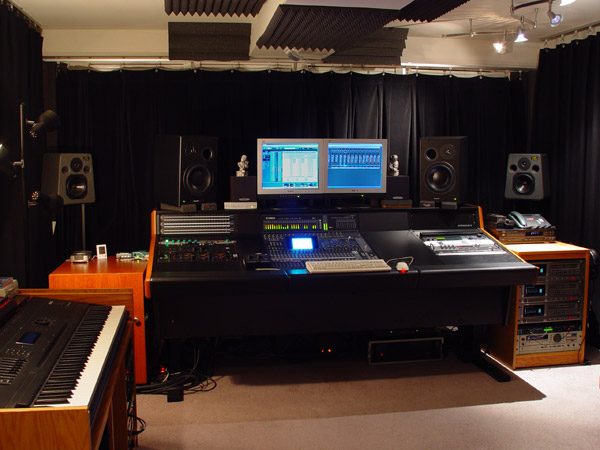
Here's a shot of my current setup in the lower level of our current home:
Recovered from web.archive.org — originally hosted at http://www.dbar-productions.com/photos/studio_01.jpgIn this picture you can also see the edge of my keyboard workstation which is only a fairly large and deep desk as well (with two racks under the keyboard with more modules, and then a computer monitor and a couple of other table top modules above and behind the keyboard).
I also have a 6' x 6' Whipser Room in an adjacent bedroom to this space.
Comments greatly appreciated!
Thanks!
Steve
Steve, I agree you should keep looking - that ceiling arrangement would be hard to neutralize as near as I can tell. That would put your speakers really close to boundaries which would take quite a bit of absorption behind them to minimise early reflections - you would also likely need to put at least a 2-3" fiberglass cloud over the mix area, which by the time it was wide enough would drop your ceiling height in center by at least another foot.
A ceiling peak running lengthwise can also horn load your sound too much, making the sweet spot pretty twitchy and small.
If that's all you have to choose from, is there a possibility you could widen that tall area in the middle by building a pair of pretty large shed dormers at one end of the room? Just an idea, sometimes quirky solutions work... Steve
Knightfly,
Thanks very much for the reply!
There is certainly more to choose from and we will keep looking... there are a few other little things that make that house less than ideal, such as only a small one car garage and no extra storage space, and close to neighbors.
It's just good to get information on what types of rooms might work since in the past I've always just set my stuff up in whatever extra room was available and tried to make it work with some acoustical treatments.
A couple more questions:
1. In general, are vaulted ceilings better or worse than a regular ceiling that's parallel to the floor? I just had this thought in my head that vaulted is higher and would be better, but then I guess it's hard to calculate nodes problem frequencies in a room that's not a regular rectangle. So, if you had vaulted ceilings, would you leave them as is with just some simple acoustical treatment, or would you create a hanging ceiling type thing with some much better acoustical treatment or devices?
2. How much emphasis should I be putting on ceiling height? In my mind I really want to get as high of a ceiling for my space as possible, but is it really more of the total dimensions and volume of the room that is important? I certainly wouldn't want to go with a ceiling less than 8' if at all possible, and I've at least seen some plans that show how to do things with an 8' ceiling. Is there a minimum ceiling height that's workable? (considering some acoustic treatment added on)
I guess I'm hoping to find one large room for my control room and an iso booth or two, and still enough space to put drums in on rare occasions (or to possibly "borrow" other rooms in the house if needed for drums or other instruments). Hopefully we can find a nice place in a quiet neighborhood where the neighbors are not very close so that we don't have to do much in the way of sound proofing type construction.
Thanks!
Steve