Sen,
> How low down the frequency range is this theory gonna work? <
"Work" is relative. It's not like rigid fiberglass absorbs 100 percent down to some cut-off frequency, and then stops absorbing completely. Rather, it absorbs completely above a certain frequency, then falls off gradually below that. Three inches of rigid fiberglass spaced three inches off the wall should absorb pretty well to 100-200 Hz anyway.
--Ethan
Steve,
> Ethan, Eric - my comment from the accident thread ... don't even THINK of bringing your eternal feud to this board <
I'm not sure what you're referring to. I just reviewed all of my posts in this thread, and the only evidence of a feud I see is the last few posts by Eric where he apparently edited out some insults. Yawn - so what else is new? :?
It should be clear by now that all insults come from him, never me. This is a perpetual problem, but one I have no control over. Accordingly, you should address your warnings to Eric, not me, since he's the source of all ongoing friction.
--Ethan
Knightfly,
:oops: Please accept my apologies. Just read the other thread regarding your wife’s auto accident. I had no idea. Being a relative newcomer to this forum I really don't know you; but at the risk of sounding too familiar, my hopes and prayers are with you and your wife- for her full and speedy recovery and quick return to what you would consider normal, productive lives.
In the search for the car crash thread I came across another thread where you are describing your work schedule, construction/remodeling plans, etc. In that respect there are many parallels between our lives, and I would assume, between the lives of many others who frequent this forum. Again, at the risk of sounding too familiar, why do we do the things we do? What is it that drives us with such insatiable curiosity toward these goals and aspirations? Is it the thrill of the hunt? The desire to outwardly manifest the treasures deposited deep in the strata of our being?
I've just been through another Atril Fibrillation episode this last week. Every time this happens I search for the meaning behind it, and reevaluate my life, where I'm going and what has real meaning.
Some of the hardest things in life yield the greatest treasures.
Best wishes, Christopher
Ethan,
." I came to the conclusion that the optimum gap size is the same as the material thickness.
Thanks. Another "real world" gem.
I Appreciate your response. Obviously I need to go back to your site with my mining helmet on and do some more study.
Eric,
I did look at the links you posted. Thanks. I'm the type of person who has to pound on the nail quite a few times, frequently pulling the bent and useless nail out and starting again with a new one, before getting the pieces to stick together. One of my better (if you can call it better) attributes is that I'm too stubborn to quit. It may take me a while but I'll get it.
Christopher
Ethan,
." I came to the conclusion that the optimum gap size is the same as the material thickness.
Thanks. Another "real world" gem.
I Appreciate your response. Obviously I need to go back to your site with my mining helmet on and do some more study.
Hello Ren Man,
That's exactly what I'm scared off. (someones unsubstantiated believes when repeated often enough or published as pseudo science, NOT knowledge, becoming gospel)
This real world gem is WRONG and has nothing to do with real world.
Christopher,
> Another "real world" gem. <
Thanks.
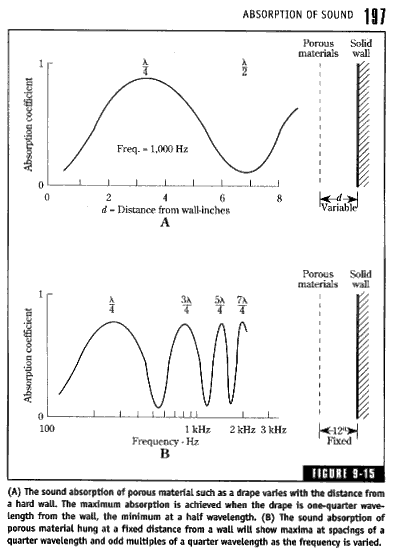
Once you think about it, and look at the supporting figure from Everest's book, it makes perfect sense. However, as the material is made thicker the behavior shown in that graph becomes less significant. But the principle shown is certainly valid for the 1-4 inch thick rigid fiberglass panels you typically see used for acoustic treatment.
To save everyone else the trouble of tracking down that figure from my Acoustics FAQ, here it is again, below.
--Ethan
Recovered from web.archive.org — originally hosted at http://www.ethanwiner.com/airgap.gif
Ethan, how does that figure support your "thickness = distance" theory? All it shows is that there are several peaks and nulls in absorption relative to the distance from the surface of the absorbent to the wall - all that differing thickness of absorbent would do is make those peaks and nulls more rounded for increased absorbent thickness, since there is less of the sound wave's path that is un-impeded -
To my mind, more thickness = higher absorption and less unevenness of response - the only reason I could see for less thickness is budget, or possible space limitations. As to spacing from the wall, I would use more for lower frequency effect, whether I could only afford 1" stuff or 6" - but I would definitely prefer the thicker, because of the smoothing effect it should have on these quarter-wave peaks and nulls. Of course, all this ONLY applies to straight incidence, which I feel makes it even more of a moot point.
As to your innocence in the "feud", I never referred to posts just on this board - you may remember a few choice words over at RO that didn't seem so one-sided. My reference to the "feud" encompasses everywhere I've seen both of you post.
To both you and Eric - I know for a fact that it takes two to fight - when either person won't, it's called something else. As I said before, regardless of who starts it it is still childish and demeans both of you. My contention is that this board is my main home, and I and all the members who come here to LEARN should not have to be subjected to this.
Eric, I didn't send you away, nor was that my intention - all I'm asking is that you stick to factual rebuttals, meaning that you present your reasons why something is or is not correct - I consider myself typical in my learning abilities, and I NEVER learn anything useful listening to fights - I ALWAYS learn something when arguments are presented pro and con - anytime you or anyone disagrees with something, you should state what you believe to be correct (and why) - that way we ALL learn.
BTW, if the two of you REALLY want to "take the gloves off" and get to it, I guess you could do so in the "Wombat Hole" - at least that won't get in the way of others seeking help... Steve
Christopher, sorry about that - I managed to get some time to work on your other treatments/locations, but I'm not quite there yet - coming up on night shifts, so hopefully I'll get finished if things stay slow at work -
One thing I've yet to see from you is the FREQUENCY your null(s) are centered at - Although if you'd rather, I can probably tell YOU once I've finished the model of your space - I would think that two possibilities of nulls would be at 70 hZ and 210 hZ, possibly others although I've not completed laying the other two average room dimensions out yet -
More later.
No apology necessary, you're not the one who made the illegal turn... :? Steve
Steve,
Ren man wants short and clear answers. I gave that
For more look at the measurements in Bob Golds absorption table.
For even more look at the ChrisW file.
I can hardly explain a soundfield every time again, which isn't even interesting for Ren Man.
He wanted an answer:
I gave it short and clear, with additional references if wanted to check real live measurements and to simulate it based on algoritms from top acousticians.
One just have to enter a few numbers to see the result real time in a graph.
And after that many times, I get frustrated. Ethan reads my message and just ignores it, and this causes again the same work to correct.
My interest is SOLELY giving correct info, not continuously restoring info.
And if ren man needs more in function of more described circumstances than we can construct.
Now I need my energy to neutralize this info (once more and until the next time) or get it in perspective.
Eric
You may moderate this or not.
It's indeed your home and responsibility.
Not further my worry
Steve,
> how does that figure support your "thickness = distance" theory? <
This is not "my theory" - it's explained well by that very graph. The explanation is simple, and has been in my Acoustics FAQ for two years now. From my FAQ:
For a given thickness of absorbent material, the ideal air gap is equal to that thickness because it avoids a hole in the range of frequencies absorbed. For example, if you install fiberglass that is four inches thick with a four-inch gap, higher frequencies whose 1/4 wavelength falls within the four-inch material thickness are absorbed regardless of the gap. And for those frequencies whose 1/4 wavelength is between four and eight inches, the fiberglass is also at the proper distance from the wall or ceiling. This is shown below in Figure 6.
Have a look at that entire section in my FAQ, "Optimizing the air gap," for further explanations and additional charts.
> As to spacing from the wall, I would use more for lower frequency effect, whether I could only afford 1" stuff or 6" <
Sure, but that's when the "holes" in the absorption become more of a problem. The graph I posted from Everest's book is an extreme example, but it makes the point well.
> As to your innocence in the "feud", I never referred to posts just on this board <
Look, Steve, I'm here to help people and nothing more. I never start anything with Eric, though I have defended myself a few times when his attacks were blatant. Look at any bad exchange between us in the last year on any web site or newsgroup. In every case Eric has taken pot shots at me, never the other way around. For example, look at the last exchange at RO you just referred to. Here's a direct link:
www.recording.org/postx20156-0-0.html
Someone asked about rigid fiberglass density versus low frequency performance, and I replied by giving my direct experience based on tests I paid for in an acoustics lab. The very next post in that thread is Eric attacking me and insulting my company's products. I replied politely and answered Eric's accusations. Eric replied with a huge diatribe, again attacking me personally and attacking my company's products. I think my reply was no less polite than could be expected by any reasonable person, and that was the last of my involvement. Eric and some of his friends continued to attack me and I ignored them. To this day Eric and his friends in StudioTips continue referring to that thread, and others they started, daily pointing out to all who will listen that I'm an asshole.
If you want a dozen more examples of Eric butting in and insulting me unprovoked, I'll be glad to post the links. Kurt Foster at RO told me he and Chris asked Eric to leave and stop posting there. Someone else who runs another acoustics forum - someone you know very well - told me he too is "sick of Eric's bullshit" (his words) and wishes Eric would go away.
I didn't see what Eric wrote in the two posts in this thread that he since edited, but I can only assume it's more of the same insults. No?
How can you possibly lump me together with Eric and accuse me of "it takes two to fight?" :?
--Ethan
I don't continue this, so don't worry.
I only want to straighten something VERY explicite, since Ethan suggests wrong things here, creating a FALSE impression.
Ethan Winer wrote:
...... Kurt Foster at RO told me he and Chris asked Eric to leave and stop posting there. ...... Ethan
I am NEVER asked by Kurt, Chris or whoever from RO management, neither direct nor indirect, to stop posting there.
As such your comment tells more about you and your ways than about me, openly showing what I stand for.
And you really shouldn't like private Email between RO management and myself becoming public.
This really are my last words about this, which I shouldn't have entered without your public suggestion meant to slander me.
> I don't continue this <
You just did.
I don't want to continue this either, but since you're calling me a liar I think anyone who might be inclined to believe you should see this email I received from Kurt last month:
From: Kurt Foster ([removed])
To: Ethan Winer
Sent: Wednesday, June 02, 2004 3:12 PM
Subject: Re: Eric and RO
Ethan,
I know you have been on your best behavior. I just asked Chris to ban him from RO.
============
Ethan Winer wrote:
Kurt,
I've been on my best behavior, and Jeff has been great too. If only Eric would learn to be a gentleman ... or just go away.
Thanks.
--Ethan
Knightfly,
Several years back I purchased ETF software. I made some measurements using an inexpensive Radio Shack sound level meter as the mic source. I upgraded to ETF 5 when it came out but haven't used for quite some time. The software is loaded on my PC which is in a different location than my studio. This makes it even less convenient as I have to take the PC down and set it up in the studio. I became frustrated by my lack of understanding as to "accepted" testing procedures and how to interpret the final results. I wasn't clear on the best mic location, best location to broadcast the test tones into the room. It never seemed to make sense to me to test at the "sweet spot" when my objective was to widen the acceptable listening area. After a time I just got lazy and gave up. I plan to pick up a laptop sometime (when budget allows) and strike out again hopefully with better results and less confusion. If it would help the cause I'm willing to move the PC with ETF on it out to the studio. Can't say for sure that my abilities in using it would be a benefit however. Christopher
Christopher, If I remember correctly the radio shack SLM's start to peter out on frequency response at around 500 hZ, so they're fine as a mic source for doing modal things or any other low to mid freq tests, but will NOT give you an accurate picture of your room's total response. The cheapest thing I've heard of that will, is the Behringer ECM-8000 - alternatively, ETF offers a complete package that includes a SD condenser and preamp. The problems you're talking about right now wouldn't need more than the RS meter, however.
I hope to get your room "sussed out" in the next day or two, just got off graveyards and am headed to bed. Meantime, if you find time you might try simply raising both speakers and your head by about 3-4 inches and see if that helps - I still need to know what the frequency of your null is, if you know it... Steve
BTW, moving your 4" panels out another 3" (for a total air gap of 4") would lower the effective absorption range by just under an octave. Not a huge amount, but definitely noticeable...
Knightfly,
This evening I set up (at the mix position) the "calibrated mic" which came with my Rane RA-27 real time analyzer, patched it through an Avalon AD2022 and directly into Digital Performer via an Apogee AD-16 (no UV22 limiting). Using a MIX audio test CD (tracks 57 and 58 which are frequency sweeps from low to high and high to low respectively) I recorded a pass and played the track back with the Waves PAZ analyzer plug-in on the Master channel strip. It showed significant dips at 210hz, aprox 300 hz, and aprox 600 hz.
I then used an EV PL-9 (which is proported to have a fairly flat frequency response) through the same set up. Overall, the low end was boosted, much more even, and showed none of the dips at at the above mentioned frequencies. As a matter of fact 210hz was slightly boosted.
I fear I'm documenting the speakers' and microphones' frequency response rather than the actual room response.
In real world situations, I have to step to the back wall to judge the bass guitar and kick drum. They are greatly attenuated- almost dissappearing- at the mix position.
I know that's about as scientific as smearing peanut butter on the wall and counting the flies it attracts...
Christopher
PS
If I raise my speakers and head 3" higher my feet will be dangling from the chair. I'm already sitting as high as I can.
PSS
I think I'll try the same test using the RS meter as microphone.
Knightfly,
Tried the same test using the Radio Shack sound level meter as microphone and got completely different results. :?
I don't trust any of them...
Christopher
One of the main resonances of typical kick drum shells is around 300 hZ, which makes it sound like your nulls are real - for the tests, were you using both speakers or just one? you can get some wierd comb filter effects using both.
As to height, if you can't raise things how about lowering them? You're sitting within 2" of dead center vertically, you get enough nulls left to right by having to maintain a symmetrical stereo field. Although you'd need to lower things by about 6-8 inches in order to escape the center null, which would be nulled at around 70, 210 and 350 hZ for vertical center.
If neither raising or lowering head/speakers is an option, maybe a sloped "cloud" with plywood backing; this should help minimise the "centered" effect vertically, while improving RFZ effects a bit. I'm thinking at least 2" 703 over at least 1/2" plywood (full sheet), nearly touching the ceiling toward the rear of the room, and 4-6 inches off the ceiling toward the front, centered over the mix position -
It would be fairly easy to first find out if vertical placement is the problem, by just temporarily putting some blocks under your speakers and raising your chair for a brief test - if it doesn't improve the nulls, then we're likely looking at SBIR effects, which I've not gotten time to finish scaling your room to examine... Steve
Knightfly,
Hate to sound difficult, but I'm afraid lowering the speakers 6 to 8 inches would put them too low behind the console.
In addition to improving the balance at the critical mixing position; another objective I have is to widen the usable listening area so that when two people are seated at the console or people are in different locations in the room the sound is fairly consistent overall.
Just so I understand; by installing the 'cloud' you spoke of, your objective would be to manipulate the relationship between the speaker-to-ceiling and speaker-to- floor distance by creating an artificial ceiling area? My ceiling already rises 13" in 11 feet, the low end being at the wall the speakers are next to, and rising to a greater height behind the mix position. The 'cloud' would increase that angle.
Just brainstorming... an idea I saw used in one of the higher profile Chicago studios was utilizing the dead airspace below the floor by creating openings between the studio and airspace. As you can see from my control room elevation, I have an air space between the lower joist ceiling and the bottom of the trusses of the outer structure. I have no idea if this would be useful at all but would consider using this airspace even if it compromises the control room sound isolation somewhat. Probably a stupid idea...
Christopher
Yeah, I was afraid lowering things wouldn't be doable - I still need you to try raising them a few inches just as a test, so we can put the height thing to rest and move on.
I didn't notice the existing splay on your ceiling, thanks for pointing that out.
May get time to finish the other dimensions/vs nulls model later tonight... Steve
Knightfly,
Since raising the monitors really wasn't feasible, I lowered the Genelec S30-C's (Genelec's are my primary monitors) and flipped the Tannoy System-8 Dual Concentrics over (use Tannoy's as secondary monitors, mostly to check vocals in mixes) so that the center of the woofer cones were 42-1/2" from the floor and 54-1/4" from the ceiling. This repositioning afforded no improvement in the low frequency response at the mix position. In fact it imparted a nasely midrange honk to the sound of the monitors.
I returned the monitors to their origional positions except this time I moved them as close to the wall as possible. This seemed to improve the overall sound and stereo imaging a bit; still no improvement on the bass response however.
The present position of the monitors is 49-1/2" from the floor, 46-1/2 from the ceiling, 78" center to center (to woofers) on the Genelec's and 52" center to center on the Tannoy's.
Distance from woofer to listening position- Genelec's 78", Tannoy's 75".
At mix position, ear to floor distance- 48", ear to ceiling distance 53".
Hope this is useful information. Christopher