Hello!
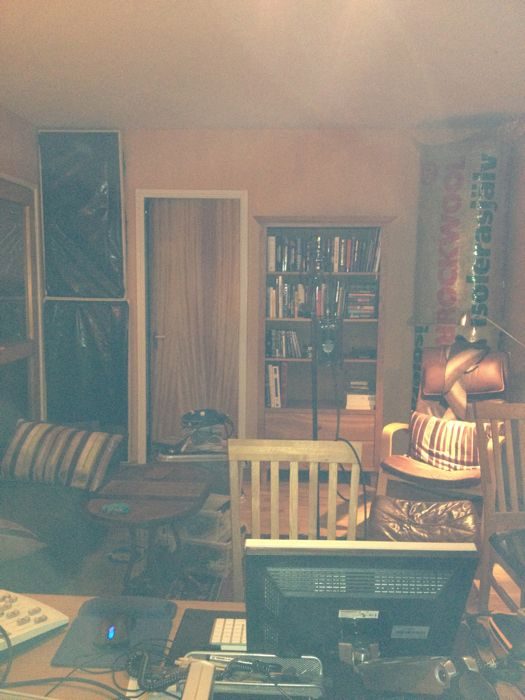
This is my first post and I hope I get it right. I recently moved into a new apartment and I am working on my control room/listening room at the moment. All walls are made of concrete including roof and the floor have a thin layer of wood. As you can see on the plan the left long wall is angled and therefore I have no idea how to calculate room modes and such. The hight of the room is 250 cm. The front of the room have a large window. The window pane is 27 cm deep from inner wall to glass and is placed 87 cm up from the floor.The hight of the window is 140 cm and width 270 cm. Underneath the window there is a metal radiator 200 cm wide and 45 cm high.
The right back corner have a door which is 60% made of glass and 40% wood. The is also a heavy door on the back door.
I have downloaded sketchup but it will take weeks to get it under control.
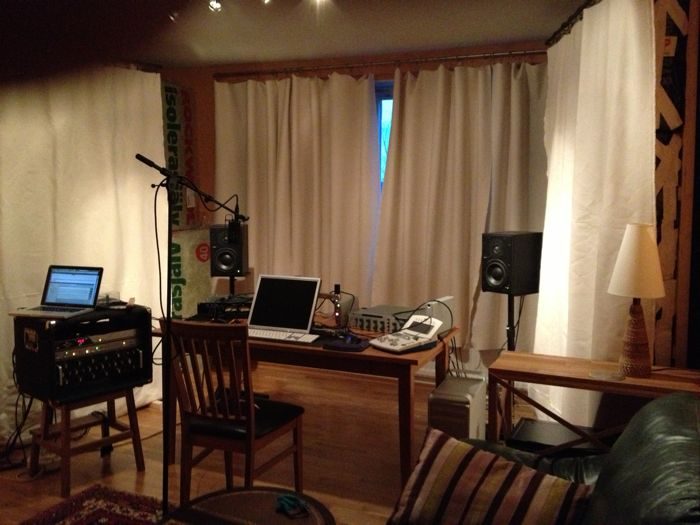
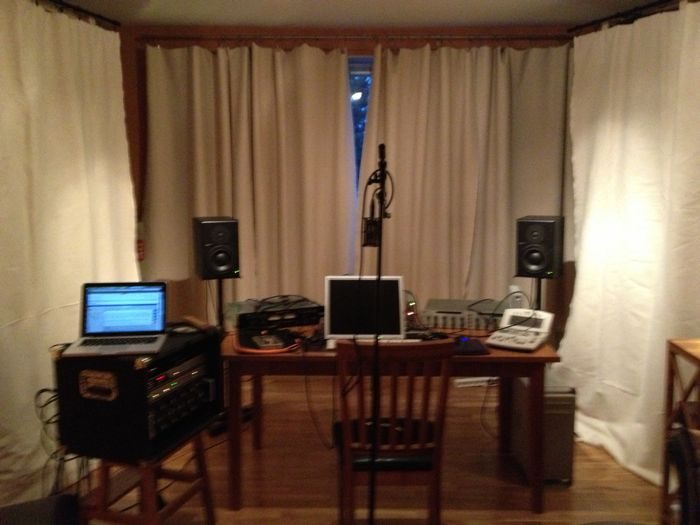
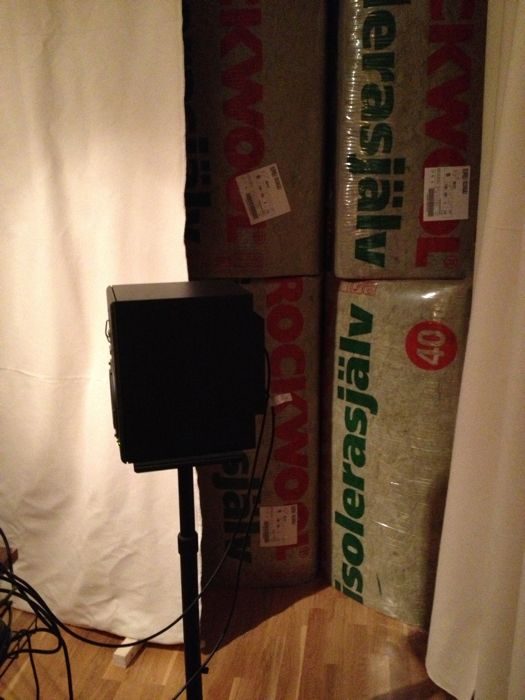
The base of the speakers are 90 cm from floor and the tweeter is 118 cm from floor. Please ignore my crappy speaker stands. Once I get the room "mixable" I will buy a better solution. Left speaker is 90 cm from the surface of a 45 thick pack of rockwool leaning against wall. The front of the left speaker (the woofer cone) is 100 cm from back wall.
The right speaker is 97 cm from right wall including 45 cm thick Rockwool and 120 cm from the glass of the window of the fron wall.
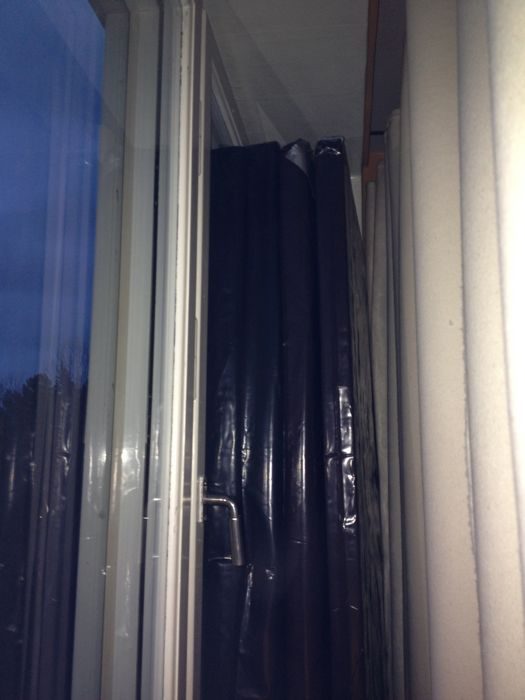
In the window I have placed 20 cm deep compressed free standing mineral wool panels (covered with XL plastic bags and sealed with tape) against the window. The panels are 60 cm wide and 120 cm high and placed in the windows left and right corner. I have enough panels to cover the whole window but for now I want some light in the room besides the view of trees and birds.
I discovered a sound leak from my neighbors in the left front corner. There's a TV and cable installation in that corner by the floor. I put two compressed wool panels against the wall (60x120cm) from floor to cealing and put a pack of Rockwool infront. These "packs" are about 45 cm in diameter 116 cm high covered with thin plastic. I have 4 packs in both front corners. Measuring 90 deep 45 wide and 232 cm high.
I made two free standing movable walls to deal with side reflections. I covered 4 panels of uncompressed mineral wool i XL plastic bags and sealed with tape to avoid health issues. The panels on the left side are 95 cm thick, 56 cm high and 116 cm wide. The movable "wall" is about 240 cm high 116 cm wide. The wall on the right have thicker panels. 14,5 cm.
I bought molton cottom drapes. 500 gram / meter and covered the Wood/ wool walls for looks. I also used it for the window drapes. I used 5 x 160 cm wide, 200 cm high curtains for the window.
The wasn't much room for absorbtion in the right back corner so I put two panels there against the wall. I will cover it with a drape later. The left back corner have two stacked packs of Rock wool and I will cover the packs with a drape later.
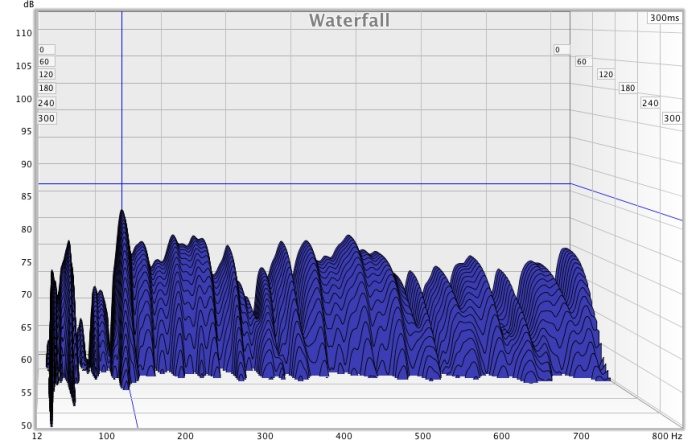
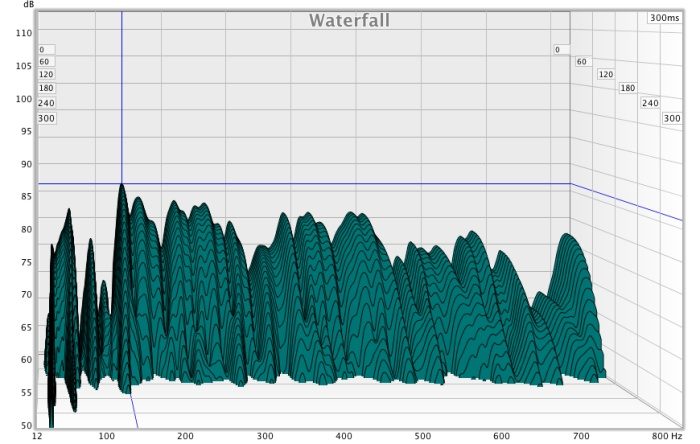
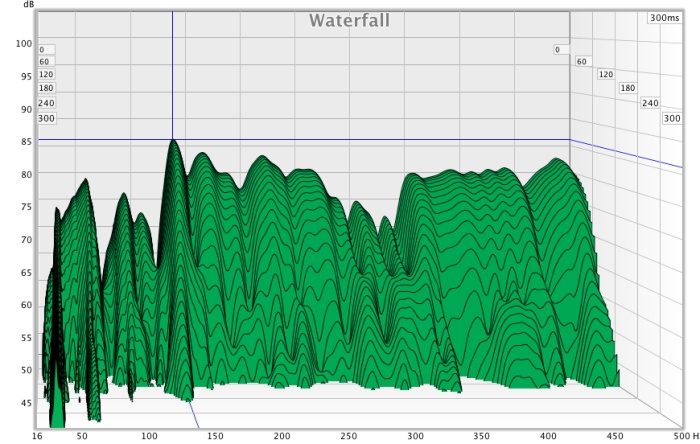
Since I mounted four of the stacks of Rock wool today I have listened to recent albums I have made and I am quite happy this fare. I do sense a problem around 150 Hz. REW says its 140. But I honestly don't know whats causing it.
I should mention that my plan for the free standing walls is to mount two diagonal 360 cm 2x2" on top from which I can hang absorbers to reduce reflections from ceiling. I still have to find the sweet spot for the walls.
I will post pictures and REW readings as soon as they are sized correctly.
Since REW is new to me I only look for certain things and I am aware that this room is fare from ready. Much can be done.
What do you think about the 140 Hz peak? I am sure it can be addressed easy If I do it right. Any thing else that catch your attention?
Thanks!
Best regards
Martin.
Image not preserved: right speaker april 18th.jpg
left speaker april 18th.jpgboth speakers april 18th.jpg
Good morning.
I came to think of the wall bounce calculator somewhere on this site. Here are some new measurements. I moved each speaker 10 cm closer together and 10 cm further away from the front wall. I realize that I didn't use the same monitor level because I was too tired yesterday to remember to write it down. But the mic is untouched. The new position did not affect the peak at 140 Hz but the overall response is more even. It's getting better :)
Correction; I moved the right speaker 20 cm not 10 cm from front wall since it was apparently not the same distance from mix position as left speaker. Bah, my english is not happening atm. More coffee!
both speakers 19th.jpgleft speaker 19th april.jpgright speaker.jpg
The room is 540 cm front to back, 364 left rear corner to right rear corner, 431 left front corner to right front corner. 250 cm height.
Thanks!
Martin.
Hi Martin, and welcome! :)
I'd have to see the actual MDAT file from REW in order to understand what is going on with your room. It's not possible to see from the graphs you posted.
I'd also need to know what speakers you are using, how they are adjusted, and how you did the REW test (what microphone you used, how you set it up, etc).
364 left rear corner to right rear corner, 431 left front corner to right front corner.
That might have something to do with it: Your room should never be narrower at the back than at the front. It should be narrowest where the speakers are, and either stay the same width all the way to the back, or get wider.
In the photos, I don't see any treatment on the ceiling at all, and there's a mode in the vertical plane at about 138 Hz, so I'm wondering of that is part of your problem. You need a cloud (hard-backed, angled) as well as horizontal superchunks in the wall/ceiling corners to help with that.
I made two free standing movable walls to deal with side reflections. I covered 4 panels of uncompressed mineral wool i XL plastic bags and sealed with tape to avoid health issues.
What health issues? There are no health issues associated with mineral wool or fiberglass. You might want to read this:
http://www.gearslutz.com/board/bass-tra ... eview.html
Also, while it might be necessary to put plastic on your bass traps to help keep the high frequencies in the room, you CANNOT cover the absorption at your first reflection points with plastic, since that defeats the entire purpose of the absorption: the purpose of the treatment is to STOP reflections, but plastic reflects high frequencies! So that that plastic off, and just cover the insulation with good quality acoustic cloth.
The panels on the left side are 95 cm thick,
:shock::!: Your side absorbers are nearly one meter thick???? 15cm is normally enough. You only need that type of thickness for bass traps, not first reflection points.
I still have to find the sweet spot for the walls.
Walls do not define the sweet spot: the speakers themselves and the correct geometry of the speaker, chair and treatment define the sweet spot. Walls can create problem with the sweet spot, yes, but they do not define it. In order to get the sweet spot set correctly, you need to place your speakers in the correct geometric locations or that rooms, at the correct height and angles, and also have the listening position in the correct location. Then you need the treatment set up correctly to deal with the artifacts as much as possible. Sweet spot is a function of speakers, geometry and treatment, not walls.
Since REW is new to me I only look for certain things and I am aware that this room is fare from ready. Much can be done.
What do you think about the 140 Hz peak? I am sure it can be addressed easy If I do it right. Any thing else that catch your attention?
It's hard to say without seeing the actual data file. To me, it looks like those speakers are too far away form the front wall, and the treatment is not suitable. It's a small room, so you won't be able to get the speakers far enough away from the walls to avoid SBIR. Therefore the only real option is to put them right up against the wall, so the SBIR artifacts are moved up higher in the spectrum, where they are less critical.
The new position did not affect the peak at 140 Hz .
Correct. Because it is a modal issue, not related to speaker position.
Finally, you seem to be doing your REW tests at a level that is much too low. They should be done at an average level of around 85 dB: your average level seems to be about 65 dB. You probably won't be able to get useful IR data at such a low level.
- Stuart -
Hi Stuart.
Thanks for your response. First let me clear out a few language faults I made.
Health issues; My son is developing allergies. We don't know whats causing it but its progressing. In other words He is getting allergic to new things as time goes by. I heard somewhere that the mineral wool fibers can cause allergies and thats enough for me for now. Besides, my old room got dusty from loose fibre flying around the room. The thick Molton fabric is placed 5-10 cm in front of the plastic to compensate/absorb the reflection of the plastic.
Sweet spot; I should have said most effective angle from the walls. I thought that they would have a broader absorption effect If I angled them. I also have the option to move them inwards towards the speakers to increase the distance from left or right walls. Nothing is final in this setup. Thats why I made everything mobile. I lack the skills of calculating room modes in an angled room. I figured I have to do it by trial and error before I drill any holes in the concrete walls. Two weeks into the process I discovered this forum. I also discovered this last night. http://www.mh-audio.nl/CancellationFreq.asp
Thickness of panels;
The packs of wool are 45 cm thick. I have two of them in a row. If you measure from the actual front left corner you get 45 width and 90 length wise towards the left back corner.
There are many reasons for placing the speakers in the widest part of the room. The most obvious reason is the doors in the back right corner. My son is only 9 years old and he might bump into something someday. Or myself for that matter. I mainly do remote recordings in various acoustic environments so I have to transport a lot of gear often. The third reason, based on my ever-inferior-acoustics-skills, is that I have plenty of room for absorption.
Equipment and REW;
Dynaudio Acoustics BM6A (rear ported). On the back you can adjust hi and low but there is no scale so I left them pointing straight up, hoping that this way I am neither adding or subtracting, Thuresson 502 microphone in omni mode placed at ear-hight in mix position. Thuresson is a one-man company that makes hand made microphones in Sweden. Very accurate and very good. Equivalent with DPA or Schoeps but in my ears better. I am not certain how REW catalogs its measurements. I will make new ones at louder volume and figure out how I can post them here.
I am still puzzled why the 138 Hz mode is only absent in the left speaker waterfall?
One new question regarding SBIR and nearfield monitor placement;
Would it be smarter to leave the speakers where they are and get a subwoofer and place that close to the front wall? Lets say my BM6As only played from 120 Hz and up. Or a higher cut-off for that matter?
The thick Molton fabric is placed 5-10 cm in front of the plastic to compensate/absorb the reflection of the plastic.
Unfortunately, that won't help. The plastic itself is the problem.
If there is an allergy problem with mineral wool or fiberglass, then don't use it: use proper acoustic foam instead, which does not shed fibers. It is much more expensive than mineral wool / fiberglass, but it does have that advantage.
I should have said most effective angle from the walls. I thought that they would have a broader absorption effect If I angled them.
The most effective angle for the speakers is the one that gives you the correct geometry of the speakers and listening position in the room. There are guidelines for this on the forum.
Also, walls do not absorb: they reflect. The walls MIGHT absorb at very low frequencies, if they happen to act as panel traps, but that has nothing to do with the sweet spot: since low frequency sound is non-directional. The sweet spot is far more about mids and highs, and at those frequencies your walls are purely reflective.
I also have the option to move them inwards towards the speakers
From what you say, it sounds like you can move your walls? Or did I misunderstand that? If you can move your actual room hard boundary walls, then that's excellent: You can fix a lot of the problems by setting up the room boundary in the best location.
I figured I have to do it by trial and error
There's no need to experiment much: Just start out with the correct basic geometry and treatment, then do a couple of small adjustments to confirm if that is the optimum position. The normal basic "standard" layout and geometry that should work fine for most rooms.
Yes. That's SBIR. I think I mentioned that in my first response. Your room is not large enough that you can get your speakers sufficiently far away from the walls to have the SBIR artifacts occurring at frequencies that are too low to be important. Therefore you have to get the speakers as close as possible to the front wall, to drive the SBIR artifacts up to a frequency where it won't be too objectionable. Or you could soffit-mount (flush mount) your speakers, which eliminates the problem entirely, and also eliminates several other major problems with speakers in small rooms.
On that site you linked to, they are telling you the same thing I already said in my last post, and here too: "The speaker should be moved as close to the wall behind it as possible so that cancellation frequency is very high. At these higher frequencies the speaker has far less omni-directional energy so the cancellation effects are greatly reduced. One side effect of this method is that the bass tilt should be set correctly to compensate for the additional loading presented to the bass driver by the wall. "
There are many reasons for placing the speakers in the widest part of the room. ...
Yes, but those are all lifestyle reasons, not acoustic reasons. All I can tell you about is the acoustic reasons why that is a bad idea. If you have to have the room set up in that orientation, and you say you can move your hard boundary walls, then just move one of them so that it is parallel to the other (making the room rectangular), and that problem will go away.
The third reason, based on my ever-inferior-acoustics-skills, is that I have plenty of room for absorption.
That's good, and yes you certainly will need a lot of bass trapping in that room (not just general absorption, but specifically design for bass). However, no amount of treatment can make a bad room sound great. It can help a bit, but it cannot solve all of the problems if the basic room shape is poo, acoustically.
On the back you can adjust hi and low but there is no scale so I left them pointing straight up, hoping that this way I am neither adding or subtracting,
Those controls are there for a purpose: to compensate for the location of the speaker in the room. It's not about adding or subtracting, but rather about calibrating. The simple fact of placing a speaker close to a wall affects the way the speaker propagates sound into the room, and those controls are there to "fix" that. If you place a speaker close to a wall, then you are causing an increase in the apparent bass response of the speaker, since the inherent power imbalance caused by having a speaker in a small cabinet is now being partially corrected by the wall. So you have to adjust the bass roll-off, or bass-shelving, or bass-tilt control to compensate for that. In your case, you will need to roll off somewhere between -4dB and -6dB on the bass control. The treble control is for another purpose, that you might need to adjust later. But for now, leave it on zero.
Thuresson 502 microphone in omni mode placed at ear-hight in mix position.
OKm that should work fine. I looked for technical data on that mic on-line, but I only found subjective reviews, no actual graphs of polar patterns and frequency response. But if the response really is flat, and the polar pattern really is omni, then it should work well as a measurement mic.
I am still puzzled why the 138 Hz mode is only absent in the left speaker waterfall?
The left speaker might not be triggering the mode very much, or it might be masked in some way, or it could be the room shape, or it could be the way you have the treatment set up. There are many reasons why a mode might appear active for one speaker and not for another. But it does demonstrate that you have a much bigger problem with your set up: it is not symmetrical. Symmetry is critical to getting an accurate stereo image and clean sound-stage, as well as an even and broad sweet spot, and mostly for mix translation. I would suggest that you start by fixing your symmetry issue, then repeat the tests.
Would it be smarter to leave the speakers where they are and get a subwoofer and place that close to the front wall?
The mains will still be producing some sound at low frequencies, even of the crossover has a very steep filter, so there will always be some contribution to the modal response by the main speakers. A sub is good for extending the overall bass response down to much lower frequencies, which you might need to do if that is important to the type of music you mix, but on the other hand, it might also trigger lower frequency modes that aren't' being triggered right now, since it will be putting out significant energy at frequencies that your mains just aren't even getting to. So you might reveal additional problems with the room by adding a sub.
If you want to get rid of SBIR, then the only solution that is absolutely guaranteed to do that, is to flush-mount the speakers in angle wall segments at the front of the room. This is often called "soffit mounting". However, you can only do that with front-ported speakers, or un-ported speakers. You can't do that with rear-ported speakers.
he left panel is 9.5 cm thick. The right is 14.5 cm thick.
They should be the same thickness. The room, the treatment, and the speaker layout must all be symmetrical.
Don't forget to post the REW file, so we can analyze it more completely.
- Stuart -
Hi.
Sorry for the delay. I run out of money and could not make the adjustments I wanted to.
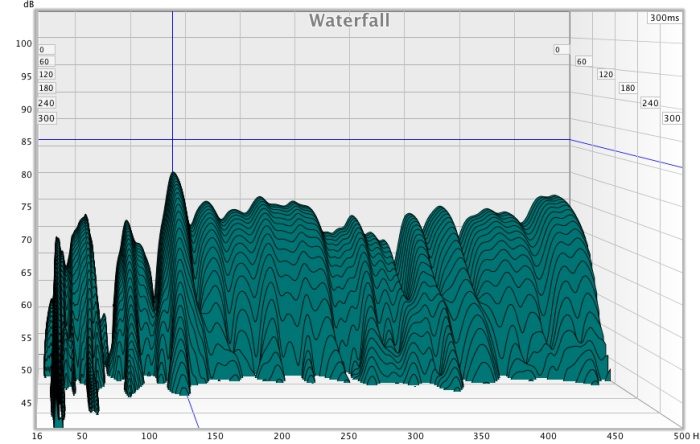
That 140 Hz bump is gone now due to my cloud panels. Side reflections have been taken care of. Many adjustments and measurements have been made. For a day or two I went for the SBIR concept and put the speakers as close as possible to the front wall. I got a fairly flat bass response on paper and tried to address the new null in the 450 area. Made a dussin tests and prepared for a listening session with my favorite records. I was chocked when I heard the results! Those test curves may have looked nice but it sounded absolutely horrible.
Anyhow. Decided to go by ear and find a good or decent monitor position and wait with tests until most of my planned treatments were in place. I have attached a zipped mdat. The only difference between the two is that on the first the rear wall is open into the bedroom. On the second file with the deeper dip in the 70Hz area I have closed that door as far as possible without damaging the cables that runs into the noisy equipment placed in the big wardrobe. My plan is to make a permanent cable tube through the wall later on. (Or leave the door partly open)
Thanks for taking your time.
Edit: My zipped mdat is 3.8 MB, maximum allowed is 500 KiB. What shall I do?
Best regards
Martin.
Yes, it works fine!
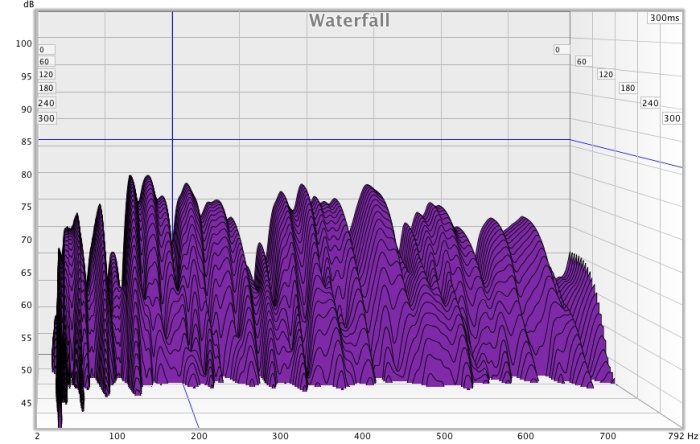
There's still a lot of activity on the modes associated with the length of your room, specifically at 32 Hz, 64 Hz and 98 Hz (approximately). They are all ringing loudly, and long. Particularly the one at 64 Hz: it is nearly one second long! So I would suggest lots more bass trapping on the rear wall.
There's also a lot of very early reflections, within the first 5 ms: very likely those are coming from the surface of the desk and the equipment on it.
- Stuart -
Hello.
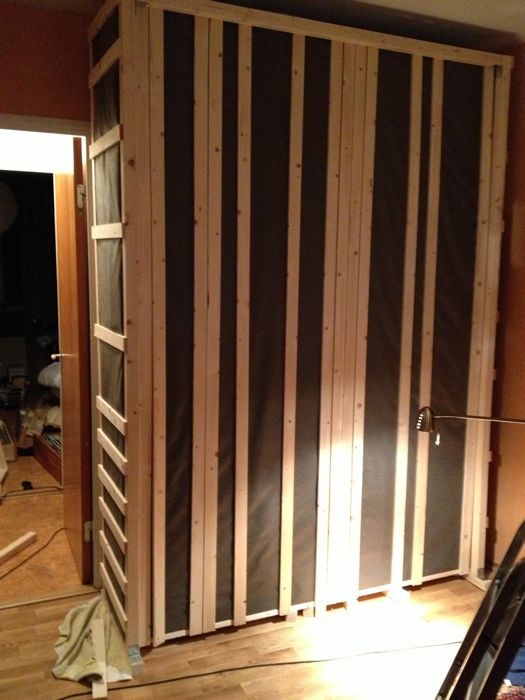
Thanks for your input! My plan for the rear wall is make a big 40 cm thick absorber. The front of the absorber will be covered by 50% with 5 cm wide wood panels. I have found a binary sequence on gearslutz (boggy's) based on 127 slots. From what I understand I can start anywhere in the sequence. I guess the point is to find a part of the sequence that covers the width of the panel by 50%. I intend to have a 3 mm gap between slots (either panel or open slot) The absorber will be 168 cm wide and 240 cm high. It will be spaced from the rear wall by 20 cm. In other words (pardon my english) the front of the absorber will be 60 cm from the rear wall.
There aint much to do about the rear door. I'll try to attach a panel to it. The area in the right rear corner next to the rear door isn't very big. I can either have two panels (56x116 cm) slightly spaced from the wall about 5-10 cm. OR I can make 60 x 40 cm Limp Mass Absorbers. I'll wait and see until I know how much the big absorber swallows.
I have all the material needed at home. If you think my plan is no good please let me know cause I have the day off tomorrow and I plan to put it together then.
Cheers!
Phew!
That was a lot of work. Too late to run sweeps tests tonight. I was listening to a nice piano trio while installing the wool in the trap. The grand piano sounded very "grand". I will do some sweeps in the morning.
Edit: Position 84-113 from Boggy's 127 position binary sequence fitted the width of the absorber. (well almost;16 slots and 15 slats)
The side of the panels slats have no logic at all other than extra slats for protection.
Cheers
Monster Trap.jpg
Here is the new MDAT
https://dl.dropboxusercontent.com/u/783 ... 0Trap.mdat
Since I am a noob at REW I only look at the waterfall to see decreases in peaks and nulls and decay time of the mode.
I have moved the bookshelf from the back wall as you see in the picture. I don't know were I'll end up putting it but for now it is where it is. I don't know what harm it may cause in this position?