As much as we would love to include an HVAC system, it's just not possible to squeeze it into the budget.
You really don't have much alternative! As Brien pointed out, you do need to breath in order to stay alive, and without some for of getting fresh air in and stale air out, you won't live long enough to actually ever produce a mix!
:)
I know you don't want to hear this, but HVAC is probably the single most overlooked and under-planned item in home studio builds. People forget that they need to breathe in oxygen and breath out CO2 in order to remain alive, and that studios, by nature, are sealed air-tight, with a very limited amount of oxygen inside. Once that is used up, you pass out and die. It is that simple.
It is not a matter of comfort, but very literally of life and death.
But, as Brien also pointed out, even before you pass out and die you'll be gagging on the uncomfortably hot, stale, bad, smelly, ugly air. It simply is not an option to have a studio with no HVAC. The very least you need is fans, ducting, filters, silencers and registers dimensioned sufficiently to proved the minimum legal number of air changes per hour, based on the room volume and occupancy. But in reality, that isn't enough: you will also need, at the very least, a mini-split system to cool and dehumidify each room.
Then there's the issue of humidity: instruments and some types of microphone are sensitive to humidity: their tone changes as humidity increases or decreases. So even if you learn to hold your breath for hours at a time, you still wont be able to track and mix in there, as the sound of your instruments will be changing all the time as the humidity rises...
So really, HVAC is a must: you don't have a choice.
also, i re-read one of the "before you post" threads and updated my first entry with the budget
but you are still missing something, rather important! It's in big blue letters,
and hard to miss... (click here).
:)
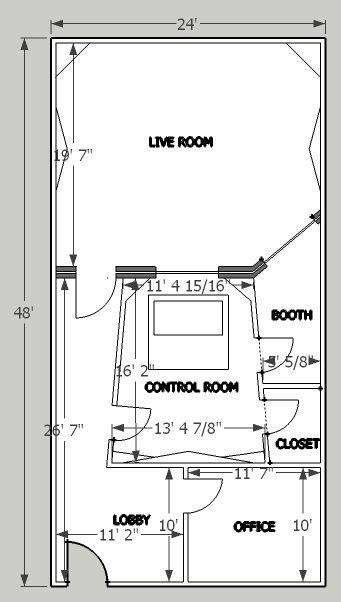
However, I do know to avoid parallel walls and include absorption and diffusion throughout the rooms.
Actually, parallel walls are an option, if done correctly. There are reasons why you might need (or just want) to splay your walls, but there are quite a few very successful plain old rectangular studios around... Splayed walls are only needed if you want them, and the issues they solve can also be dealt with in other ways. Your semester of acoustics probably only presented the basics, so they never got to the part of how to deal with parallel walls when you want them.
Also, on diffusion: Most types of diffusion can only be used in large rooms, since all numeric-sequence based diffusers, as well as some other types, cause "lobing" in both the spatial and temporal domains, and that takes a lot of space to smooth over. So things like skylines, QRDs and other similar numeric-based diffusers are only appropriate for large enough rooms. Your control room, for example, is way too small to be able to use diffusers, unless they are only tuned to very high frequencies. But in that case, why would you need them anyway?
:) Your live room might be able to use them, though.
The budget isn't too big (about $10,000), so we're going to have to cut some corners here and there.
Hmmm.... In a 48x24 floor area, that works out to around US$ 8.68 per square foot. Sorry, but that just isn't realistic. To get an idea of what this is really going to cost you, call around some local building contractors, and ask if they have a basic flat rate per square foot for finishing an unfinished garage or basement as a home theater or extra bedroom suite. Add about 20% to the rate they give you, and that's roughly what it will cost you to do this. With US$ 10,000 you MIGHT have enough to do the basic structure of the control room, but that's about it. And that doesn't even consider your HVAC or electrical installations, permits, inspections, other fees. I would really, really suggest that you need to re-think that budget. Add a zero to it, and you are in the ball-park. Or shrink the project way down to a single rectangular room. Or build the project in stages, as funds become available. Or bring in an additional partner, with deep pockets. Or get financing. But trying to do a project this big on a budget that small is just not realistic.
Once again, that is certainly NOT what you wanted to hear, but it is the cold hard truth.
- Stuart -