Hi all,
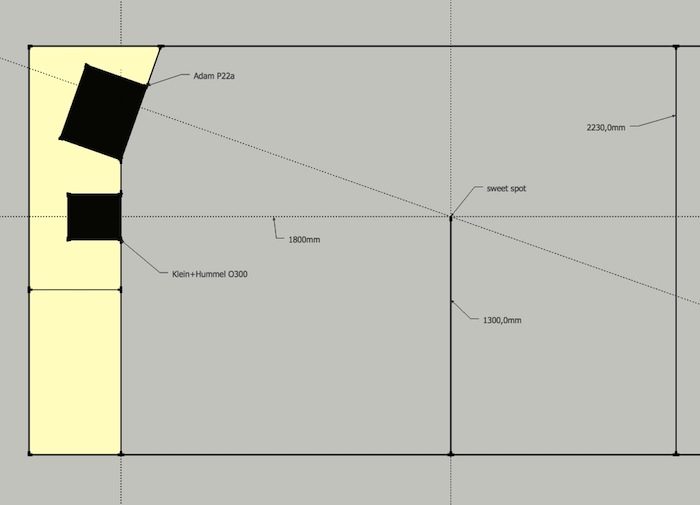
now i am one step closer to my little studio dream! :-) I got a plan for my mixing room! However, I want this to last as long as possible with possible adjustments that might happen in the near future. This is my original plan for my 5.1 system of adam p22a with LCR soffit mounted:
Image not preserved: blueprint.jpg
The nice thing of this is that I can change the monitors easily with just having to replace the bezel. However, in spite of having enough room above the LCR speakers there is no way of getting an additional stereo pair inside the wall, without the listening position going off axis ... That is why I think about the following modifications of my plan:
Var 2.jpgHere, the problem seems to be (and I am not sure, if there is a problem), that it gets pretty narrow for the adam monitors. My biggest concern is, that my flat screen monitor (1000x700mm) has to be mounted way to deep and the monitor on my desk will be in sight line with the mounted one ...
That's why I came up with an alternative:
Image not preserved: Var 1.jpg
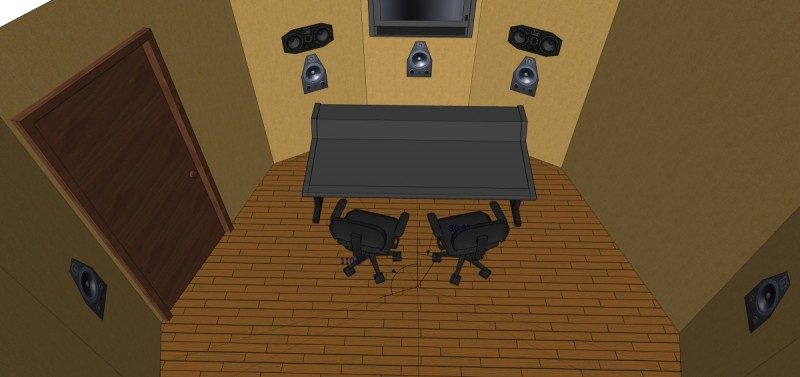
This looks way better in terms of spacing. This is a 3d representation of the design:
Image not preserved: var 1 3d.jpg
My only concern is the flat area where each monitor is mounted is way smaller than in the original layout and this is the very reason for soffit mounting: creating an "endless front" for the monitors. So, will this sound in any way "worse" than just having a single stereo pair (or rather LCR)? I have not found many examples of people soffit mounting multiple stereo pairs. Surely, there must be a reason for this.
On the other hand, I see many goodies about my design:
- great flexibility in terms of speaker modification
- on axis and same distance for two stereo pairs (plus the option of a third one on the meterbridge)
- good location for the flat screen (it will show the movies I score most of the time)
What do you guys think? Did I make any mistakes? What about the distance between monitors (the o300 pair) and ceiling? Is it to close? Is there some kind of margin, how close it my get?
Any input appreciated!
Happy new year to all of you!
Hi there, "FriFlo", and Welcome back to the forum! :) A rather late welcome, but better late than never! Been a bit busy here on the forum lately, and I only just noticed that nobody had replied to your post.
Anyway...
This is my original plan for my 5.1 system of adam p22a with LCR soffit mounted:
It is possible to mount two sets of speakers in one set of soffits, but you do have to be careful: there are limits to what will work. Yes, you can tilt part of the soffit to do it, but you should never go beyond 10° of tilt, and some of us think that even 10° is too much, and 7° should be the limit (for rather complex reasons, to do with the way the human ear works, and how it identifies direction). I'm not sure what angles you are tilting at, but the look like they are more than 7°.
Also, the way you show your P22's is not correct. The beveled edges need to be sunk into the soffit, so that the front fave of the speaker is flush with the soffit all around. That means that you need a strange shaped and unusually angled hoe cut in the soffit panel, to mimic the shape of the beveling on the P22A, but it is the only way to do it correctly.
My only concern is the flat area where each monitor is mounted is way smaller than in the original layout and this is the very reason for soffit mounting: creating an "endless front" for the monitors.
"Infinite baffle" is the technical term, but yes, that's the correct concept. However, you actually are doing that, since all three soffits will be solid, hard, flat rigid surfaces that meet, so each soffit is a sort of extension of the one next to it. As long as you blend the L and R soffits into the room side walls, you should be OK. There seems to be enough area around each individual speaker, and the adjacent surfaces will do the rest of the job, albeit not perfectly.
I have not found many examples of people soffit mounting multiple stereo pairs. Surely, there must be a reason for this.
Yep! The reason is that it is dam hard to get it all done right! It can be done.
- on axis and same distance for two stereo pairs (plus the option of a third one on the meterbridge)
I'd skip the "third one on the meterbridge" part: that's never a good idea, even though you see it so very often, and even in studios that should know better! :)
Any input appreciated!
One thing I did notice is your aim points are slightly off. Yes, I know that that's how EBU shows it, but in reality most people have their ears mounted on the sides of their heads, not the center of their brains, or in their eyeballs, so it is better to adjust those speaker locations slightly such that the acoustic axes of the speakers are aimed at your ears! :) Make a sphere about the size of your head, and position it so that the equator is 1.2 m above the floor, centered on the theoretical EBU circle. Now re-aim the L, R and surround speakers so that the axes graze just past the edge of the sphere, maybe a cm or so away. The axes from the L and R speakers will intersect about 25 to 30 cm behind your head, and the axes from the surrounds will intersect a few cm in front of your nose. That's the correct way to do it, and gives you a better sweet spot.
What about the distance between monitors (the o300 pair) and ceiling? Is it to close? Is there some kind of margin, how close it my get?
It's not so much the distance, as the first reflections. It looks like you might have a problem there with reflections off the ceiling getting to your ears. There's also not much space up there for a cloud.
- Stuart -
Hi Stuart,
thank you for taking the time!
So, I have to watch, that the tilt is no more than 10°, less being better.
The looks of the P22As is misleading, as I just put them there at about the height they should be, just for you guys to see where they sit. I have seen John's P11As soffit designs, so I know how to cut the front baffle. Thanks for pointing that out for me, though.
If the construction does its job, "albeit not perfectly", that is fine with me, as I am not a perfectionist. I want to do as good, as I can, but I know my limitations.
I will also skip the 3rd pair of monitors on the desk, as adviced. This was just an option I thought of and I was not a priority. However, that makes it really way more important to have the ability for a second stereo pair, as I do not want to be stuck with the P22As. You know, I wanted a Surround set of monitors, but I can only afford that with those older models, where I could easily afford 5 pieces on ebay. However, I know the limitations of those 2-way-speakers to well, as I recently tested some 3-way systems, so it is kind of carved in stone for me, that at some point I will get something like the Neumann KH 310 (Klein+Hummer o300), as soon as I can afford them. It might also become an Adam S3X-H, as I generally like Adam, I just didn't have the opportunity to test these.
So basically, when I finish my soffit mount construction, I would like to plan ahead a little and leave this option for later. Of course, I could just dump the P22As, as soon as I buy new monitors, but that would force me to buy the whole surround system with way more expensive monitors - at least for the LCR monitors.
So, you say it is damn difficult to build a construction like that right. I agree, it is one step further, however, what I don't get is, where lie the exclusive problems here? And: Would you definitively recommend me to stick with the simpler design? Or would you say, I should try it, if I so much want the optional monitor set?
I agree with the early reflection part: This is actually, what I am most afraid of, as I read somewhere here on the forum, that the distance between floor and speaker axis should best be less than the distance between speaker axis and ceiling. However, mounted at the correct position this is not even the case with the adams in the simple layout ... So I thought about these early reflections, but there is still space above them (albeit not much!) for a ceiling cloud, as the o300s are not very tall.
Well, would you guys say the risk in screwing the whole thing by this idea is to great to take the chance? Personally, I would do it, but it kind of keeps me off, that almost no one else seems to have tried it ...
So, you say it is damn difficult to build a construction like that right. I agree, it is one step further, however, what I don't get is, where lie the exclusive problems here? And: Would you definitively recommend me to stick with the simpler design? Or would you say, I should try it, if I so much want the optional monitor set?
I guess the biggest problem is in getting all the angles to work out, especially in actually cutting the wood accurately. You have compound angles there, changing in both two and even three dimensions in some places, so you need to lay it out carefully in SketchUp, accounting for all the angles, then you need a skilled carpenter with a good chop saw (or radial arm saw) to cut the wood and put it together. If you are comfortable with 3D geometry and know SketchUp well, then it's not that hard to design, and a good carpenter should certainly be able to do it, but it might not be the ideal project for a beginner DIY'er... That's part of what I meant by "hard to get right".
You also have to consider how you are going to support each of those speakers rigidly and independently from the others, and how you are going to keep the angled ones in place without them sliding out over time from vibration: there has to be a slight gap around the front of the speaker, between it and the infinite baffle of the soffit front. They cannot touch, so you can't rely on the soffit panel to hold the speaker in place. Etc. The support system inside the soffit is going to get rather interesting!
And finally, there's the issue of heat and ventilation: All of those speakers need good airflow past the rear surface to keep them cool, so you need independent air paths to bring cool air to each speaker and exhaust the warm air out through the front again, high up. You don't want the hot air from the lower speaker flowing past the upper speaker, for example.
Combing all of those is quite a challenge.
I agree with the early reflection part: This is actually, what I am most afraid of, as I read somewhere here on the forum, that the distance between floor and speaker axis should best be less than the distance between speaker axis and ceiling.
either greater then OR less than, if possible, but it's not life or death, and there are ways around that if it turns out that your speakers are slam bang in the middle. For example, you could angle the front part of your ceiling, or you could build a hard-backed ceiling cloud.
What you also need to do in SketchUp to check those reflections, is something called "ray tracing", which basically means that you draw many lines leaving the acoustic center of the speaker at various angles, and follow each line straight out to see what surface it hits. You then draw a new line that bounces off that surface at the correct reflection angle, and follow that one to see where it goes. You must make sure that none of the "bounced" lines reaches your ears. If one does, then you need to angle the surface that it hit until it no longer reaches your ears, or put another surface in the way to block it, or figure out some method to prevent it getting to you.
When speakers are high up and angled down, there's a very good chance that you will be getting first reflections off the surface of your desk and console, right into your ears. Those are often hard to deal with.
Well, would you guys say the risk in screwing the whole thing by this idea is to great to take the chance? Personally, I would do it, but it kind of keeps me off, that almost no one else seems to have tried it ...
Actually, others HAVE tried it, and done it successfully. If you can make it work in SketchUp, then it will also work in real-life. So I'd say play around all you need to in SketchUp and see if you can get an optimal situation where everything works out well.
- Stuart -
Thanks again, Stuart. I think, now I realize the problem!
While all things regarding air-flow can be solved, there is one major concern:
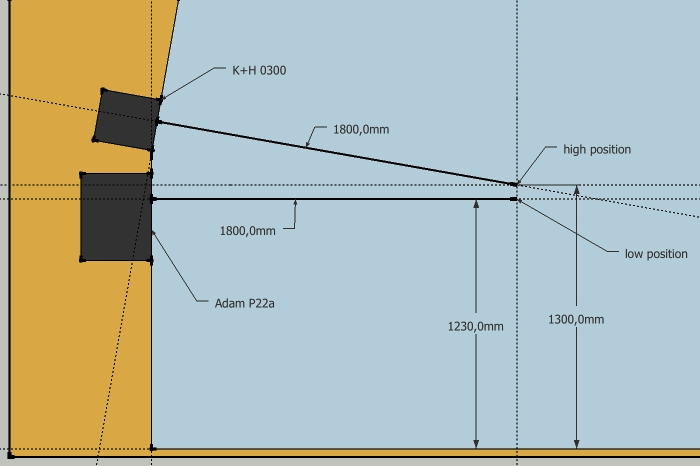
The height of the lower speakers is calculated to be 1,30 meters, derived from the height of my ears seated. This sets the location of the monitors, but also sets the boundary where the wall can be tilted from. Even if I set the tilt at the maximum of 10 degree (which would better be even less, as you implied!), I do not have enough room to place the upper stereo pair on axis with my listening sweet spot. Hence, I have to choose between:
1) Setting the axis of the upper stereo pair higher than my ear height
or
2) Setting the axis of the lower speaker pair lower than my ear height
or
3) Tilting beyond 10 degree ...
How has this problem been solved by others? Any threads there to look through? I couldn't find any regarding multiple speaker pairs mounted ...
Did I get it? ;-)
The height of the lower speakers is calculated to be 1,30 meters, derived from the height of my ears seated.
We are talking about the height of the ACOUSTIC AXIS, correct? Not the height of the top, bottom or center of the actual speaker cabinet?
Also, 1.3m seems a bit high, unless you are unusually tall or sit on a very high chair. Most people are in the range 1.15m to 1.25m (although some really are a lot taller or shorter).
This sets the location of the monitors, but also sets the boundary where the wall can be tilted from.
Not really: What sets the tilt point is that height PLUS the depth of the speakers. If you move the entire soffit more into the room, increasing the depth behind the speakers, then you can start the tilt lower down. In fact, there are examples here on the forum where the entire soffit is tilted, all the way down to the floor, with very large speakers, too.
How has this problem been solved by others?
See above... :)
Any threads there to look through? I couldn't find any regarding multiple speaker pairs mounted ...
I don't think there are any threads on that, but it looks like you have now started one! :) So this will be the definitive thread on how to do it... But I do know that it has been done, as I have seen a design where Glenn did that for one of his customers, and it worked great. But you'll have to ask him if he wants to share that in public, since it was a proprietary design that was paid for by his customer, and he might not be willing or able to share it. Hopefully he can!
But if not, then 'm sure we can all figure it out here, and then this thread will be very useful to others who need to do the same thing.
- Stuart -
Quote:
The height of the lower speakers is calculated to be 1,30 meters, derived from the height of my ears seated.
We are talking about the height of the ACOUSTIC AXIS, correct? Not the height of the top, bottom or center of the actual speaker cabinet?
Also, 1.3m seems a bit high, unless you are unusually tall or sit on a very high chair. Most people are in the range 1.15m to 1.25m (although some really are a lot taller or shorter).
I am 1.85 meters tall and indeed have a rather high seat, which has to do with my preferred ergonomics to play keys. And - yes - I speak about the acoustic axis of the speaker.
Quote:
This sets the location of the monitors, but also sets the boundary where the wall can be tilted from.
Not really: What sets the tilt point is that height PLUS the depth of the speakers. If you move the entire soffit more into the room, increasing the depth behind the speakers, then you can start the tilt lower down. In fact, there are examples here on the forum where the entire soffit is tilted, all the way down to the floor, with very large speakers, too.
Sorry, I don't quite get, what yo mean by the depth of the speaker ... Of course, I need to have enough depth behind the soffit to have room for the speaker. But what does its depth got to do with the point of the tilt? To my understanding, I would have to start the tilt point at least a little higher than the upper physical boundary of the lower speaker, which would have to be at about 1.45 meters according to my ear height. How would moving the whole construction closer to the listening position change that? If anything, this would force me to use an even wider angle for the tilt. But how would it change the physical boundary of the lower speaker pair?
For this example I set the tilt to 10°. From what I understand, there are only the following measures to influence the positions of the upper speaker pair:
1) Obviously, the farther away I put the sweet spot (listening position) from the speaker (here it is set to 1.8 meters), the higher I may place the upper speaker. Going beyond 1.8m will be difficult, though, as this is the maximum distance for my LS and RS speaker in the back to be at an acceptable angle.
2) Changing the tilt beyond 10° would also allow me to position the upper speaker somewhat higher, but you implied earlier that was not a good idea.
I couldn't thank you enough, if you could explain based on the picture, which parameters should be changed to get a better solution. Obviously, in the example there is not enough room between both speaker pairs, to make the construction work ...
Hi Fritz,
the stereo speakers above and 5.1 speakers below would be better along with the reduced angles. however - in most cases, it's really hard to get both stereo and 5.1 in soffits, it's usually one or the other. so maybe it's best to soffit mount the stereo speakers and put the 5.1 on stands. this way you can tweak the front wall treatment a bit to accommodate reflections from the rear speakers and also position the stereo mains for best stereo imaging.
Hi Glenn,
thanks for the answer! So, if I understand you correctly: Stereo plus 5.1 all in one soffit mount is a little bit to much to get under one hood.
But what if it were only two separate stereo monitors and no surround? Just to weigh my options: How would I get those two to work together? By raising the distance of my listening position?
One last attempt, before I get rid of the idea to soffit mount an additional speaker pair: As I thought about all the parameters to change it seems the only valid one is height of the ears. I got no reply on what else could be done to place both speaker pairs for one ear height (except for increasing the distance even more, which is not an option for me), so I guess, there is none.
This led me to thinking more about, how I sit in different kinds of workflow and which speakers I would primarily use for that kind of work. I am composing music for media, so most of the time I sit on a piano bench without back rest, hence, fairly upright (ears at 1.3m). When I do mixing, I sometimes use the same seat, at other times, I use another chair (more comfy), that puts down my ear height at about 1.23m. My piano bench is easily lifted and raise by a hydraulic system and can be put down to ear height at 1.23m, too. I also tested these heights and everything in between with the early layouts of my working desk (another project, once this is finished). It seems to be working fine in terms of ergonomics, the higher position being better suited for keyboard playing.
What do you think about that: I could push down the Adam speakers by those 7cm. This would give me the last bit of room needed to place the K+H o300s at the perfect spot for my high-ear-position and to keep the tilt at 7-10°. I really think, I could live with the 5.1 system being optimized for sitting lower, as I can easily sit and work lower for mixing. Mouse, keyboard and euphonix mc mix (I haven't got a console and will never need one) are postioned as lowest elements, anyway!
On the other hand, what really frightens me about this idea is that I cannot really try this sound wise ... so, if this turns out to not work well, I have to take the whole construction down and almost start from scratch!
Would you guys be so kind to tell me, if this is madness and I should forget about that additional stereo pair? In that case, I would still soffit mount LCR adams and wait until I can replace the adams with K+H completely (at this time I couldn't afford 3 o300s, while I could afford a used pair from ebay.
Or is this worth trying? Thanks for your help!
Seitenansicht mit zwei Ohrhöhen.png
if you're going to soffit mount them all, then put the S3 above and the A22 below all on the same level (or the rear ones raised 6" or so). if you frame out the soffits so the structure for the speaker box is larger than you need (assuming you're moving up to a larger set of speakers, if not ignore), and then a sub-frame inset into that to hold the speaker boxes. for the soffit face i'd use a layer of 25mm MDF or plywood with 35mm-50mm insulation under cloth to cut reflections from the rear speaker (and make the rear soffits soft as well) but mount all the speakers in the soffits. if you were to pursue only the stereo in the soffit - keep them up higher so the freestanding 5.1 speakers don't interfere. as with my previous comment - keep the difference of angles between as little as possible. if desired you could stack them into a single vertical soffit rather than an angled set.
Wow! Thanks, Glenn!
I just cross-edited my sketch to the post.
Unfortunately, I cannot soffit the LS and RS speakers. The geometry of the room and especially the position of the door makes that impossible ...
viewtopic.php?f=1&t=17825
My original layout is supposed to be reflective front and absorbing back of the room. But you are right! Covering the bezels with insulation and cloth absolutely makes sense for killing those reflexions of LS and RS. Does this plan still make sense, if I can't soffit LS and RS? There will be some treatment (absorbers) to kill some early reflexions.
In your sketch (thanks for the effort!!!) it looks like you are not even tilting the soffits to make up for the acoustical axis ...
This astounds me a little, as I understood being off axis would be definitively not a good idea ... especially with ribbon tweeters, which only have a very narrow axis. I guess, the o300s would be a little more forgiving. However, it would definitively save me a ton of work, not to tilt ...
In that case: which monitor would the acoustical axis be optimized for? Or would it rather be some kind of in between both? The acoustical axis of both monitors would be 272mm apart, if I were to just put the o300s on top of the P22as, by the way. But wouldn't create it even more of a heat problem, if I just stacked them on to of each other?
Finally, if I abandon the idea o an additional speaker soffit mounted, I will not go for free standing 5.1. It will rather be soffit mounted LCR (that also serves as stereo pair) and LS RS free standing, with the option to upgrade LCR at a later point. I will however always be stuck with one brand of speakers for the front, hence, all my stubborness to get this working with two speaker pairs ... ;-)
And another thought regarding to covering the front baffles with insulation an cloth:
Isn't it crucial for this to get the front of the speakers meet with a solid front on one level? What would the front of the speakers have to meet with? The clothing or the plywood/MDF?
it's all about trade offs - the reason for the flat face instead of angles is simply the S3 is going to be hot so a few inches above "perfect" is going to be OK on your ears, as is the A7 slightly below, you're likely to find that the acoustic centers are what, 6" apart? but again, if you want to angle them do so...
on the soffit faces, the soft face is only say 25mm-50mm deep and backed by hard surfaces so the diffraction on the mid-high is attenuated and the low mid and LF is not significantly affected. on the RS/LS, perhaps if you cannot soffit mount you'll want to make sure your baffle compensation can be set to match the front (one of the reasons to just freestand the 5.1 units) and if the speakers don't have sufficient granularity in this regard, get a crossover unit which can.
Thank you, Glenn.
Regarding the tilt or not tilt thingy: I do not plan on buying Adam S3a (or similar) for the upper stereo pair. If anything, I would use them as a replacement for the 5.1 speakers (at least the LCR). But that is just speculation for the future and not the important thing here. I am thinking about getting Klein und Hummel o300s for the upper stereo pair. Fortunately, those have a very low acoustic axis, about 145mm from the bottom. With the acousic axis of the Adam p22as (it's not a7s, but close enough, I guess) being very high, I indeed thought about putting them on top of each other.
However, somebody adviced me, it is crucial to be EXACTLY ON the axis, with your avarage ear height (or rather slightly below.
What do you think? Would the o300s change you position on that matter? And what about the exact height of both monitors (apart from things standing in the way of the source, like PC-monitors and the working desk in general- I'll figure that out): Would you choose the average ear height in between both acoustical axis?
(what is the plural of axis, by the way? ;-) )
Regarding the dampened soffit face:
Ok, so I plan to meet the monitor front with the clothing, right?
What material would you choose as insulation under the clothing? Dense mineral wool? Is there something like a kg per cubic meter that would be advisable? For 25mm I guess it will not be loose mineral wool, will it? Maybe dense foam?
on the RS/LS, perhaps if you cannot soffit mount you'll want to make sure your baffle compensation can be set to match the front (one of the reasons to just freestand the 5.1 units) and if the speakers don't have sufficient granularity in this regard, get a crossover unit which can.
Sorry, but I don't quite get, what you mean by that: By baffle compensation you refer to the -6dB EQ to compensate for the increased low end? The Adam P22s do have a +/-6bB at < 150Hz. I hope, that is the right frequnecy, otherwise I will buy a Hardware EQ or use the DSP-EQ of my RME soundcard.
But what has to be compensated for the free standing LS or RS apart from a general adjustment to the room after treatment? Sorry, I don't understand what you mean by that ...
In the lowest part of the soffit mount I plan to put my PCs and some 19" units in. I forgot to mention that before. The PCs need to be silenced, so there need to be 2 doors in the soffit front (on the bottom, of course). This is the main reason, why I don't want to go with free standing speakers, as I want to keep the space behind the desk accessible.
the O300 would be less hot on the HF so i'd suggest going more on-axis there. (plural would be "axisesses" :mrgreen:)
the soffit face would be something like 25mm 96kg/m3 semi-rigid insulation covered with cloth.
yes, the baffle step for the soffit mount would get the normal -6db treatment but because your other units are not soffit mount and depending on their final position relative to the boundaries, you might not find a simple switch setting that sufficiently matches so you're probably going to rely on your eq/daw settings to zero in on.
if you mount your pc into the front center, you're likely to find you need that depth to then be 20" (500mm) which might not be desirable (too deep?). do you have an option for a machine closet outside the room or perhaps an iso cabinet under the desk?
Thanks again, Glenn. What you said about the o300 being less hot on high frequencies, I can confirm! :-) So I decided to go the extra way and tilt it by 7°. Plans will follow here, as soon as I had the time ...
Regarding the Rack-Space under the speakers ... yes, I loose a bit more space that way. But I absolutely want the PCs to be silent and not to be exposed directly to them. Before, I had them in the second room, which is going to become the recording room now. I always had problems with e.g. USB cable extensions not connecting to the Virus synth, etc. So I decided it would be the best choice to have them under the soffit mount, as this is close to my working space (max. cable length 3m, which is good and makes everything easier), but isolated sound wise.
I will try to integrate that plan into the illustration to follow soon. Let's see, maybe I didn't plan this to bad ... ;-)
Iso-cabinet under the desk was an idea, I also considered. I always have 2 - 4 PCs though, as I compose film music and need PC slaves for orchestral samples. It is just to much for one desk to hold comfortably. I have enough complications to get that built to be optimized for working ... getting 3 PCs, isolate them well enough and keep them accessible at the same time would complicate that even more. The space under the speakers would be wasted otherwise, anyway ...
One other thing you might want to consider with the position of the PC's, is the effect of a lot of hot air rising past your speakers by convection. The effect is small, but if you are a perfectionist, it might be of concern. Sound travels at different speeds through air at different temperatures and pressures...
Probably not a biggie, but you should be aware of that.
The space under the speakers would be wasted otherwise, anyway ...
Actually, it would not be wasted! :!::D It should be used for acoustic treatment, such as hangers. There's a nice large unused volume under the speaker shelf, ideal for a good size bass trap with a few hangers, and a nice large port at the bottom, against the floor, where it is the most effective.... Without that, you'll be short on bass trapping at the front of the room. Take a look at John's soffit design, the get the idea.
- Stuart -
Quote:
The space under the speakers would be wasted otherwise, anyway ...
Actually, it would not be wasted! It should be used for acoustic treatment, such as hangers. There's a nice large unused volume under the speaker shelf, ideal for a good size bass trap with a few hangers, and a nice large port at the bottom, against the floor, where it is the most effective.... Without that, you'll be short on bass trapping at the front of the room. Take a look at John's soffit design, the get the idea.
You are right. It wouldn't be wasted that way. However, the way I planned doing it it would be, because I went with an easier system, where the space for the speaker just goes from the floor to the ceiling, sealed by the soffit front. Then I saw, there wouldn't be a better space for my PCs ...
Regarding heat flow: I build a sealed iso box in the bottom (MDF) with ventilation pipes going up, exiting above the speakers. I have yet to speak about the details with a knowledgable friend, as I am no expert in air flow and ventilation. He is, though. At this point I just told him about it and he said, it was possible.
I think I didn't explain the point very well: If you use the space under your speaker soffits as isolation cabinets for your computers, then you will not be able to use that same space for what it is REALLY needed for: bass trapping. So you will not have enough bass trapping in the front end of your room. Since the soffits take up the entire front wall, there just isn't any other place to put the bass trapping that you need. You'll end up with a sort of combination RFZ and LEDE design, with all the drawbacks of pure LEDE. That is valuable acoustic treatment space under the soffits.
I'm not saying you should not do it that way: I'm just pointing out that you'll be missing low-frequency absorption in the front of the room, so you'll need to take that into account in your acoustic design, and compensate for the lack of absorption in some other way.
- Stuart -
Ok. Would bass trapping in the back of the room compensate for that?
I guess, by LEDE you refer to the fact, that having bass trapping only in the back would be less preferable than having it both in the front and the end of the room. Right?
What I meant is, I didn't really include hangars in my plan from the beginning. There is however much unused space behind the soffit mount, that will be filled with loose mineral wool. I understand, this is not the same as a bass trap, but it should also work on low frequencies, I suppose, as really low frequencies will not be stopped by gypsum boards or MDF pannels with 3 - 4cm thickness and therefore bass would be dampened by huge amounts of mineral wool.
If I am wrong about that, what would your advice be? Where could the bass trapping be placed, if not under the speakers?
Ok. Would bass trapping in the back of the room compensate for that?
Well, you'll need bass trapping at the back in any case, but you'll also need it at the front. That's a small room, so it will need lots of bass trapping, and there simply isn't enough space at the back alone. Besides, you need bass trapping in the places where it can be effective at damping all of the modes. Bass trapping on the rear wall alone cannot deal with modes that do not interact with the rear wall!
It looks to me like you are trying to follow the RFZ design concept for your room, which is a very good and quiet common way of doing it. RFZ implies a more live front end that directs all first-order reflections to the rear of the room, where they are either heavily absorbed (in small rooms) or diffused (in rooms that are large enough for diffusers). So the entire rear will have to be highly absorbent in your case, due to the design concept. But if the front end is totally hard and reflective, with no absorption at all, then the room is too much like the old LEDE concept, which RFZ replaced. LEDE was abandoned precisely because it just doesn't "sound" right, and isn't comfortable to work in (it is rumored to be rather fatiguing on the ears after many hours of critical lsitening).
RFZ takes the basic concept of LEDE (which is a good concept), but improves on it by dealing with the problems in LEDE. Part of that problem was the imbalance in absorption between front and back. If you look at John's soffit design, he has some pretty major absorption at the front of the room, even though it is mostly reflective: the entire bottom section of the soffits is filled with hangers, plus he also puts deep absorption on the lower half of the soffit front panels. That helps very much with reflections off the back of the console and desk, but also "softens" the front end of the room in general. In some of his designs, John also adds more absorption up front, for the same reason: so that the room is better "balanced", front to back, in terms of "live" and "dead". Yes, the front is still much more live than the back, but it is nowhere near as live as a true LEDE design (which was the other way around, in any case). John also uses some reflection on the sides and even the rear, as needed, to keep them room from being too dead, and once again to balance toe overall effect.
At least, that's my take on what John does, from trying to analyze the way his rooms work! I may be wrong on some of the details, but take a close at his designs and you'll get the general concept: balance and neutrality, with a generally more reflective front end and a generally more absorptive rear, and combined absorptive/reflective/diffusive sides.
There is however much unused space behind the soffit mount, that will be filled with loose mineral wool.
Yes, but that is inside the soffit cavity, and its purpose is to damp the multiple resonances going in in there. It won't have much effect on bass in the room, since technically the speaker cavity is not really part of the room, but rather is part of the speaker.
I understand, this is not the same as a bass trap, but it should also work on low frequencies, I suppose, as really low frequencies will not be stopped by gypsum boards or MDF pannels with 3 - 4cm thickness.
You'd be surprised! The surface density of a 4 cm panel of MDF is about 34 kg/m3. That gives you roughly 32 dB of transmission loss over the range 100 Hz to 3200 Hz. According to mass law, you are still getting 21 dB of TL at 80 Hz. (kick drum fundamental, aprox.) and even way down at 35 Hz (low bass guitar) there's still 15 dB of isolation. So no, not much bass energy will be getting through to that insulation inside the cavity.
what would your advice be? Where could the bass trapping be placed, if not under the speakers?
I really don't know, to be honest! Perhaps at the top, in the wall/ceiling corner, if you have enough space up there? Or maybe Glenn has a better take on how to deal with that? My concern with leaving a gap above the top of the soffit would be that you'd still get edge diffraction going on up there at the top edge of the soffit, since your top speakers would be so close to the ceiling anyway. Another option might be in the top half of the front center soffit?
It's a tough situation...
- Stuart -
generally speaking, the front soffit wall can provide a significant amount of absorption and since you're also shaping the room, mode shifting. if the speaker boxes are sealed (because you don't need the venting for example a front ported speaker) or the venting of the speaker boxes is via some ducting, then you can leverage the entire soffit space for absorption. having a similar sized set of absorption on the back wall and ceiling then work to create the desired balanced response most folks are looking for. side walls can be fully absorptive + slats + etc or spot treated depending on the room, options for placement, and overall response you're looking for.
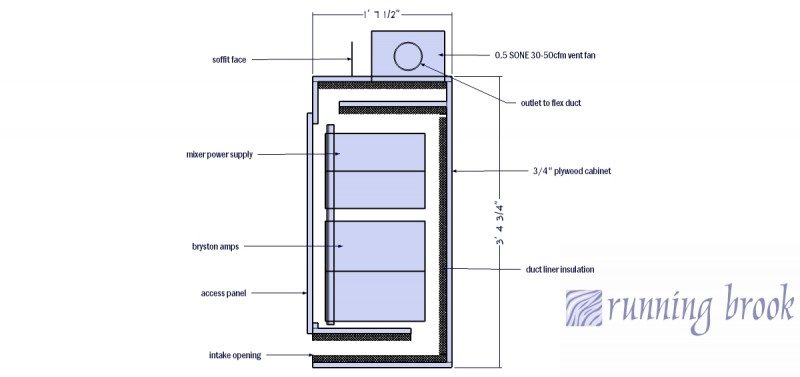
on the PC (as well as power amps, x-overs, power supplies, etc) heat rising in front of the speakers - not so good. if you can put them into a vented cabinet it helps - reduce or eliminate any fan noise, directs the heat via venting/duct to be above the speakers (and into the room air supply or return) etc. if you don't need frequent access to the device, the cabinet can simply be a screwed on panel in lieu of a hinged door.