How to deal with nulls in a small room

Started by saint gillis on 1 December 2012. 16 replies, 2012–2014.

Originally posted at johnlsayers.com, topic 18002.

Hi everybody! I'm curently working on a small room monitoring studio, unfortunately it is almost square : 3m32 on 3m91 on 2m37 (floor to ceiling) So I ve got 52Hz resonating on width, 44Hz on width and 72Hz between floor & ceiling ! When I put my monitors on the lenght I ve got a big null around 52Hz, when I put my monitors on width it is more decent because Im not in the middle of the room but 44Hz and 89Hz are resonating very loud. Always some problems around 140Hz (72Hzx2 floor to ceiling). And always some frequencies lacking between let's say 100 and 130Hz. I ve put some bass traps like theese
External image, not preserved — original: http://img33.imageshack.us/img33/568/basstrap.jpg
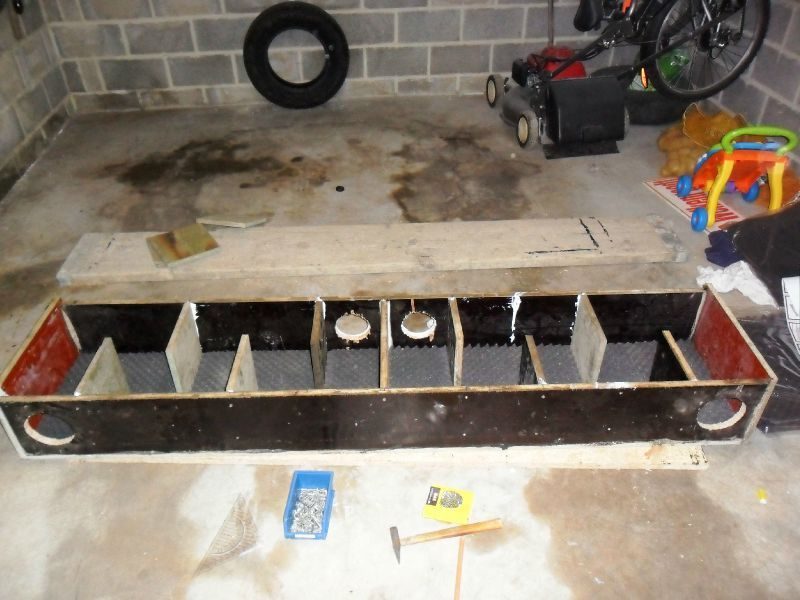
in every corner between walls and between walls & ceiling, I also plan to put a wooden floor! Now I ve experimented diy tuned bass traps (Ethan Winer style) and Helmholtz resonator tuned too 89Hz, very impressive when you put your hand on the vibrating pannel you hear the sinewave (at 89Hz) getting very loud when you take off your hand you can hear the 89Hz getting some 4Dbs lower just with a single 60cm/120cm pannel, the helmholtz resonator seems to also work pretty good, maybe less broadband and a bit less efficient (the good thing is that I can use fir which really sounds good and make a reflecting surface for high frequencies...) It seems that thoose resonators help for peaks but do not help for nulls, is it right? So my question : Should I put some tuned basstraps on length for 50Hz, on width for 89Hz & on ceiling for 140Hz? And also the main question : Do tuned basstraps help for nulls???? Ps: another question I swear it is the last : How to make a vibrating panel or a Helmholtz resonator as broadband as possible?
Here are some pics :
External image, not preserved — original: http://imageshack.us/a/img856/4625/mura2n.jpg
External image, not preserved — original: http://imageshack.us/a/img827/8101/murbc.jpg
External image, not preserved — original: http://imageshack.us/a/img152/7079/murd.jpg
I ve added bass-traps as described above at every corner included ceiling.. It's seems to have reduced the delay upper 600ms for all the problematic freqeuencies A wooden floor will be added tomorrow, then I'll make some additional mesures and I think will add Ethan Winer's style resonators or Helmholtz... Not easy to know what to do to reduce nulls... Here's also the plan:
External image, not preserved — original: http://img855.imageshack.us/img855/6567/planhc.jpg
Hi there, "saint gillis". Please read the forum rules for posting (click here). You seem to be missing a couple of things! :)
unfortunately it is almost square : 3m32 on 3m91 on 2m37
It's not too bad, actually. The ratio is 1 : 1.4 : 1.64, and it passes all three of the BBC critical tests. It isn't ideal, but should be usable.
So I ve got 52Hz resonating on width, 44Hz on width and 72Hz between floor & ceiling !
Did you confirm that with REW, or are you just going on mode calculations? If you measured it with REW, please post your data file here, so we can analyze it.
When I put my monitors on the lenght I ve got a big null around 52Hz, when I put my monitors on width it is more decent because Im not in the middle of the room but 44Hz and 89Hz are resonating very loud.
I'm not sure I understand: If you have your speakers firing down the long axis of the room (3.91m), then your speakers would be up against the front wall and your listening position would be at about 1.5m from the front wall. If you set up with your speakers facing across the width of the room (not recommended), then they will still be up against the front wall and your head will be at roughly 1.3 m from the front wall. In both cases, your head is not in the middle of the room. If it is, then you set things up incorrectly. Also, it does not matter which way your monitors face: they can still excite all of the room modes. So regardless of which way they face, you will still have a mode at 44, another one at 52, and a third one at 72. Modal response has nothing at all to do with the direction the speakers face.
Always some problems around 140Hz (72Hzx2 floor to ceiling). And always some frequencies lacking between let's say 100 and 130Hz.
In reality, you have a lot more modes than that! You have a total of 119 modes under 250 Hz. Your first 20 are as follows: 44.0 Hz. 1,0,0 Axial 51.9 Hz. 0,1,0 Axial 68.0 Hz. 1,1,0 Tangential 72.7 Hz. 0,0,1 Axial 85.0 Hz. 1,0,1 Tangential 88.1 Hz. 2,0,0 Axial 89.3 Hz. 0,1,1 Tangential 99.6 Hz. 1,1,1 Oblique 102.2 Hz. 2,1,0 Tangential 103.7 Hz. 0,2,0 Axial 112.7 Hz. 1,2,0 Tangential 114.2 Hz. 2,0,1 Tangential 125.4 Hz. 2,1,1 Oblique 126.7 Hz. 0,2,1 Tangential 132.1 Hz. 3,0,0 Axial 134.1 Hz. 1,2,1 Oblique 136.1 Hz. 2,2,0 Tangential 141.9 Hz. 3,1,0 Tangential 145.3 Hz. 0,0,2 Axial 150.8 Hz. 3,0,1 Tangential
I ve put some bass traps like theese in every corner between walls and between walls & ceiling,
You need very large "Superchunk" style bass traps, made with mineral wool or fiberglass. If you use mineral wool, the density should be 50 kg/m3 or a bit lower, and if you use fiberglass then the density should be 30 kg/m3 or a bit lower.
Now I ve experimented diy tuned bass traps (Ethan Winer style) and Helmholtz resonator tuned too 89Hz,
I would certainly not try to treat that room with Helmholtz resonators, or with any type of tuned trap, except as a last resort. You would need so many of them, and they would have to be so big, that you would have no place to put them. Much better to just start out with proper superchunks in as many corners as possible, and see how that works. Aapart from anything else, resonant traps are notriously hard to tune, and even harder to posit correctly in the room: for maximum effect, they have to be located at either the pressure peak or velocity peak for that specific mode, depending on the type of trap. Not easy to figure that out.
Should I put some tuned basstraps on length for 50Hz, on width for 89Hz & on ceiling for 140Hz?
I would not do that, no, There are so many modes that you cannot build tuned traps for all of them. Treating with absorption is a much better option.
Do tuned basstraps help for nulls????
Yes, if you position them correctly. A null is just ONE part of the wave, not the entire wave. So if you position the tuned device at the peak for that mode, then it will help to smooth out the associated null too. Of course, if you position it in the null, then nothing will happen...
How to make a vibrating panel or a Helmholtz resonator as broadband as possible?
One word: Damping. The more you damp the device, the broader the Q becomes... but that also reduces the efficiency and effectiveness. If you make it narrow band, it will be very effective at that specific frequency, but if you make it broadband it will be much less effective on several frequencies.
A wooden floor will be added tomorrow,
Not a floated floor, I hope! Just a solid wood or laminate floor, laid on the subfloor, right? - Stuart -
Hi Soundman 2020, got the forum rules now, sorry.. Thank you for answering!
Quote: So I ve got 52Hz resonating on width, 44Hz on width and 72Hz between floor & ceiling ! Did you confirm that with REW, or are you just going on mode calculations? If you measured it with REW, please post your data file here, so we can analyze it.
Actualy REW confirmed the calculations, when playing a sine wave at those frequencies I could listen to big peaks and nulls moving from one wall to another or up and down from floor to ceiling, here is the datafile : http://gypsyfarm.free.fr/saint_gillis.mdat there is the speaker response mesured in a big open room (Genelec 1031) + the room with the mic at the sweet point, monitors along length (about 1m17 between them and 25cm from the back-wall) Not all the bass-traps where installed, I ll send asap a new mesurement with more bass-traps
I'm not sure I understand: If you have your speakers firing down the long axis of the room (3.91m), then your speakers would be up against the front wall and your listening position would be at about 1.5m from the front wall. If you set up with your speakers facing across the width of the room (not recommended), then they will still be up against the front wall and your head will be at roughly 1.3 m from the front wall. In both cases, your head is not in the middle of the room. If it is, then you set things up incorrectly.
In both case I found that keeping a distance of about 25cm from the back-wall for the speakers position was better, am I wrong? If I put the speakers along width (3m29) why is it not recommended? Actually I have a better architectural symetry at the right and left placing the speakers this way (but the door on my back, which is not so good thus)
Also, it does not matter which way your monitors face: they can still excite all of the room modes. So regardless of which way they face, you will still have a mode at 44, another one at 52, and a third one at 72. Modal response has nothing at all to do with the direction the speakers face.
I swear that placing the speakers along width the 52Hz resonance moving from one wall to another is less remarkable than when the speakers are along length...
Quote: A wooden floor will be added tomorrow, Not a floated floor, I hope! Just a solid wood or laminate floor, laid on the subfloor, right?
Right, a laminate floor glued to the sub-floor! For the tuned panels (helmholtz + E.Winner style) I made experiments that were well in tune, although it is to hudge dimensions for 52Hz & 44Hz, maybe it is still possible for 89Hz 100Hz and 140Hz.. And I still need to put some reflective (wood) and absorbing areas over this uggly-sounding OSB coated by carpet, right? But before I need to decide where to place my monitors... I m a bit confused for that
monitors along length (about 1m17 between them and 25cm from the back-wall) ... I found that keeping a distance of about 25cm from the back-wall for the speakers position was better.
If you have the speakers on the BACK wall (ie, behind your chair as you face the console), then you have the room set up back to front, literally! The speakers should be in the FRONT wall, the one in front of you, the one you are facing as you sit at the console.
here is the datafile :
There seems to be a problem with the way you did the setup. The file shows that your speakers were producing 58 dB SPL for the tests, which is way too low, and actually impossible, considering the resulting graphs. You should do the test with an SPL level of at least 85 dBC, and higher would be better. I'm assuming that it was just a lack of correct calibration, not that you actually did the test at 58 dB, but it does make it impossible to accurately read the graphs. Also, there's only one data set in that file, and it does not say if it is for the left speaker, or the right speaker.
...am I wrong?
That's probably the location where SBIR artifacts were least objectionable, which may or may not be the correct location for the speakers. Do you have a photo of how you had the speakers and mic set up when you did that test?
If I put the speakers along width (3m29) why is it not recommended?
You DO want them along the width, firing down the length, if possible. In other words, the front wall of the room should be a short wall, and the side walls (to your left and right, as you sit at the console facing the speakers, which are at front wall) should be the long walls. The reason for this is to try to get the rear wall as far behind your head as possible, such that the reflections coming off it fall outside of the Haas time, or at least they are delayed as long as possible before reaching your ears.
...placing the speakers this way (but the door on my back, which is not so good thus)
Why do you not want the door behind you? It doesn't make much difference, acoustically, unless the door would end up in a location where it would cause reflection problems, or get in the way of a place where you need some type of treatment.
I swear that placing the speakers along width the 52Hz resonance moving from one wall to another is less remarkable than when the speakers are along length...
It might be reduced in intensity, but it is still there. Modes are a consequence of the dimensions of the room, nothing else, and they will always be there. If you trigger a mode, then it is triggered, regardless of level, and you are triggering a lot of them. In fact enough, REW clearly identifies practically all of the modes predicted in the table I gave you in my last post, some of them spot on, some really close. It is as though there is no bass trapping at all present in that room.
Right, a laminate floor glued to the sub-floor!
Good, but laminate should not be glued to the sub-floor! It should be laid on the type of underlay recommended by the manufacturer.
For the tuned panels (helmholtz + E.Winner style) I made experiments that were well in tune, although it is to hudge dimensions for 52Hz & 44Hz, maybe it is still possible for 89Hz 100Hz and 140Hz..
The one for 44 Hz. seems to be working, but the one at 52 is not very effective. It is shown as peaking at 51 dB, and decaying over a whopping 710 ms. But your biggest issues right now are at 89 Hz (68 dB, 860 ms), 99 Hz (59 dB, 759ms), 138 Hz (68 dB, 380 ms). All of those are either tangential or oblique, so it will be hard to find usable locations for placing your Helmholtz resonators to deal with them! Personally, I would put large superchunks in each of the 4 vertical corners (unless you plan to soffit mount your speakers). And since all of those modes seem to be related to the room width, I would also put large superchunks on the wall-ceiling corners on the left and right walls.
And I still need to put some reflective (wood) and absorbing areas over this uggly-sounding OSB coated by carpet, right?
Absolutely! (We are talking about the walls, right?) In fact, I would take off the carpet and put a layer of 5/8" drywall over the OSB, with Green Glue in between. You didn't mention isolation, so I'm assuming you are OK on that front, but it wouldn't hurt to add some substantial mass to those walls: you never know what effect they might be having on the room acoustics. Anyway, that carpet is most likely partly responsible for the dip around 5kHz to 12 kHz that is evident in the REW data.
But before I need to decide where to place my monitors... I m a bit confused for that
The general "standard" setup (if there is such a thing!) would be to put your speakers on the short wall opposite the door (labeled "Mur b" in your diagram), about 90 cm from the side walls and therefore about 1.5 m apart, and as close as you can get them to the front wall, allowing for a thick layer of insulation there. Your head would then be about 1.7 m from the front wall (the location of your ears, not your nose!), and 1.2 m above the floor. Your speakers would also be 1.2 m above the floor (the acoustic axis of the speakers, not the top or bottom of the cabinet!), and angled inwards at 30° to point at your ears. That would give you the theoretical correct location, but you might still want to tweak it a bit. I would try that out, with the superchunks in place, as well as thick absorption on all of your first reflection points and across the entire back wall, measure the result again with REW, and then see what still needs to be done to improve things further. - Stuart -
If you have the speakers on the BACK wall (ie, behind your chair as you face the console), then you have the room set up back to front, literally!
Sorry I m a kind of newbie, now I ve got in mind what is the front-wall and what is the back-wall, seems stupid however thank you for that.
You DO want them along the width. The reason for this is to try to get the rear wall as far behind your head as possible, such that the reflections coming off it fall outside of the Haas time, or at least they are delayed as long as possible before reaching your ears.
Great, got it too!
Why do you not want the door behind you?
Just a question of feeling good psychologically, nothing to do with sound, but in fact it is not really a problem.
But your biggest issues right now are at 89 Hz (68 dB, 860 ms), 99 Hz (59 dB, 759ms), 138 Hz (68 dB, 380 ms). All of those are either tangential or oblique, so it will be hard to find usable locations for placing your Helmholtz resonators to deal with them!
I thought 89Hz was the distance between the short walls (2x44Hz), 99Hz was related to the distance between the long walls (2x52Hz=104Hz, close to 99Hz) and 138Hz was related to the ceiling & floor 72Hzx2= 144Hz close to 138Hz)
Personally, I would put large superchunks in each of the 4 vertical corners (unless you plan to soffit mount your speakers). And since all of those modes seem to be related to the room width, I would also put large superchunks on the wall-ceiling corners on the left and right walls
I ve put bass traps at almost every corner included between ceiling and walls as you can see on this pic :
External image, not preserved — original: http://imageshack.us/a/img217/8860/basstraps.jpg
The general "standard" setup (if there is such a thing!) would be to put your speakers on the short wall opposite the door (labeled "Mur b" in your diagram), about 90 cm from the side walls and therefore about 1.5 m apart, and as close as you can get them to the front wall, allowing for a thick layer of insulation there. Your head would then be about 1.7 m from the front wall (the location of your ears, not your nose!), and 1.2 m above the floor. Your speakers would also be 1.2 m above the floor (the acoustic axis of the speakers, not the top or bottom of the cabinet!), and angled inwards at 30° to point at your ears. That would give you the theoretical correct location, but you might still want to tweak it a bit. I would try that out, with the superchunks in place, as well as thick absorption on all of your first reflection points and across the entire back wall, measure the result again with REW, and then see what still needs to be done to improve things further.
I ve made several mesurements with REW, speakers at 1m20 from the floor, here's the datafile : http://gypsyfarm.free.fr/saint_gillis_6_dec.mdat The mesure called "B1" is taken with the speakers close to the small wall ("mur b") but I couldn't place them at 90cm from the sides because there is a 30cm sound-trap at the left side of the front-wall as you can see :
External image, not preserved — original: http://imageshack.us/a/img20/1013/piegeson.jpg
However the mic is at 1m70 from the front wall, I ve put some absorbtion behind the speakers and at the first reflection points as you can see :
External image, not preserved — original: http://imageshack.us/a/img442/2622/20670628.jpg
The mesure "B2" is the same with additional absorbing plates at the back-wall :
External image, not preserved — original: http://imageshack.us/a/img13/2331/85612741.jpg
"B3" : The speakers are ~30cm from the front-wall (the left speaker is close to the sound trap), absorbing plates behind the speakers, at the first reflection points and at the backwall. Speakers at 90cm from the sides, mic at 1m70 from the front-wall. "B4" : Same as "B3" but no absorbtion at the back-wall. "A1" : Speakers along the long wall ( 3m92), mic at 1m50 from the front-wall, no absorbing plates at all Here is the pic :
External image, not preserved — original: http://imageshack.us/a/img9/6674/85862460.jpg
"A2" : Same as "A1" + absorbing plates behind the speakers & at the first reflections points :
External image, not preserved — original: http://imageshack.us/a/img502/4231/38581442.jpg
"A3" : Same as "A2" + absorbtion at the back-wall:
External image, not preserved — original: http://imageshack.us/a/img443/6881/27293959.jpg
"B3" don't look so bad, we thought of placing a big tuned bass trap at the front wall to got a uniform surface with the 30cm sound-trap at the left... Maybe we need also some reflective wood to help for the higher frequencies too? Thank you for helping us Stuart!
I thought 89Hz was the distance between the short walls (2x44Hz), 99Hz was related to the distance between the long walls (2x52Hz=104Hz, close to 99Hz) and 138Hz was related to the ceiling & floor 72Hzx2= 144Hz close to 138Hz)
Not really, no If you look at the table I gave you before of the first 20 modes for your room, you'll see that there is an axial mode at 88 Hz related to the length of the room, but you seem to showing activity at 89 HZ, which corresponds to a tangential mode that involves only the side walls, floor and ceiling, and has nothing to do with the length. 99 Hz is spot on for the first oblique mode that involves all six sides. 104 Hz is NOT close to 99 Hz, acoustically: there is a difference of 5%, which is actually an entire note. 98 Hz is G, while 104 Hz is G#: That's a big difference. 104 Hz actually is the second harmonic mode (axial) related to you room width. Also, 144 Hz is NOT close to 138 Hz. 138 is a C#, while 144 is D: This high up the spectrum, it is hard to say what we are seeing, but 138 Hz is closer to your 2,2,0 tangential mode at 136 Hz., than it is to the second harmonic of your height mode, at 145 Hz. Etc. It is a big mistake to ignore the tangential and oblique modes. Some room mode calculators do not even take those into account, but you should never use a calculator that does not do that: They are very important, and must be considered. If you are using a calculator that only shows axial modes, then that is no use. Stop using that one, and start using a good one that considers all room modes, not just the axials.
I ve put bass traps at almost every corner included between ceiling and walls as you can see on this pic :
How did you build those? What are they made of, and how big are they? They don't seem to be very big, for a small room like yours.
I ve made several mesurements with REW, speakers at 1m20 from the floor,
OK, but there is a basic error with the way you have the speakers set up: they are lying on their sides, but they should be standing up vertically, with the tweeter above the woofer. If you have them on their sides, then your sweet spot is very, very narrow, and as you move your head from side to side you hear different combinations of woofer and tweeter, which is not good. Set up the speakers correctly, and repeat those measurements. In addition, the speakers seem to be sitting on top of cardboard boxes, which is also a bad idea. The boxes themselves and the air cavity inside them will be vibrating and resonating. You must use very sold, rigid, heavy, massive stands for your speakers. Some people use concrete block or bricks for the type of testing you are doing. You also did not say which speaker you were using for the tests (left or right). That is important, since there might be difference between the room response of left and right speakers, that would reveal other issues about the room.
The mesure called "B1" is taken with the speakers close to the small wall ("mur b") but I couldn't place them at 90cm from the sides because there is a 30cm sound-trap at the left side of the front-wall as you can see :
What do you mean by "30 cm sound trap"? What is that, how is it built, and why is it on that location? It is making the front of your room non-symmetrical, and should not be there. Remove it, and repeat the tests with the speakers close to the front wall, with a 15 cm gap, just big enough to fit the absorption panel in between the wall and the speaker. Room symmetry is critically important. The front haf of the room must be as symmetrical as possible in all aspects. You cannot have something on one side of the room that is not duplicate on the other side, since that will greatly change the response on the left and right. The two speakers will sound different, you will subconsciously adjust for that in your mixes, and your mixes will therefore not translate well: they will not sound right when you listen to them in other places.
absorbing plates behind the speakers, at the first reflection points and at the backwall. Speakers at 90cm from the sides, mic at 1m70 from the front-wall.
The absorption on the back wall is good, but not enough. It must be much thicker than that. I would make it at least 15 cm thick, and space it 15cm away from the wall as well. It should cover the entire wall, floor to ceiling and as wide as the space between the rear bass traps.
"B3" don't look so bad, we thought of placing a big tuned bass trap at the front wall to got a uniform surface with the 30cm sound-trap at the left...
B3 is definitely the best, with the smoothest response,but I would not put a bass trap on the front wall: it would only affect modes that involve the length axis, which is important, but you do not want to upset the frequency response and SBIR issues of the speakers at the front wall. Much better to put your axial treatment on the rear wall. Your biggest single problem right now is the huge dip at around 112 Hz, which is either the 1,2,0 tangential mode or the 2,0,1 tangential mode, or maybe both. And both of those are related to the length of the room. If you take a close look a the difference between B3 and B4, you'll see that with the absorption on the rear wall is working to smooth that out, even though it is very thin and does not cover the entire wall. Your big peak at 44 Hz is also related to that, so I would concentrate on the rear wall treatment, and front wall symmetry. The dip at 112 Hz is also related to the height of the room, so you do need a ceiling cloud. I would make it thick, angled, and hard-backed.
Maybe we need also some reflective wood to help for the higher frequencies too?
Yes, but I would put that on the side walls, and I would do slot walls there. From the panels at your first reflection points all the way back to the bass traps in the rear corners would be a good place for slot walls: I would also put 6 mil plastic on some of your corner bass traps, to reflect back the highs that you are losing in the 5Khz to 10 kHz range. - Stuart -
Hello Stuart, sorry for my late post I was on the road for some gigs I ve just came back home... thank you for helping!
104 Hz is NOT close to 99 Hz, acoustically: there is a difference of 5%, which is actually an entire note. 98 Hz is G, while 104 Hz is G#: That's a big difference.
Ok, I do understand my mistake.
How did you build those (bass-traps) ? What are they made of, and how big are they? They don't seem to be very big, for a small room like yours.
They are ~25cmx25cmx35cm triangle bass-traps made of RockSol mineral whool (~150kg/m3) 4cm leaves there are some few air-gaps between thems as shown in the drawing in my first post, I now know that they should be completly stuffed with mineral whool.
OK, but there is a basic error with the way you have the speakers set up: they are lying on their sides, but they should be standing up vertically, with the tweeter above the woofer.
Ok I ll take some other mesures this way? I plan to also use some additional NS-10 monitor, I thought horizontaly I could put them inclined over the Genelecs...
Some people use concrete block or bricks for the type of testing you are doing.
Ok.
You also did not say which speaker you were using for the tests (left or right). That is important, since there might be difference between the room response of left and right speakers, that would reveal other issues about the room.
Actually I've made the mesures with both monitors playing sound, I ll now take the left measure then the right one.
What do you mean by "30 cm sound trap?
A sound trap is a kind of element that lets the air pass into the room and blocks the sound for soundproofing (their positions are shown in the map), something of that kind :
Recovered from web.archive.org — originally hosted at http://p9.storage.canalblog.com/98/16/953989/73066775.jpg
I can't remove it... what I can do is placing some resonators on the front wall in the gap to get a uniform surface with the sound-trap. then I ll put overthem the absorbtion panels behind the speakers.
The absorption on the back wall is good, but not enough. It must be much thicker than that. I would make it at least 15 cm thick, and space it 15cm away from the wall as well. It should cover the entire wall, floor to ceiling and as wide as the space between the rear bass traps.
Ok.
B3 is definitely the best, with the smoothest response,but I would not put a bass trap on the front wall: it would only affect modes that involve the length axis, which is important, but you do not want to upset the frequency response and SBIR issues of the speakers at the front wall. Much better to put your axial treatment on the rear wall.
You advise me to take off the bass traps between the ceiling and the front-wall? What about the bass-traps between the front-wall and the side-walls?
The dip at 112 Hz is also related to the height of the room, so you do need a ceiling cloud. I would make it thick, angled, and hard-backed.
I'm sorry for my bad english, I don't really understand what you mean here... is it made of absorbing leaves?
Yes, but I would put that on the side walls, and I would do slot walls there. From the panels at your first reflection points all the way back to the bass traps in the rear corners would be a good place for slot walls: I would also put 6 mil plastic on some of your corner bass traps, to reflect back the highs that you are losing in the 5Khz to 10 kHz range.
Fine! what about Helmholtz resonators with holes? Actually I ve got some wooden panels, I could use them for that...
They are ~25cmx25cmx35cm triangle bass-traps made of RockSol mineral whool (~150kg/m3) 4cm leaves there are some few air-gaps between thems as shown in the drawing in my first post, I now know that they should be completly stuffed with mineral whool.
And they also need to be much bigger. You say that yours measure 25cm on the sides: the normal recommendation is 90 cm, but if you don't have enough space for that, then at least 60 cm.
Actually I've made the mesures with both monitors playing sound, I ll now take the left measure then the right one.
Ahhh! OK, that could be part of the problem. with both speakers playing, you could find that one of them is masking a problem on the other side. So test with just one speaker at a time, and post both sets of readings.
A sound trap is a kind of element that lets the air pass into the room and blocks the sound for soundproofing (their positions are shown in the map), something of that kind :
Ahhh! ok, that is usually called a "silencer box" or a "baffle box". I thought you were talking about some type of acoustic treatment, not part of your HVAC system. Can you move that silencer somewhere else, where it would be symmetrical? Or at least another "fake" one on the other side of the room, to balance out the lack of symmetry.
I can't remove it... what I can do is placing some resonators on the front wall in the gap to get a uniform surface with the sound-trap. then I ll put over them the absorbtion panels behind the speakers.
I would not do that, no. I would not use any type of resonator on the front wall, since it is so close to your head, and potentially could make the whole SBIR problem even worse by interacting with the speakers at frequencies that are not even related to the gap.
You advise me to take off the bass traps between the ceiling and the front-wall? What about the bass-traps between the front-wall and the side-walls?
No, those are fine as they actually do involve other walls. In fact, those are too small! They need to be much bigger, as I mentioned above. Your room is small, so it needs a LOT of bass trapping. When you said you wanted to put bass trapping on the front wall, I assumed that you meant on the wall itlsef, not in the corners, which are different, acoustically.
I'm sorry for my bad english, I don't really understand what you mean here... is it made of absorbing leaves?
No problem! A "ceiling cloud" is just a wooden frame with insulation in it, that is hung from the ceiling using chains or wire, above the desk and mix position. Sometimes the cloud needs to be hung "flat", meaning parallel to the ceiling, but more common is like your case, where it should be hung at an angle. It should be a bit lower down at the front of the room (over the speakers) and a bit higher up at the back end (above your head). And "hard backed" means that instead of just being a frame with insulation in it, rather it also has a solid wood panel on the top side, above the insulation. The purpose of the hard backing and the angle is to help break up the vertical room modes a bit. Vertical room modes are all of the modes that involve the ceiling or floor in some way.
Fine! what about Helmholtz resonators with holes? Actually I ve got some wooden panels, I could use them for that...
You seem to have a fixation on Helmholtz resonators! :) :shock: :!: To be honest, Helmholtz resonators are over-rated and are most likely NOT needed in the majority of home studios. Helmholtz resonators are also very herd to tune correctly, and even then must be placed at the correct location in the room where the pressure component of the standing wave is at maximum. If you put it some place where the pressure component is not changing much, then it will not do anything at all! Also, you must make sure that you are using the correct version of the equation! Many text books and lots of internet web sites use the wrong version, which seems to have been due to a printing error in one book many years ago, and others just copied that one, without checking. Helmholtz resonators sound very "cool" and fancy, but the are seldom actually needed. I would only use them if you have already tried the normal approach of broadband absorption, followed by also trying with a panel trap (membrane trap), and even by angling the wall at that point, or with a poly cylindrical diffuser, and despite doing all that, you just cannot get rid of one specific mode. That's the only time I would try Helmholtz, and even then I would take great care to tune the trap empirically, not just rely on the equations. What is really needed in most home studios is not dozen different Helmholtz resonators, each tuned to one mode, but rather a large amount of broadband absorption, most of it very thick and set up as bass traps. That's what works in the majority of cases. - Stuart -
And they also need to be much bigger. You say that yours measure 25cm on the sides: the normal recommendation is 90 cm, but if you don't have enough space for that, then at least 60 cm.
Ouch! The less the room is big the more we need absorbtion, life doesn't always go the best way. Do you think I could put some classic 5cm rockwool of that kind overs my existing bass-traps? (question of time+money)
Ahhh! ok, that is usually called a "silencer box" or a "baffle box". I thought you were talking about some type of acoustic treatment, not part of your HVAC system. Can you move that silencer somewhere else, where it would be symmetrical? Or at least another "fake" one on the other side of the room, to balance out the lack of symmetry.
So I ll build a fake one at the right, could I make a cupboard to store mics (with a sliding door due to the speakers position) or should it be sealed and air proof just as the silencer box?
No problem! A "ceiling cloud" is just a wooden frame with insulation in it, that is hung from the ceiling using chains or wire, above the desk and mix position. Sometimes the cloud needs to be hung "flat", meaning parallel to the ceiling, but more common is like your case, where it should be hung at an angle. It should be a bit lower down at the front of the room (over the speakers) and a bit higher up at the back end (above your head). And "hard backed" means that instead of just being a frame with insulation in it, rather it also has a solid wood panel on the top side, above the insulation. The purpose of the hard backing and the angle is to help break up the vertical room modes a bit. Vertical room modes are all of the modes that involve the ceiling or floor in some way.
Great thank you, "a wood panel at the top side" you mean the wood facing the ceiling or facing the floor? the panel at 10 or 15cm from the ceiling, 10cm of rockwool someting like that? this above my head, what about the rest of the ceiling, absorbing? reflecting?
You seem to have a fixation on Helmholtz resonators!
Hahaha, alright you got me I trully find them beautiful! But someone gave me an excell file to calculate them, I ve made a try for a 89Hz resonator and it was very well in tune. My idea was only to make at the same time absorbing + reflecting (wooden surface) for the areas where I should reflect.
The absorption on the back wall is good, but not enough. It must be much thicker than that. I would make it at least 15 cm thick, and space it 15cm away from the wall as well. It should cover the entire wall, floor to ceiling and as wide as the space between the rear bass traps.
So we have here "live end/dead end" with the dead-end on the back wall right? On the front wal I ll put absorbtion behind the speakers, what about the center of the front-wall, should it be "live-end"? should I put a skyline diffuser or something like that?
Hi Stuart! (hi also for everybody who might read this) I come with some additional informations and tests we've made today. Here is the file : http://gypsyfarm.free.fr/saint_gillis_11dec.mdat First of all I ve added 10cm of absorbing wool on the door ( I couldn't put 15cm spaced by 15 other cms on the door...) :
External image, not preserved — original: http://imageshack.us/a/img812/6027/doorre.jpg
I first made a mesure with concret blocks instead of cardboard and positioning the speakers vertically, 90cm from the sidewalls and 42cm from the front-wall (because I have the 27cm silencer box + the place where I will put 15cm of absorbing wool, I didn't put it for now) the mic is as you advised 170cm from the front wall. I made a mesure for the left speaker, it is called "LEFT" in the REW file, then one for the right called "RIGHT", like that:
External image, not preserved — original: http://imageshack.us/a/img823/7458/32745057.jpg
Then I added 2 panels of 15cm rockwool spaced from the wall by 15cms on the backwall, I ll add a 3rd one later :
External image, not preserved — original: http://imageshack.us/a/img820/8906/bckwallabsorbing.jpg
I ve mesured left, called "LEFT bckwall absorb", right called "RIGHT bckwall absorb", and both speakers called "STEREO bw absorb". Then I ve spaced the speakers 104cm from the sidewalls instead of 90cm to get a more accurate sweet-point (not too much space between the speakers for the stereo :( ), like that :
External image, not preserved — original: http://imageshack.us/a/img820/4552/104cm.jpg
I called the mesure "STEREO 104 CM", and with the 2 absorbing panels at the backwall I called it "STEREO 104 CM bw absorb" I also tried to face an angle like that :
External image, not preserved — original: http://imageshack.us/a/img713/6842/losange.jpg
With 2 big packs of absorbing wool, it is called "LOS ABS X2", I removed the upper pack of absorbing wool it is called "LOS ABS X1", then I removed completly the wool and called it "LOS ABS X0" . When listening to music in that position the sound was really much more nice but the left and the right are unfortunately too different as you can see on mesures "LOS ABS X0 L" and "LOS ABS X0 R". Finally I made a mesure with a big pack of rockwool behind each speaker (so of course the speakers were at a longer distance from the front wall, but I kept the mic at 170cms from the frontwall just by curiosity), it is called in the REW file "BIG ROCK WOOL", it was like that :
External image, not preserved — original: http://imageshack.us/a/img43/6739/bigrockwool.jpg
I also tried to find the areas on the walls where the problematic frequencies were at their highest peak, it was mainly on the front wall, you can see on this pic the highest peaks for 115Hz (they re on the front wall) :
External image, not preserved — original: http://imageshack.us/a/img62/8961/115hz.jpg
For 97,5Hz the peaks are on the right front-wall, on the left side-wall near the first reflection point, and at the bottom corner on the back-wall facing the left speacker, only the bottom corner!
External image, not preserved — original: http://imageshack.us/a/img17/7103/975hz.jpg
Here are the zones of hudge peaks for 142Hz, you can add the 2 top-corners of the back-wall!
External image, not preserved — original: http://imageshack.us/a/img201/6726/142hzh.jpg
And finally the peaks for 70Hz (they were less hudge than for other frequencies above, ~ -3/-4db) :
External image, not preserved — original: http://imageshack.us/a/img805/4589/70hz.jpg
I didn't find any great peak in the room for 77Hz, strange isn't it? The peaks on the photos were really hudge, ~ -1,5/-2,5db Shouldn't I focus great absorbtion on the front-wall? What about "live-end/dead-end" ? ...It was really a big mistake to put the silencer box this way, now it is too late I have to do with it... Sorry for so much questions in my 2 last posts...
Hi! Today I ve put in place the fake silencer box at the right to have a correct symetry and I also put in the center of the top front-wall my first extension panel over my existing bass traps to make 60cm instead of 25cm (completly full of rockwool), there was a great peak at 115Hz at this place, it has greatly smoothed this frequency at the sweet point!!! Here is the REW file showing the comparison between befor and after the big bass trap, have a look around 110Hz, wow! http://gypsyfarm.free.fr/LEFT_CHUCK_NORRIS.mdat
I ve now put 3 superchunks on the frontwall and also a fake silencer box at the right :
External image, not preserved — original: http://img543.imageshack.us/img543/1548/pic2402.jpg
Here the REW file http://gypsyfarm.free.fr/saint_gillis_13dec.mdat You have the left, right & stereo before the superchunks, and you have left, right and stereo with the superchunks (I realize that the levels are not the same after and before, I truly feel sorry for that...); it look really better for the left side! I don't understand why the left and right look now so different (more different than before indeed) is it because of the fake silencer-box? I ve made it airproof and with wood screwed in the middle as it can't vibrate... And when mesuring both sides together ("STEREO 3X superchunk") everything seems much much better... :roll:
I ve realized I ve made some wrong mesures (not checking the right soundcard in REW), sorry for that left & right are quite similar, it's ok... I ve put some superchunks and the ceiling cloud, it's far better but I still have a big hole between ~60Hz & 115Hz, I dont really know how to deal with it...
External image, not preserved — original: http://img441.imageshack.us/img441/1038/sweetpoint19dec.jpg
Here's the REW file : http://gypsyfarm.free.fr/saint_gillis_19dec.mdat Here's the room :
External image, not preserved — original: http://img9.imageshack.us/img9/1197/cloudtq.jpg
I know Stuart somewhere in the forum you said that :
Is your room big enough for that? Diffusion can only be used successfully in rooms of a certain size or larger. (Of course, that doesn't stop may ignorant DIY builders from putting in skylines or other QRDs just a walls that are just couple of feet away, and thinking that they did something amazing.... )
hahah sorry for the little black & white diffusors, let's say it is decoration...
Hi guys, I m back here like 1 year later, I didn't published news on the forum but I must say that the month after this debate we've put a hudge inclined pannel of rockwhool (30 cm thick) and big superchunk basstraps at the places where the bass frequencies lost at the sweet spot where loud , and it made the trick now we have a nice uniform sweet point with no resonances longer than 300ms! Also a lots of absorbing pannels on the front wall , and wooden slotwalls about 10° inclined on the sides We are very happy with this room, it is a pleasure to mix in and several projects have been made since We first worked with our Genelecs 1031 but there were maybe too powerfull for the size of the room, so we've put some Dynaudio BM5A, they are very performant for the price and life is good, I ll put some photos So a very special thank you to John Sayers and Stuart aka Soundman2020 ! Thank you guys for helping
We are very happy with this room, it is a pleasure to mix in and several projects have been made since.
:yahoo: Glad it worked out for you! It's always good to hear back from members who competed their rooms well, and found that the advise they got here actually does work!
So a very special thank you to John Sayers and Stuart aka Soundman2020 ! Thank you guys for helping
:thu: Glad to be of help, and thank you for taking the tame to come back again and update your thread with the final results!
I ll put some photos
Yes! Please do! That would be great. - Stuart -