It seems a lot of project studios have a major problem with a null at the mix position in the low bass. It is very apparent with most of the projects I master that are mixed in project studios, because I find they generally have way too much low end. This is also important to me at this time because I am helping someone design a small studio and want to try and avoid this problem. I myself have mixed in a lot of different backroom environments (hundreds of live to air live mixes), with from terrible to really bad accoustics across the frequency band, yet the only thing that I really couldn't coupe with was when there was a strong null in the low end. It really drives me crazy and I never get comfortable with things.
What is the math involved? Is it the distance of the mix position to the back wall that is the main issue or the overall room dimensions or ? Is it a matter or determining the main frequency and building a resonator that centers on and absorbs this frequency?
I have attached some basic math for a critque. Thanks!
Nulls will happen at odd 1/4 wavelengths, not half - 1/4 wave from the wall, then to wall, and back to that 1/4 wave distance, = 1/2 wavelength - this puts the original out of phase by 180 degrees with the reflection, so they cancel (minus the slight attenuation caused by inverse square law) - the same occurs at other odd 1/4 wavelengths, like 3/4, 5/4, 7/4, etc - but to a lesser degree in each successive case (again, due to the reflection's loss of amplitude) -
Other causes - mixing with no sub and 5-6" nearfields - having either your head or speakers located in modal peak locations - one "freebie" I've found useful for avoiding this -
http://www.harman.com/wp/index.jsp?articleId=131
This mode calc puts a peak/null graph onscreen for all three axial modes, so you can see exactly where peaks and nulls occur and avoid them with placement.
For sub placement, the simplest way is to put up a known commercial mix, place the sub in your chair, and crawl around the floor til the bass sounds right - then just swap positions, putting the sub where you thought things sounded "right" -
If you're using near/midfields NOT soffited in a parallel walled room, this might be some help -
http://www.cardas.com/cgi-bin/main_cont ... Room+Setup
There are several more pages, click the link at the bottom labeled "For those who must know more" -
Don't bother trying to get the laser link to work, apparently checkpoint is long gone... Steve
Oops, yes 1/4 wave length from the wall. Thanks for giving my brain a shake Steve! I have corrected my example sheet and attached.
Good idea on the sub on the chair test, I hadn't thought of that.
In the case that changing speaker physical placement is not an option (as is the case with near fields and no sub), what are the most effecient and compact dampening resonator designs for these low frequencies (to absorb instead of reflecting)?
Kinda losing me on this one - you started out asking about nulls, and now we're trapping peaks :roll: I'm also not following why you can't move nearfields just because there's no sub - I've had people on different BBS's move their speakers as little as 3-4 inches, and been called a genius - one guy even made a fancy plaque for the front of the 4" spacers he made for his speakers, that said "Sound by Knightfly" -
To my way of thinking, the first thing to do in ANY room is to make sure your speakers/head are in neither a void or a boosted area for any known modal frequencies - this, because no amount of EQ can fix a modal peak - as soon as you move your head a tiny bit, all the cut you applied is now "gutting" the sound - and boosting EQ more than a little can wreak havoc with phasing in and around the affected frequency - Sooo, before you reach for any knobs you need to first get all the "temporal" problems fixed in the room - this needs to be done by keeping heads, speakers, mics and instruments out of obvious null/peak points. In order to do this, you need to be able to easily calculate where those "no-no" points are, in all three axes.
If the room has bad LWH ratios which cause some of the modal problems to be un-fixable by positioning, and you can't change the dimensions of the room, then it's time for more surgical traps, some of which can be taylored to the specific problem frequencies (for peaks, not nulls - although taming peaks will help even out the nulls) - all rooms, however, can benefit from broadband trapping of corners .
Users of NS-10's claim they watch the cones to tell if they're overdoing the bass, since those speakers are pretty bass-shy - if I were stuck using small speakers, I'd keep a top set of (flat response)cans around(NOT Sony, a lot of them are too hyped in the bottom) to check the rest of the spectrum on from time to time.
Wall construction is another gray area for a room - if you're in a room whose walls are solid concrete, the bass will drive you nuts - if your walls are light paneling with some insulation inside, they can act as panel traps and give you a bass-light condition. Sheet rock walls provide some panel trap effect, usually around 65-90 hZ depending on cavity depth, # of layers and sheet rock thickness.
There are many more factors that can affect bass in a room, and we can eventually cover all of them - but to start, I'd recommend NOT building a bad ratio room, NOT rushing into building til a full understanding of what controls what is achieved, and carefully choosing both speakers and their placement in all three axes - those three things will go a long way toward getting a good sounding room that won't lie to you... Steve
Thanks Steve. Sorry for the confusion, I may be trying to cover too many bases with my questions. I understand what you are saying to some degree.
My focus in this post is on low frequencies (sub 100 Hz). It has been my experience that slight position change to speakers, or one's head, makes little or no noticable difference when talking about low frequencies. I had assumed that a low freq absorber would be able to counteract a low frequency null if tuned to the correct frequency (in the case the rooms size is less than optimum and the monitor position somewhat fixed for practical layout, therefore no real position change options). What am I missing in my thinking?
In the case of the people I am trying to help out (Teen Drop-in Center Studio), the overall space has been determined (the room's envelop is concrete and brick so it will certainly have considerable issue with regard to bass), but the individual rooms are still up for grabs, as I try to work out the best compromizes for a $5000 USD construction budget (including electrical and ventilation). It is interesting that almost all the studio designs are *not* rectangles, but more complex shapes, yet all the basic design tools for calculating room modes are for rectangular rooms. How should one be looking at the room ratios with these more complex shapes?
Howard,
> Is it the distance of the mix position to the back wall <
Yes, that's a huge factor. To my way of thinking, room modes are a subset of the basic peak/null problems caused by simple acoustic interference. As Steve said, speaker placement can influence the response at the mix position. Though in my experience you can take that only so far and get only so much improvement. In the end you'll need a fair amount of bass trapping to be able to mix with confidence, no matter what the room's dimensions and shape are.
> what are the most effecient and compact dampening resonator designs for these low frequencies <
The notion of designing bass traps that target specific frequencies is old school, and not so effective in the small rooms people are using these days. What you really want is broadband absorption that works well to as low a frequency as possible. The most effective design I know of is the traps my company sells. :D But you can get good results with either thick, dense, rigid fiberglass straddling the room corners, or a mix of low-bass and high-bass wood panel membrane traps mounted flat against the walls. John Sayers, who hosts this fine forum, often uses slat resonator style traps.
--Ethan
Hey guys,
Just put this room studio together....
Ok I am having the same exact problem. But im not looking to get too technical with calcs and quantum physics =) I need to get somewhat accurate bass in my Mix Position.
Think its possible to get some assistance from the experts (but in laymans terms) ?
Thanks all in advance,
jim69
Cliff Notes -
-room is about 14x10 and 8-10ft ceilings
-to my left is a closet with no doors, goes about 9-10ft high
has record shelves but empty space above them (sound probably gettin lost)
-my mix position is about 6 feet from the front wall
Jim,
> im not looking to get too technical with calcs and quantum physics =) I need to get somewhat accurate bass in my Mix Position. <
You need bass traps, plain and simple. The more you put in the room, the better the LF response you'll get, and the more even the bass will be around the room.
Was that okay? :D
--Ethan
J, without spending a few weeks playing with CARA, which may or may not be able to model such a room (haven't had the time to dig as deep as that requires) the only non-physical way I know is to AVERAGE your dimensions - if your CR is 11 feet across the front and 14 feet across the back (and symmetrical) you would use 12-1/2 feet for the average dimension. Same with ceilings if they're not parallel.- for a live room with NO symmetry or parallel walls, good luck - best just build it, calculate what you need for balanced RT60, listen and tweak. This is where either a helper or a pair of accurate RF cordless headphones helps with mic/instrument placement.
If you DO have the time, CARA is a TON of deep for a pittance -
http://www.cara.de/ENU/index.html
Hope that helped... Steve
Hello Steve,
For what it's worth: just a general remark.
This corridor acts as a connected room.
If not strongly absorbed, this mostly gives a strange (not so healthy) effect.
I've been playing with Cara too now (on someone elses CPU).
Amazing what they give for the price.
On a scale from 1 to 10 ratio value/price = 20.
However I want to check some things with them. The program can't handle diffraction (as far as I can see). So I don't expect them to handle such a corridor correctly. It will also not see the open end (entrance) of this corridor as an acoustic boundary.
What I miss in Cara is a better explenation how they handle things.
I can't find how they handle temperature. It seems that they take temperature into acount for air absorption, but which formula do they use for velocity?
I plan (hope) to contact them for some additional background.
I still didn't found which sound speed they exactly use.
Their 1/9 octave band scale is strangly build on a log 2 scale with 10 Hz as an arbitrary start. Why they didn't use a more logical log 10 scale in order to match the official 1/3 octaveband scale sounds a bit strange to me.
But anyhow it's indeed incredible what the program does for the price.
Anyhow this are just some thoughts, nothing more.
The guy with the CPU I used doesn't have this teaching CD.
Does this has some texts with more in-depth explenation?
Warm regards
Eric
Not really - CARA is installed on my laptop (not with me at the moment) but if I remember correctly, the tutorial CD has mainly just several "lessons" on how to do things, not much on how they are computed - these "lessons" are narrated by the person running the software, and you see what happens on the screen as they do the various operations. Even so, I consider that extra disk essential to getting a good start using the software. Even buying the complete package (except for the controller) is still amazingly cheap for what's there.
Given proper specs for your particular speakers, it even lets you model your own speakers as part of the simulation - I did wish they had included more ready-made models of speakers, but it's hard to complain for the price.
I've yet to find time to check this out, but it looks like you can model almost any architectural feature with enough time to play with it, including splayed walls, vaulted ceilings, etc -
Sorry I'm not more help, maybe when I get more "play time"... Steve
Yes, that's a huge factor. To my way of thinking, room modes are a subset of the basic peak/null problems caused by simple acoustic interference.
Note: This might be a bit OT, so the mods should feel free to point me in the direction of a new thread, if that's necessary.
FWIW, I recently built Speaker Boundary Interference Response (SBIR - the technical term for the "peak/null problems" mentioned above) into a test version of an LF response spreadsheet I created a while back. Originally, I created it only to predict modal response for small, rectangular rooms. Now that I've included the effects of SBIR on overall response, I thought this a good place to mention that the modal response still dominates the net response. This is as I would expect since I have compared many measured LF responses in small rooms with predicted modal responses and they always tend to agree very well.
So, this concept of modes as a "subset" of SBIR is incorrect. Modal response and SBIR are mutually exclusive. This is neither unexpected, nor new. Besides my own observations over the years, Richard V. Waterhouse concluded much to the same effect in the myriad papers he wrote in the 1950s and '60s on wave interference.
It should be noted that my interjection here stems not only from this thread, but others where I have seen this "subset" concept proposed. I apologize if it seems like grandstanding.
Final note: I apologize for omitting any link to the aforementioned spreadsheet. It is not yet 100% complete (other things I still wish to include) and the most recent version is over 31 MB. I may post it to the Auralex site in the future so stay tuned.
Best regards,
Jeff D. Szymanski
Chief Acoustical Engineer
Auralex Acoustics, Inc.
Jeff, there's absolutely no need for apology here - I've yet to see a post from you on ANY forum that isn't more edifying, more gentlemanly, or less commercial than anyone could expect from someone in your position.
Sometimes I think that if I had just printed out all your posts from the different boards that I could have saved myself several hundred $$$ in acoustics books - oops, too late :?
Thanks... Steve
Steve, thanks for the link......I'll look into it more. Great measurement guess too.
The studio is complete, except for the bath. I have to dig under(plumbing) my slab, which i haven't had the time to do :(http://www.nukmusic.com/doctasoffice.jpg
I still have some gear to buy and connect. But the CR sound pretty darn good when playing back commerical cds. I do have a little dip around 180 r so(i think) at the mix position...... And a slight Bass null, but I can still hear what's going on. On the sofa, the commerical cds sounds like magic, almost perfect. The bass sound like a there is a sub in the room, but not overwhilming. I do mostly R&B and Hip-Hop, so this is a plus. I think the Mackie HR824's have a midrange dip also, but when played together with my Hafler M5's adds back the lower mids, in turn, puts things on the money(for some strang reason :lol: ).
I have 2 16"x4' bass tubes in the front corners, and 2" and 6" foam onthe back wall, 3' x 6' x 6" hanger on the ceiling. A little 2" aurlex on the sides and foam wall. Overall the room sound nice. My ears are great but I may get someone come in to test it out, to see if more tweaking can be done. Maybe I'm just luck to get the CR sounding good on the first go round? I have mixed a fews songs, which turned out nice. Has a listen: MP3 clip
The booth has some of the same treatment and sounds good for close micing, but far micing has that upper mid sound(empty) may be the mic too???. I have to do I haven't tried drums yet.
Thanks
Jeff,
As one how does plenty of grandstanding myself :D your comments are totally in line.
> I recently built Speaker Boundary Interference Response (SBIR - the technical term for the "peak/null problems" mentioned above) into a test version of an LF response spreadsheet <
I think it's important to distinguish SBIR and LBIR, where the "L" stands for Listener. These appear similar to be sure, but are not at all the same thing. Wes Lachot explained the key difference a while back over at RO. If anyone cares I can try to track down that thread.
> the modal response still dominates the net response. <
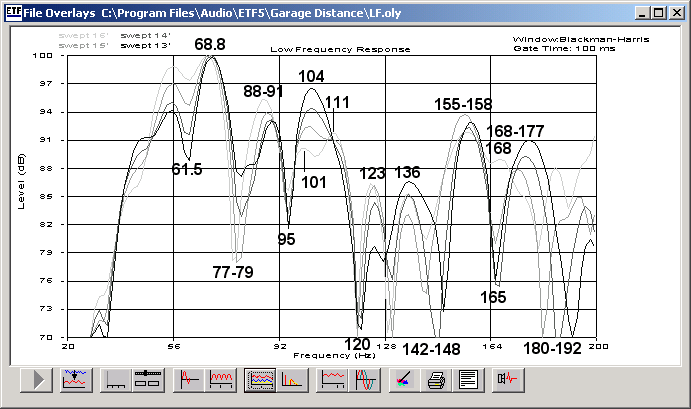
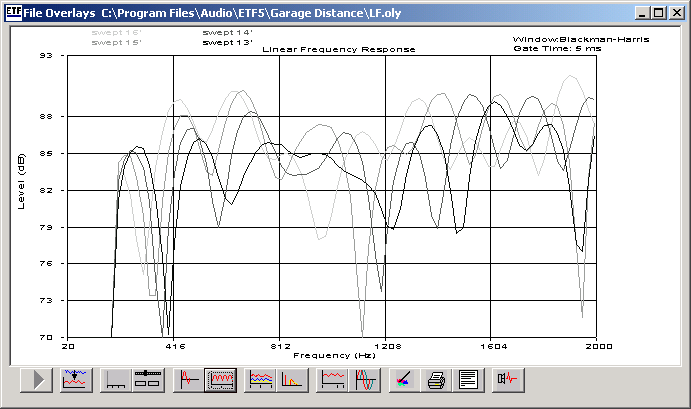
It depends on the frequency. As shown clearly and irrefutably in my "Room Modes Part Deux" threads elsewhere, below about 165 Hz (in my test room) the modal response does indeed dominate. Above that point LBIR dominates. Since others here may not have seen these posts, I reproduce the data again below.
Recovered from web.archive.org — originally hosted at http://www.ethanwiner.com/garage/graph_lf.gifRecovered from web.archive.org — originally hosted at http://www.ethanwiner.com/garage/graph_hf.gifBoth graphs show the change in response as the measuring microphone is moved closer to the rear wall, with the graph lines becoming darker as the mike gets closer to that wall. The first graph shows the response below 200 Hz, and the second graph shows what happens above 200 Hz. Note how the peaks and nulls do not shift with the changing "listener" position at low frequencies, but they do shift at higher frequencies. In this room the shift occurs above about 165 Hz.
The reason I insist that modes are a subset of the more general case of acoustic interference is because acoustic interference came first. It occurs outdoors against a single boundary, so you don't even need a room at all. As you close off one wall, then two, and so forth, until the room is completely enclosed, that's when the interference patterns become stronger due to reinforcement within the enclosed space. But simple boundary interference is the basis of all of this - the parent, if you will - and the additional properties of room modes develop only in an enclosed room.
> Modal response and SBIR are mutually exclusive. <
I'd love to hear that explanation! :twisted:
--Ethan
I think it's important to distinguish SBIR and LBIR, where the "L" stands for Listener. These appear similar to be sure, but are not at all the same thing. Wes Lachot explained the key difference a while back over at RO. If anyone cares I can try to track down that thread.
By definition, SBIRincludes the listener position. You need a source and a receiver to measure (or predict) any room response, be it from modal excitation or from SBI effects.
> the modal response still dominates the net response. <
It depends on the frequency.
It depends on a lot more than the frequency.
> Modal response and SBIR are mutually exclusive. <
I'd love to hear that explanation! :twisted:
It should be fairly obvious if you understand the physics involved.
Best regards,
Jeff D. Szymanski
Chief Acoustical Engineer
Auralex Acoustics, Inc.
Jeff,
> By definition, SBIRincludes the listener position. <
No, SBIR and LBIR are two different and unrelated sets of peaks and nulls. SBIR creates one set of peaks and nulls whose frequencies depend on the distance between the loudspeaker and the room boundaries, and those frequencies remain constant no matter where the listener (or measuring microphone) is in the room. The other set of peaks and nulls change frequency as the listener moves around in the room. So in fact there are two sets of peaks and nulls, though they do interact and combine to yield a single response for any given speaker placement and listener position.
> It should be fairly obvious if you understand the physics involved. <
That contributes nothing to the discussion.
--Ethan
No, SBIR and LBIR are two different and unrelated sets of peaks and nulls. SBIR creates one set of peaks and nulls whose frequencies depend on the distance between the loudspeaker and the room boundaries, and those frequencies remain constant no matter where the listener (or measuring microphone) is in the room. The other set of peaks and nulls change frequency as the listener moves around in the room. So in fact there are two sets of peaks and nulls, though they do interact and combine to yield a single response for any given speaker placement and listener position.
No, SBIR is defined by the position(s) of loudspeaker(s) and listener(s). What you've just described above is not SBIR. I guess I can reassure you and tell you that it is something, just not SBIR.
Regards,
Jeff D. Szymanski
Chief Acoustical Engineer
Auralex Acoustics, Inc.
Speaker-Boundary Interference Response
The next type of acoustic distortion is due to the coherent interference between the direct sound of a loudspeaker and the reflections from the room...It is called the speaker-boundary interference response, or SBIR. The room's boundaries surrounding the loudspeaker mirror the loudspeaker forming virutal images. When these virtual loudspeakers (reflections) combine with the direct sound, they can either enhance or cancel it to varying degrees depending on the amplitude and phase relationship between the reflection and the direct sound at the listening position.
Emphasis added by me.
Best regards,
Jeff D. Szymanski
Chief Acoustical Engineer
Auralex Acoustics, Inc.
SBIR creates one set of peaks and nulls whose frequencies depend on the distance between the loudspeaker and the room boundaries, and those frequencies remain constant no matter where the listener (or measuring microphone) is in the room. The other set of peaks and nulls change frequency as the listener moves around in the room. So in fact there are two sets of peaks and nulls, though they do interact and combine to yield a single response for any given speaker placement and listener position.
No, there is only one special case where the inference response is independent of the listening position. This is the case where one speaker is directly between the listener and a wall - as modeled in my 1-dimesional Wall Bounce Calculator. And considering that it's impossible maintain this ideal alignment with respect to two or more speakers in a room with 6 or more reflective surfaces, this whole idea of positionally independent interference patterns is useless.
My 1-D calculator is really only good for getting a feel for the magnitude of the problem, as well as seeing the bass power response step of freestanding speakers in proximity to a wall.
Thomas
Guys,
We've beaten this to death already, but I don't understand why you can't see that two independent sets of peaks and nulls are involved. Yes, the listener receives only one composite response, of course, and I acknowledged that earlier. So you could rightly say the response always changes based on the listener position. But there are still two sets of peaks and nulls at work - one based on the distance between the speaker and the room boundaries, and another based on the distance between the listener and the room boundaries. No?
Wes Lachot touched on the distinction between SBIR and LBIR briefly at RO a long time ago, fourth post on this page:
www.recording.org/postx17872-0-15.html
In fact, on page 3 of that thread Jeff said this, which I read as acknowledging the additional path:
As with many acronyms, "SBIR" doesn't really do the phenomenon justice. I would lean towards "L²BIR" for Listener/Loudspeaker-boundary Interference Response.
We've beaten this to death already, but I don't understand why you can't see that two independent sets of peaks and nulls are involved. Yes, the listener receives only one composite response, of course, and I acknowledged that earlier. So you could rightly say the response always changes based on the listener position. But there are still two sets of peaks and nulls at work - one based on the distance between the speaker and the room boundaries, and another based on the distance between the listener and the room boundaries. No?
No. I believe Thomas and I have sufficiently covered it for you above.
In fact, on page 3 of that thread Jeff said this, which I read as acknowledging the additional path:
As with many acronyms, "SBIR" doesn't really do the phenomenon justice. I would lean towards "L²BIR" for Listener/Loudspeaker-boundary Interference Response.
Sounds about right. It's quoted here completely out of context. (Valiant effort!) But since the link is also given, I will trust people to judge accordingly...
Semantics aside, neither this discussion nor that one can change how SBIR is technically defined.
Best regards,
Jeff D. Szymanski
Chief Acoustical Engineer
Auralex Acoustics, Inc.
Jeff,
Are you really saying you can't see that there are two paths, each contributing different distances and thus different delays?
> Semantics aside, neither this discussion nor that one can change how SBIR is technically defined. <
Some definitions are open for interpretation, as my recent poll over at alt.sci.physics.acoustics made clear. You insisted that standing waves and modes are the exact same thing, but at least one pro acoustician at that group said my distinction has merit. Dr. Matt Nobile at IBM also agrees with my distinction, as did every other respondant in that poll beside you and Eric. Now, I fully understand that science is not a popularity contest. :D But to not recognize multiple interference paths amazes me. Or maybe you do recognize it, but disagreeing with me is so entertaining you can't resist? Recovered from web.archive.org — originally hosted at http://www.ethanwiner.com/Smileys/Fight.gif--Ethan