This is my first post here, but I have been scouring this forum for about a couple of months now. I am being offered a small space at a great price in a typical shop/warehouse building owned by a professional contractor who will help with construction and can provide much of the framing materials.
While the dimensions I have to work with are far from ideal, roughly 11'x12', I am wondering if it would work to build a small room with faux backwall, made out of 2" thick 6lb mineral wool, within the larger room, hopefully eliminating the acoustic problems that a back wall at my working dimensions present.
Goals: Balanced Frequency response at the mix listening position
Not concerned about: isolation, electrical and a/c details
Budget: not much, $1500, maybe $2000. I will be able to get much of the framing timber at no cost from the contractor, as he comes across leftovers or tear down material quite often. All necessary tools and construction expertise are readily available.
These pictures should help..
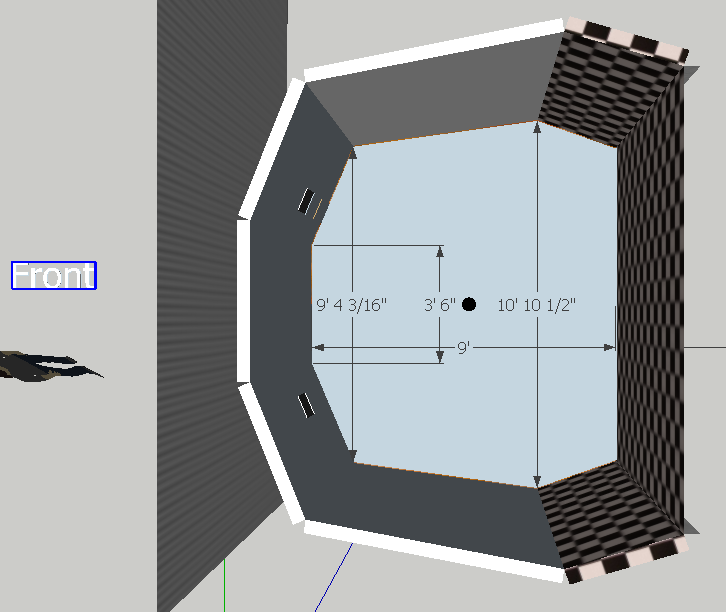
Detailed mix room with dimensions (height starts at 8ft in the front to almost 10ft at the back, angled 12 degrees)
mixroom.pngThe checkered area represents mineral wool used to make the faux wall. I have not added the framing details, but the other walls, inner and outer will be drywall. Black circle in middle is the listening position. Side walls each angled 8 degrees out, celing 12 degree angle upward. Soffit mounted Adam A7's.
Here is the mix room within the big room
Image not preserved: bigroom.png
The big room ceiling is angled upward from the front of the mix room at about 4.8 degrees, and has pink insulation covered by plastic bag type material. The long side walls are sheetrock with standard insulation, the front and rear walls are metal (not sure what type) with no insulation. Concrete floor.
Here is the sketchup file
File not preserved: mixroom.skp
I dont need any isolation as I will not be recording, and the whole complex is empty by 7pm, when I would start mixing.
As you can probably see, I am aiming to create a reflection free zone in the mix position and direct all reflections to the back faux wall. I understand that the rockwool faux wall will not absorb the lower frequenciess, but the main question is will the low frequency reflections from the big room back wall cause problems by the time they reach back to the listening position? The other question I have is are the side walls angled enough to prevent modal frequency build up?
Any insight or suggestions for other things I should consider would be greatly appreciated.
Daniel
While the dimensions I have to work with are far from ideal, roughly 11'x12',
That's fairly close to a square, which isn't good (especially if you have an 8' or 12' ceiling), but your room is also oriented the wrong way. In general, it is better to have the speakers firing down the long axis of the room, rather than across the short axis. But that is not your biggest problem by any means!
I am wondering if it would work to build a small room with faux backwall, made out of 2" thick 6lb mineral wool, within the larger room, hopefully eliminating the acoustic problems that a back wall at my working dimensions present.
I'm not sure I understand: Are you saying that you want to make the back wall of JUST insulation, with no actual solid wall there at all? If so, that will not work. Insulation is used for treatment, not for isolation. Isolation and treatment are two different things.
You say that you do not need isolation, but in fact you do: you can't accomplish what you appear to be trying to do unless you have an isolation shell around you, for many reasons.
To isolate your room from the surroundings you need to surround your room with isolation! without that, you don't even have a room. Your "room" is defined by the solid, hard, reflective, massive boundaries around it, not by bits of foam and cloth stretched over frames.
In other words, you need solid, massive, air-tight walls on all sides, and also on the ceiling. Anything less that that, and you have no isolation at all: you don't even have a room! You cannot leave out one wall, or the ceiling, or even part of a wall, or even a tiny little crack in one wall: it has to be an entire, hermetically sealed "shell" around you.
In fact, your drawing shows no isolation AT ALL! It just shows the treatment that goes inside the room, but it does not show any room. There is no room there.
The huge 900 pound gorilla in the room here, is that without the isolation shell, the treatment you show is incomplete, and will not work as intended! The speaker soffits are normally sealed up to the front wall, or built as sealed "boxes" next to the front wall, but all you show is the front panel, without the box: That will not work. You must have the entire structure in order for that to work. Your side walls seem to be slot walls, which must also be sealed against the isolation wall or have their own sealed rear in order to work. They are tuned elements: If there is no cavity behind, then there is nothing to tune them, so they are just plain old holes in bit of wood, and won't do anything at all. Your rear wall and rear corners appear to be bass traps, but once again without any shell behind them, there is nothing for them to work on. You have bass traps that are designed to work in corners, yet you have no corners, and a rear trap that is designed to deal with reflections of the rear wall, yet you have no rear wall! So basically none of that will do anything useful, unless you also put an isolation shell around it.
The other question I have is are the side walls angled enough to prevent modal frequency build up?
Well, you don't actually HAVE a room, so there cannot possibly be any modes in it! Any modes you experience in there will be entirely from the "big room", (which actually is a room). So the treatment you show is not going to treat any modes that might be present, since it is in entirely the wrong place to do that: it would have to be up against the walls of the "big room" to have any effect at all. Absorption has to go in the velocity zone (not the pressure zone) of a sound wave to be effective, and the only place in a room where you are guaranteed to find the velocity zone is close to a wall. Better still is close to where two walls meet (a corner), since you get a free 12 dB boost, and the best is close to where three walls meet (a "tri-corner"), where you get a free 18 dB boost. But out in the middle of nowhere like that, you really have no way of knowing what it is doing, and you get zero boost anyway.
Any insight or suggestions for other things I should consider would be greatly appreciated.
I would suggest that you build a proper isolation shell around your room, even if it is only a single leaf. You say you don't need isolation for your room, but you do at least need SOMETHING there in order to actually have a room, and to have something against which the acoustic treatment can actually work.
Put your room in place, seal the devices properly, and what you have is somewhat feasible, but still needs a lot of modification. Without the isolation shell, it is useless.
- Stuart -
Stuart, thank you for your response. I apologize because I see now I did not make my plan or drawings clear enough.
The mix room will have a shell, built like a standard room in a house, with 1/4 inch drywall on each side and fluffy pink insulation in between, for the front and side walls, as well as the ceiling. It is only the back wall that will be 2" rockwool. My thinking is that this gives me a 40 foot dimension for the length, and the rockwool is there to prevent it from sounding 'reverby'.
Also, I intend to properly soffit mount the speakers, complete with any necessary framing and insulation, though the drawings I have show the speakers just to give an idea of where they will be.
Again, I should have clarified this information, but I wanted to focus on the basic concept before going into more detail. I will update the drawings soon as that should make it easier to discuss the concept.
I will update the drawings soon as that should make it easier to discuss the concept.
Yes, please do that. You might know what you have in mind, but we are not mind readers! Unless you show us the full and complete plan, we can't see it.
My thinking is that this gives me a 40 foot dimension for the length, and the rockwool is there to prevent it from sounding 'reverby'.
Like I said in the previous post, unless you locate the wool in the zone where the velocity component of the problematic waves is at or close to peak, then it wont do anything. In order for a porous absorber to work, it has to be in the velocity zone, not the pressure zone. And like I also said in the previous post, if you put it out in free space, instead of close to a wall, even if you can get it in the velocity zone, you only get one half of the absorption effect that it would have had up close to a flat wall, one quarter of the effect that it would have had in a corner, and one eighth of the effect that you could have had in a tri-corner. In other words, you will need up to eight times as much absorption if you want to put it in free space, compared with what you would need if it was correctly positioned in a tri-corner. (And that assumes that you can somehow figure out the location in space where the velocity peaks would be for your imaginary modal issues, and manage to place your absorbers right at the velocity peaks.)
You can't just guess, think and hope with acoustics: you have to understand the underlying concepts, and use them to your benefit. Treatment placed at the wrong location can make things WORSE, not better, since it will treat problems that you didn't actually have at all, while NOT treating the ones you DO have.
In other words: you need a back wall on your room. :)
- Stuart -