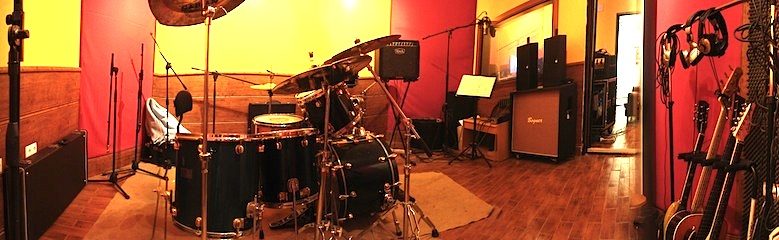
My recording studio has a hole wall made of cloth covered with insulation (rockwool) and the opossite 2 corners too.
I'm looking for a DIY panels to hang over my cloth covered absorber walls to record rock drums or any kind of acoustic instrument that needs it.
There are any type of hangers, sliders, I could use?
What about covering the rockwool walls with MDF solid panels? Would it works?
The ceiling is made of fiber tiles, and the RT is too short. Can I replace them with platerboard tiles?
Regards.
With all those soft walls and the soft drop ceiling anything that would get you back some hard surface reflections would help.
Might come in the form of a hard panel suspended over the drums...granted that would be hard to support with a tile ceiling...still.
If you have had any success with this room, meaning you like the sound of it, then I would go slow. Maybe start with making some hard paneled GOBO stands to get some of the reflection back that you have lost.
If you like that, then maybe move into adding 50 percent hard surface over the existing walls, spaced in equal measure to keep some of the absorption until you have a better handle on what it is that you have and where it is you are going with it.
maybe some freestanding polys? 2x3 frames with 1/8"-1/4" (3-5mm) plywood bent about 7" (175mm) deep. you could also hang these on the walls on hooks or even from the ceiling. altering the sizes - some full frame, some 5 per frame etc would also be beneficial.
Oh that's great!
But how can I bend a 5 mm plywood board? i think it will break.
Would a multidrilled 3 mm mdf panel works? The thicker the better?
Regards!
i've been in a wood store checking how much can a 5 mm plywood be bent.
I've tried with a 60 x 80 cm and there was no way to bend it without breaking the board.
Then I've tried with a 60x120 cm and it was so much easier, but i don't know how much could it be bent.
So when I was coming home, I've found a bending boards company but I don't know how much it costs a bent board.
Tomorrow I try to call them and ask for the price list.
3-5 mm plywood is easily bent...but the issue is not so much a poly but IS the attempt to put more hard surface into the room.
The plywood poly will be a diffusive area but or you, it is a hard area, and that is what you require first and foremost, do not let that get lost in translation :)
IS the attempt to put more hard surface into the room.
that's what I was thinking. But I want a variable acoustics room. More bright and reverberant for drums and dead for voice.
I was thinking to put a hinged boards (six 240 cm x 60 cm) boards over the cloth with polys attached or maybe plain routed boards.
it would be closed to record drums and opened for vocal recording.
But I have a question: if I do the polys, what's the best degree of bending?
For variable acoustics, I would just build some gobos on wheels! Easy, cheap, quick. Wheel them in/out and around the room as needed. Done deal!
- Stuart -
Your gobos will have a soft side and a hard side...problem solved.
You can turn the hard side into the area you are recording when you need and when it proves to be of no effect, turn the soft side into the room to reduce the reflective properties.
Would it work?
I need to build 2 of them to cover one wall. And if I hang a lot of polys on celiling there were only the oposite corners of the wall abrsovernt.
Here you have the idea:
What does it means? If the 4 walls are sloted, does the room sound better for vocals and drums? Only for drums? Does I need a vocal booth?
Slot walls are broadband acoustic treatment devices, that do both absorption and diffusion, to differing extents. They help the overall acoustics of the room, if properly installed. They are not meant to be specifically "good for vocals" or "good for drums", but rather "good for the room acoustics".
- Stuart -
Ok I understand it now.
I'll start performing the recording room in a month or two.
What about the ceiling? Should I made it solid? now it's absorbent.
Floor is made of faux wood ceramic tiles, but there is a big carpet ( 2 x 3 meters) under the drums.
Recovered from web.archive.org — originally hosted at http://dl.dropbox.com/u/1537287/MONTAJE%202.jpg