Hello Everyone,
My control room is finished, treated, setup and I've been using it for a few years now.
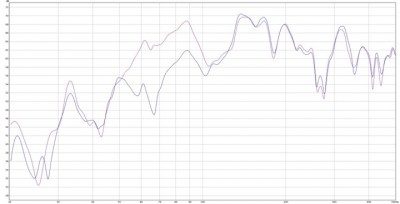
I'm trying to improve the sound of the room a bit more. There seems to be a hole at 65, bump at 130, and hole at 260.
I made Steve's map, moved the speakers around a ton, etc. . but I still can't get rid of the hole. Well, I should say that it moves, but sounds worse.
Here are some plots, photos and a full description:
final overlays 20-500.jpgWith and Without Sub
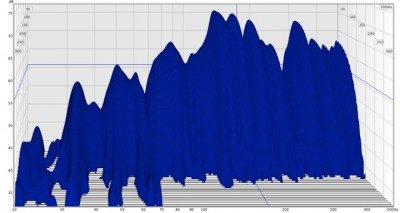
final no sub wf 20-500.jpgNo Sub
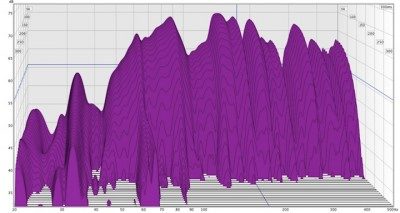
final w sub wf 20-500.jpgSub On
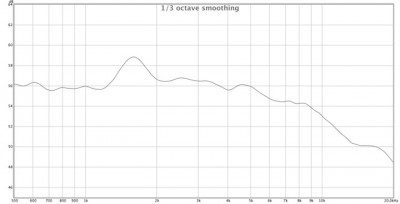
his no sub avgd boost 6k+ 1db.jpg500-20k Averaged (no sub on)
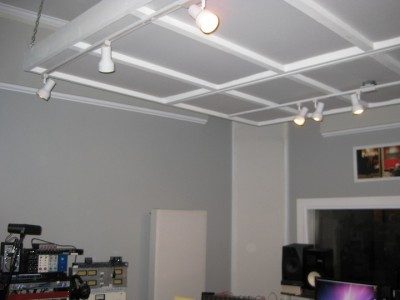
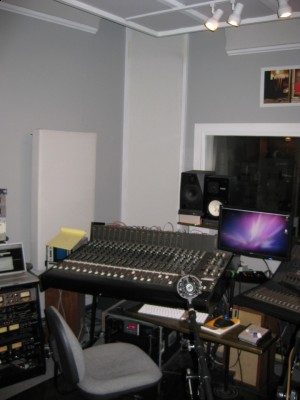
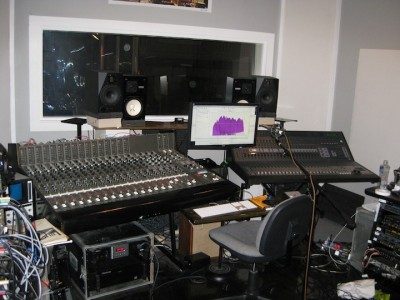
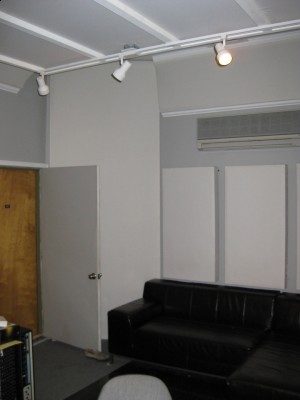
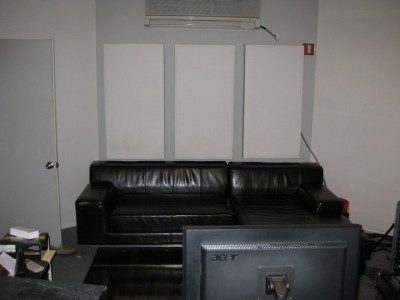
IMG_1982.JPGIMG_1983.JPGIMG_1985.JPGRoom dimensions: 17'9" long, 14' 9" wide(average), 11' 6" tall
Side walls are splayed at 12 degrees
Floated room with homosote and 5/8" sheetrock on the inside.
Floor is 3 layers of subfloor with green glue, carpet on the edges, oak in the middle.
Treatment (all using Roxul from SPI):
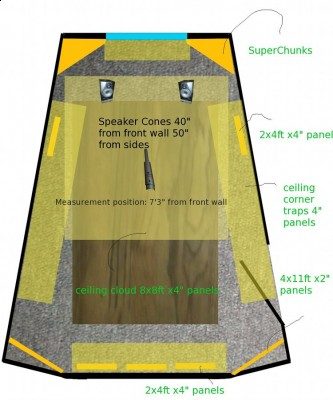
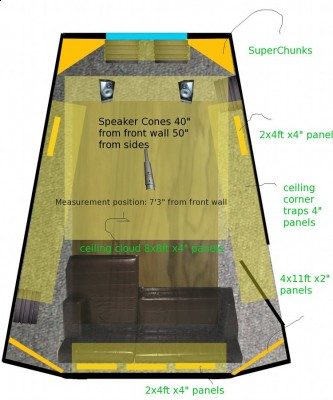
Superchunks in front vertical corners
4" broadband corner traps covering 70% of the horizontal (ceiling) corners
4" 2'x4' absorbers 4" off the walls: 2 at L and R early reflection points for listening position
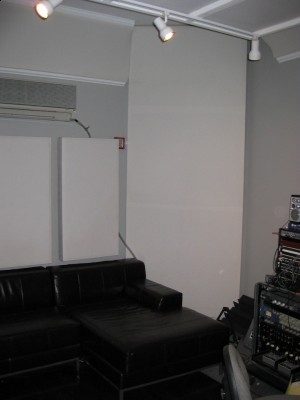
3 on the back wall
Ceiling cloud hanging 8" down consisting of 8 4" 2x4 roxul pieces
Back corners are actually cut off with walls where corner traps should be (I know that got screwed up during the building), but are totally covered with 2" roxul 4" off the sheetrock.
I also recently added 4 auralex LENRDS and one angled Maxx Wall to the horizontal (floor) corners
My Adam P11a's rest on MoPads on a shelf that's bolted to cinderblock towers, there is a tannoy sub in the front left corner.
Budget: I would love to spend less than $500, but will try to do whatever you guys suggest.
Thanks everyone for such a great forum!
Chris
just a quick guess - you need way more absorption on the back wall. the modes looks like they are the room length axial modes.
L 1st 31.83 B0 2nd 63.66 B1
maybe fill out those back absorbers to 8" deep of rockwool spaced 4" off the wall.
the better option would be to re-construct those corners properly and put in the trapping and preserve the floor space.
Thanks so much for the response! I totally agree about those corners and am so bummed about the mistake, although I really can't blow em out ($$ wise).
I posted some pictures of the back of the room below.
Would it be good to build a pair of 2' wide, 11' tall, 4" deep traps, and place them in front of the existing ones?
That would make a 2' section 6" deep in effect and a few inches off of the wall.
Agree with Glenn: Maybe put 4" 703 over the entire rear wall (except in front of the air con, of course!), with a large air gap behind it. Two layers wouldn't hurt!
- Stuart -
Woa! I didn't realize I needed so much more! The room is pretty dead as it is, do you think it will kill too much of the reflections if I cover all the surfaces on the back wall?
plan on adding some panels or slats over the absorbers to provide some reflections back. 1/2" plywood panels with 2" openings and 4-6" "slats", or 1x4 slats spaced about 2-3" apart.
Hey guys,
I'm getting ready to order the additional Roxul. Before I do, I just want to make sure that I was reading the plots correctly and not making too many assumptions by saying that the hole was at 65ish (or 63 and hence a longitudinal mode).
When you look at the plots I made, ignoring the title of this thread, does that seem to be the biggest problem? Or should I be working on the ceiling cloud or something else, etc. . . By the way, just a heads up, my speakers supposedly only go down to 40 hz (with the sub off).
Thanks so much! Let me know if I can make any other plots or post things differently. The point is, I am not confident about how to read them or what scale I should be posting and I just want to make sure I did it correctly before I keep spending!
Chris
When you look at the plots I made, ignoring the title of this thread, does that seem to be the biggest problem?
That's the biggest problem all right... for that specific, exact mic position, with those specific exact speaker positions, under the exact circumstances that you measured. Put the mic or speakers in a different spot and you might well find very different issues. That's why the best approach is general broadband bass absorption, which should help to smooth out the entire low end a little. Once you have done that, then you might start noticing other issues that were being masked by the monster in the room, and they may well need treatment too. Tuning a room ain't easy... :)
By the way, just a heads up, my speakers supposedly only go down to 40 hz (with the sub off).
That spec really means that response curve tails off to -3db at 40 Hz, but the speakers will still be putting our some energy for quite a distance below that, and it may be enough to excite room modes down low.
How did you take those measurements, by the way? What mic, and where was it?
- Stuart -
Gotcha, thanks!
Re: Broadband
I thought I had the general broadband stuff, the only weak link I can see are those back corners. Is that wrong?
If it's right, to fix that weak link I'm thinking I would cover those two 4ft x 11ft 2" thick corner traps with 4" thick mineral wool.
That would be an additional 88 sq ft of 4" rigid fiberglass to the back corners.
I'm definitely not trying to argue with the masters, I'm just really literal so I'm trying to clarify.
Re: Mic + Position
Beheringer ECM8000 in a shockmount using RoomEQWizard.
It was in the seated listening position 7' 3" back from the front wall. I tried moving closer (to the 38% rule) but this position seemed better.
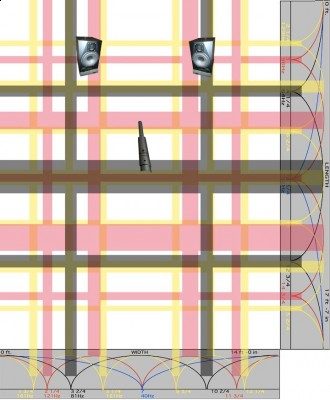
I made a drawing of the room (forgive my terrible, terrible gimp skills), and I"m posting the Room EQ mode map I made below too (although it doesn't seem accurate).
Re: Reverb Calculator
Here's what I got!
125 = .46s
250=.95s
500=.83s
1k= .79
2k= .82
4k= .8
The odd thing is that the worst issue on the waterfall plot and audibly is a big boost close-ish to 125 (at 130), not a cut as the calculator suggests (though I guess that's because of the position?).
I prepared 3 or 4 other waterfall plots of different speaker positions, if that will help, but I don't want to overwhelm you guys, so let me know if you want em!
I appreciate your help so much, thanks for bearing with me for being so literal!
Chris
Ok, so I'm a total idiot, sorry.
I didn't realize that I was supposed to include treatment in that Reverb Calculator (I thought it was more for figuring out the natural modes of the room). Those were my raw (untreated) room calculations:
Here's what I got by including the mineral wool in the calculator.
125 = .34s
250=.34s
500=.32s
1k= .34s
2k= .36s
4k= .35s
I'm going to go ahead and start by putting more fiberglass in those corners (even though the calculator is coming up with low numbers). I figure it will just deepen the absorption frequency of the corner traps, which will be good.
When you guys were talking about putting plywood or slats over the fiberglass I'm adding, are you recommending building proper panel absorbers and helmholtz resonators in those back corners or are you just saying I will add a hard surface over the front of the basic broadband traps (to get some more high frequencies happening)?
You have options. Adding the panels really addresses the latter question, but if you need tuned traps, then adjusting the construct of the corner and ceiling traps into panel or slats can still be done.