Background
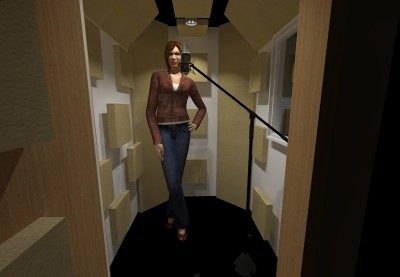
I've constructed a vocal booth for my own voiceover work and need some advice on the best way to install the Owens Corning 703 as acoustic paneling as I've read differing opinions (foil facing in/foil facing out, set against wall/set away from wall, etc).
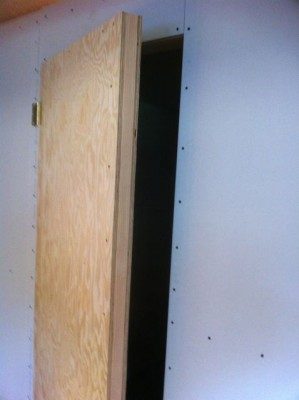
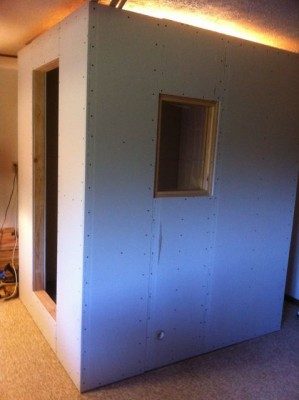
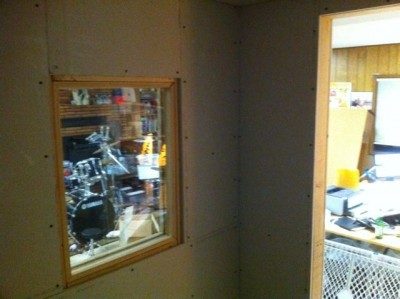
The booth is a 2"x4" stud construction (the floor is 2"x6" stud) free-standing, 5/8" drywall on inside and out, walls are internally insulated with R-19 (floor has a double layer of R-19. The booth stands free of all walls and ceilings and is located on a stone basement floor. We live rurally and there is absolute minimal external noise. The floor is 3/4" plywood with a very thin layer of "contractor" carpet on it. There is one door 2'x6' (made of 2"x4" stud with R-19 insulation, just like the walls except it's 1/2" ply), and one, double-paned window made of polycarbonate, each pane being double-sealed (in and out face) with silicon. There are two openings made from 2 1/4" plastic pipe, one for audio and one for electrical cables. These are sealed with 2" acoustic foam as required.
The booth's external dimensions are 6' x 5' x 7'6"' (length x width x height), The outside drywall will probably not be finished - only I will see it.
The booth's internal dimensions are 5'4" x 4'7" x 6'9" (length x width x height)
I intend to cover the walls, ceiling, door with Owens Corning 703 covered with burlap or some suitable acoustic fabric.
The booth already removes all external noise (heating system, fish tank pump, kids playing, occasional plane flying overhead, etc)
I already own the 2" Owens Corning 703.
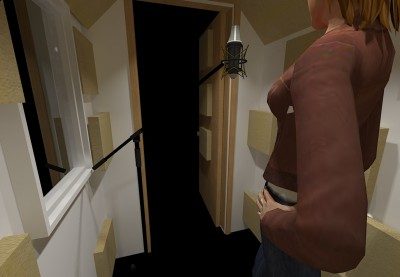
Some pics are attached to help visualize all this.
Question
1: Should the Owens Corning 703 be mounted directly against the drywall or standing off it?
2: If standing off it, what should the gap be?
3: Should every part of the walls, ceiling and door be covered with the 703 or should I just install a few panels? And if so, how many and how should they be spaced?
4: Best method of attaching the 703? I've read of the (seemingly expensive) Rotofast anchors but also, placing furring strips or 2"x4" along the wall and mounting the 703 to these with drywall screws/washers.
Thank you in advance for your input and advice.
if you have not, you probably should consider bass trapping in the corners and/or the ceiling-wall corners using 18" x 4' x 2"d with the 6" remainder (off a standard 2'x4' sheet) t'd into the corner and lightly pack the rest of the space with pink insulation cover the insulation with 3.5mil plastic and then cloth.. then i'd make a bunch of 12"x12" absorbers and tack them onto the walls, door, and ceiling in a spaced checkerboard - leave about 3" or so between. i'd have alternating ones stand off 2". this should give you a pretty decent amount of absorption and not make things too dead.
Thank you. This is very helpful and I appreciate the thoroughness of your answer. You've done this before? ;-)
How do you normally recommend attaching the panels to the walls, corners and ceiling?
for the smaller panels, hang with picture wire threaded through the cloth and some styrofoam standoff blocks glued on the back, or just hang the block on a nail angled to ensure it hangs straight, for the bass traps, use 2x2 and press insulation into place then cover with cloth.