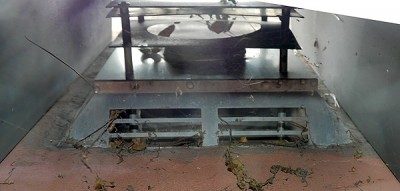
I can't even begin to figure out how to approach this problem. It's by far the weakest link in my room. At the moment I can actually hear birds chirping outside, so any kind of improvement would be welcomed. You're not supposed to put insulation around the duct, and even if I could, the thin metal walls of the duct itself will probably transmit sound.
The duct goes into a thin metal frame on the inside, through an air gap that's the 8 1/2" thickness of the wall, and ends in a thin sheet metal vent on the outside.
I was thinking of building some kind of hearth around the whole thing that can act as a sort of isolation box, but I was wondering if anyone had any better ideas, short of getting rid of the stove.
It moves heat...there are only two options. One is to live with it the other is to remove the stove and correct the offending area in the wall.
If the stove stays, there is very little you can do short of concrete around the spark arrester, but even that does not plug the hole, just the surrounding area.
Really not enough information to go on, but a typical scenario for a stove flue.
Hope that helps,
I think if it is an active fireplace then anything I could suggest might be problematic.
Either the fireplace goes or you have to develop a boundary that is resistant to heat. And you have to know that concrete will crack and or burn so anything less than that is begging for a bigger problem when considerations like air flow are taken into this kind of rehab.
Even that said, just because it is heavier does not mean it will solve the problem.
You need two things if that stove stays. Air flow and mass. And in respect to isolation this is a contradiction in terms since with isolation you want mass and restricted air flow.
You simply cannot restrict the purpose of the design for venting on this flue.
Anything, and I mean anything you do is going to be subject to maintaining the existing air flow patterns, which pretty much shoots anything you may want to do out of the water, so to speak.
It is designed to extract heat and this is done with the push of heat on the inside and the pull of air on the outside.
You change that you get smoke maybe, a lot of heat in places you didn't want it, and I suppose some isolation.
LMAO :lol:
What I think Brien is trying to point out is you're playing with fire. :roll:
You are at high risk of fire or smoke damage if you alter the vent. Plain and simple
Peace
Tom
Here's an example of what I was thinking. The flue disappears into a hearth
http://www.gaitainteriors.com/blog/wp-c ... x72211.jpg
Now obviously there's just open space around the flue in that picture, but if there were some way to get a more substantial collar around it and box in the top part more like a chimney, that might help.
Two things...what in the wide world of sports do you need a stove heater for in LA?
Second, the place you are going to stop the sound is outside, where the birds are, right?
Building anything around it [stove] doesn't stop the path and the path is the flue, the stove is more like the amplifier in this case.
Certainly a fire rated caulking around any and all cracks or penetrations around the wall/flue penetration is in order.
But your issue is with the outside of the room, not the inside.
Here's an example of what I was thinking. The flue disappears into a hearth
Just to keep us all honest, the hearth is on the floor and is a protection device in the event that embers pop out. What you are referring to is a framed and finished faux fireplace with insert.
Agree absolutely with Brien.
The problem is this: if air can get through it, then so can sound. With an ordinary HVAC duct there are things you can do safely to control that. With a flue, you can't. You cannot line the flue with duct liner, you cannot put multiple 90° bends in it, and you cannot put a silencer in it. I don't know much about flues, but I do know that hot air has to draw through it in a certain way, in order to control the burn correctly, and evacuate the exhaust gasses correctly. Anything you do to the flue will interfere with that.
It seems to me that if you can't take it out, then you are stuck with the noise. I'm surprised that a wood burning stove is even legal in LA, with all the tough smog laws. I have a nice fireplace here at home in Santiago, and haven't been able to use it in over 25 years, due to the smog laws here, and I reckon that LA is even tighter on those than we are!
- Stuart -
Wow guys, where to even start? :lol:
It's NOT a wood burning stove. There are no embers, and not really much of a smoke risk afaik. It's just burning propane. L.A. does in fact get cold. Sorry I was misusing the term "hearth" there. I was actually thinking of the word mantle.
The stove itself is sealed airtight with a thick glass panel behind that fake door. That's why I'm mostly concerned about sound transmitting through the walls of the flue and around the hole in the wall. Sound isn't really going to go through the stove and up the chimney like it would in a fireplace. Sorry if that wasn't clear from the pictures and description.
The suggestion to use fire rated caulking helps a lot. I didn't even know that existed, but that will at least be a start.
Taking the thing out is obviously the best solution, but it's actually relatively new, my wife is into it, we installed it as the main source of heat for this guest house when we were renting it out and it should probably stay in case we turn this back into a rental in the future, etc. So for now it stays. But if I can somehow get better performance than "gaping hole in the side of the wall" that would be great. :lol:
"Sound isn't really going to go through the stove and up the chimney like it would in a fireplace. "
It's a conduit basically so yea, sound/air goes in and out.
It probably is only the tip of your iceberg in attenuating the sound that is coming into this environment and you may be back later, after this fails to rectify the condition.
So, final answer and you didn't hear it from me.
Build a cover out of James Hardi type material [cement based product] that can cover the exterior spark arrestor. That is the path, the leading edge, where sound is gaining access. Commercial grade glue and brad nails will be how you affix the parts. You do not want to use any wood on the inside of the cap, you want to make it as resistant to the heat as possible.
Can't help ya with how to attache it as anything you do may well be a potential water trap or present a path for water. Like I could say use a piano hinge but then you have screws that can rust. But the cap will not be weatherproof unless you take great care in making it so. And if you do, we go right back to the smoke inside the room, heat in places you do not want it scenario.
Most likely you will find that windows, doors and poor wall construction have a stake in this claim.
Time will tell :)
I don't see how it can be! It is burning propane, right? Propane needs air in order to burn. The heater is sucking in air from somewhere! It MUST be coming from the room. It cannot possibly be "sealed airtight" if something burns inside it, unless you also have a hidden air duct leading into it.
- Stuart -
Yeah, good point. There must be an air intake somewhere. Flue must be outgoing only. I'll find the intake and plug it up with some old newspapers. Kidding! :P
Thanks for the help guys.
Yeah, good point. There must be an air intake somewhere. Flue must be outgoing only. I'll find the intake and plug it up with some old newspapers. Kidding! :P
Thanks for the help guys.
First reaction :shock: Second :lol::lol::lol:
Hope you get it figured out
Peace
Tom