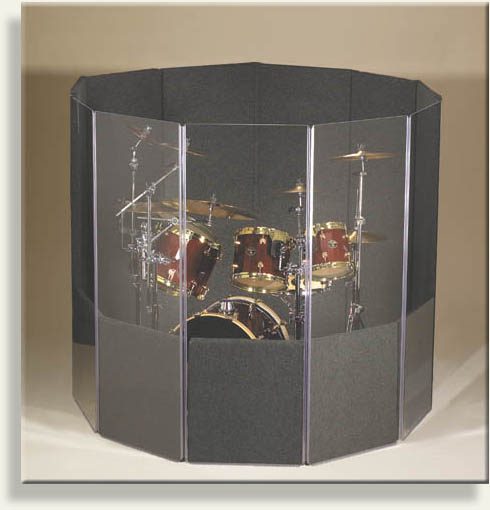
I am hoping a few people may be able to give me some advice on a building a non permanent sound reducing drum room / music studio within a room.
The room in question is located on the third floor in what would normally be a loft area, but the building construction used the loft area to
create to extra rooms and one of these, I wish to use a drum room.
The attached image is not of my room, but is the same (it is too full of things right now to get a shot) but the photo will help me explain
as this is what it would look like were it empty.
The shape of the room is as shown, i.e. not rectangular due to the roof. On the right side is one Velux window that opens upwards and on the other,
an inlet, with a double 'bay' style window.
Naturally being on the third floor and with not many properties about, noise spillage to the outside is not so much of a concern as normal,
but still a concern none the less.
It is not financially possible to have a room built within a room to soundproof, so I am looking at placing a ClearSonic sound booth within the room.
Due to the restricted height of the room, the booth will be the one below, but with a low roof added as shown in the next photo to the right.
Recovered from web.archive.org — originally hosted at http://clearsonic.com/assets/isopacC_big.jpg
The booth will be made of ClearSonic Panels which are 1/4" thick acrylic. Attached to those are Sorber baffles, with one side covered floor to top,
the other side, half way up (as shown). It will also be ventilated.
Roof Sorber Lid baffle panels will create a very low ceiling to help contain the sound further and although the booth height is only 4 foot tall,
that is fine when seated at the kit.
I am told this will reduce the noise in the room by 50-60%. I am also looking at covering the windows, inlets and the room door ( a steel plated fire door)
with SORBER baffles to absorb more sound in the leakage areas.
The room beneath the kit will not be in use, so anyone in the house will be 2 floors down.
My questions to start with are simple really and relate to aiding the booth's effect.
1) Should the drum kit be placed facing a main room wall, right up close, so in effect, I am playing into a wall rather than the drum shells and
cymbals throwing sound out into the room?
2) Should the kit be placed against the flat end wall or one of the side arched wall, so the angles help deflect the sound waves?
3) What other recommendations, ideas or thoughts could further help absorb sound?
Thank you in advance for reading and any input.
i'd put a drum platform in to decouple it all from the floor. basically a layer of 25mm polyethylene foam/Sorbothane under 2x 25mm MDF and 19mm plywood (to screw into). if you can leave the unit in the middle of the room to allow maximum amount of air gap although you probably need to also consider all the weight and any floor flex in that position.
Thanks Glenn. I did wonder about a drum platform, but my worry is that due to the sloping sides to the ceiling, the booth is a tight fit already. :(
I thought I also read the angled walls were good at breaking up the sound, but I cannot find the information now.
Do you have any thoughts on that?
the angled walls given the shape of the room might not be good due to focusing sound instead of dispersing it. yes, even though it will be tight, the drum platform will be important to avoid transfer directly into the house framing.
It seems that you are trying to isolate the drum kit, not "reduce the levels in the room", which is what you said originally. Isolating will reduce the levels outside the room, but not inside.
Like Glenn already said, your biggest problem will be impact noise getting into the building structure. The only way to deal with that is to do what he said: decouple. Get the kit up on something that is at least partially isolated from the floor.
I am told this will reduce the noise in the room by 50-60%.
That sounds about right, if you are talking about reduction in sound power, but don't forget that acoustics is not very intuitive, and reducing sound power by 50% does NOT mean that it now sounds half as loud. It means that you turned down the volume by about 3 dB. Try that on your console, and so how much difference it makes: not much. Subjectively, you need a reduction of about 10 dB before you would judge that it is now half as loud as it was. 10 dB means that you reduced the sound power by around 90%.
Not trying to scare you , just pointing out the harsh realities of acoustics and drum kits.
A drum kit is pretty much the toughest thing to isolate: It is one of the loudest instruments out there, and can easily hit 115 dB when played normally (which produces irreversible hearing damage in about 15 minutes, according to OSHA). Reducing that level by 50% brings it down to 112 dB, which means it went from "really damn loud" to just "very damn loud".
In reality, that booth should probably do somewhat better than that. With a bit of luck, you might get the level in the room down to around 100 dB. Hopefully, the house itself will get you another 20 to 25, so you could be in the region of 75 or so outside. (That's merely "loud" :) )
with SORBER baffles to absorb more sound in the leakage areas.
Not sure what those are, but you can't stop sound by absorbing it! You can only stop sound with mass. Think of it this way: you cannot stop a river from flowing by dumping a truckload of sponges in it, can you? But you can stop it by dumping a truckload of rocks in it! The same with sound: you cannot stop sound getting out of your room by absorbing it, such as with acoustic foam, rock wool, fiberglass, etc. (they serve an entirely different purpose, acoustically). To stop sound, you have to "dump a truckload of rocks" in the way, meaning a massive airtight barrier, such as sheetrock, glass, wood, etc. (That's what your booth will do, to a certain extent). But adding absorption in the room, or in the booth, will not reduce the sound levels outside. It might make the room sound much better, acoustically, but it won't stop sound much from escaping.
What you CAN do to help isolate that room, is to seal everything as well as possible. You could also build plugs for the windows. But the key point, like Glenn said, is to get the kit off the floor: If you can't do that, then the impact noise will be in the building structure, and it will totally bypass your booth, seals and plugs...
- Stuart -
Thank you for those replies which are very helpful.
I will look at building a platform for the kit.
Not being a DIY person of any description, is Glenn's suggestion discussed in another thread here? I'll do a search, but wonder if anyone recalls a specific thread?
Bottom line is I am trying to reduce the noise that escapes the room and cannot have a soundproof room within a room built, so I was looking to reduce the volume of the kit within the room and thus what could potentially leak out, while at the same time, looking at having movable.
Thank you for the analogy about the flow of sound.
It has now also been suggested to me that I cut out 8mm plywood to be a snug fit in the window opening and then also add the SORBER baffles. Do you have any other suggestions, or is that about all I can do?
Thanks again.
What Glenn described is commonly called a "drum riser", and if you use the "search" feature on this forum you'll find more than you ever wanted to know about drum risers! :)
The basic idea is simple: You put down a layer of something very thick and very resilient, directly on the floor, such as some types of acoustic foam, or even plain old mineral wool, or OC 703. Just plonk it down on the floor. Now you put a really heavy, solid, thick, massive flat layer of "something" on top of it, such as a couple of layers of 18mm plywood, HDF, MDF, or something like that. Set up your drum kit on top of that, as normal. Done!
That's the concept: decouple the drum kit from the floor, so that all of the impact noise does not get into the building. In a drum kit, a large amount of acoustic energy is present in the kit itself, and that is transmitted directly into the floor by every part of the kit that touches the floor. ie, all of the kit! The riser breaks the path, so that the energy cannot get into the floor.
Technically, you are eliminating flanking paths: This can make a huge difference to your overall isolation. If the kit is on a riser, then the only sound you have left in the room is airborne, not structure borne, and that is easier to deal with. The booth will take care of some of that: the more massive and better sealed it is, the more sound it will block. The room walls will take care of another portion, and here again, the more massive and better sealed your room is, the less sound it will let out.
Here is an example of a drum riser that I found, using an Auralex product
Image not preserved: drum-riser.jpg
You can find product on their web site, but you can do the exact same thing yourself much cheaper, the way Glenn described. In fact, you could cut the foam and the plywood to a shape and size that is just a little smaller than the interior of your booth, thus leaving a small gap around the edge (between the riser and the booth), to help even more: that way, the impact noise would not get into your booth either, which would reduce levels outside even more. If you build the booth on top of the riser deck, then impact noise in the deck would flank into the booth structure, and then into the room. But it the booth rests on the floor and does not touch the riser, then you avoid that. Even better still would be to rest the booth on its own resilient barrier. Every little bit helps...
Yes, this will eat up several inches of head room, but if you need isolation on a limited budget, and it has to be something that can be removed easily, then you really don't have any other choice. Despite what you might read on some manufacturer's web sites, and even on a few forums, there are no "magical" products in acoustics. All products have to obey the laws of physics: there is no getting around that. Mass and decoupling is the ONLY way to stop sound. You cannot do it any other way. A drum riser has mass on the deck, and decoupling in the foam. It's about the cheapest possible way of doing it!
It has now also been suggested to me that I cut out 8mm plywood to be a snug fit in the window opening and then also add the SORBER baffles.
8mm is way too thin. You need to have mass on a plug for it to work. You also need to have the natural resonant frequency of that mass as low as possible: 8mm plywood doesn't cut it there either.
Go for 18mm, or even more if you can get it. Put thick insulation on the side facing the glass (4", or more if you can). And build it to seal air-tight all around.
Do you have a link to that "sorbex" product yo mentioned? I'm not familiar with it.
Do you have any other suggestions, or is that about all I can do?
Seal everything! Walk around the room with a caulking gun, and seal every last tiny gap that you find anywhere. Walls, floor, ceiling, window and door frames, etc. Any place that the air inside the room can make contact with air outside the room, is a place where sound will get through. Even if it is a tiny crack that doesn't look like anything. Seal everything in sight: And if you aren't sure if it really is a crack or not, then seal it anyway, just in case. Pay close attention to light fittings, electrical boxes for switches and sockets, etc. Even seal the gaps where cables come into those boxes, but turn off the power before you start fiddling with electrical stuff!
Also put rubber seals around your door. It, too, should seal air-tight when closed.
Here's one way of making a window plug:
viewtopic.php?f=1&t=14227&p=99951&hilit=+window+plug+#p99951
But search the forum for the term "window plug" and follow the links you find: I guarantee you'll find plenty of ideas on how people have built them, and how well they work.
- Stuart -