Advice on wall construction needed

Started by Randy K on 14 March 2010. 9 replies.

Originally posted at johnlsayers.com, topic 14183.

I'm trying to soundproof a small music practice room on a very limited budget. The biggest concern is the ceiling, so that's where I've put most of my efforts - whisper clips / hat track and 2 layers of sheetrock with GG. So far, so good. The walls are 10" thick cement, so I really didn't plan on doing anything to them for soundproofing, but the room is so damn cold I have decided to build stud walls, insulate and sheetrock. My plan with the walls was to mount 2X4's directly to the wall, horizontally, one at the floor and one at the ceiling. Then mount 2"X3"'s to them vertically, 16" on center. Then insulate and sheet rock. My thinking was that the sheetrock and studs had such a solid mass behind them it would be good enough as far as sound deadening goes. But I happen to have some 3/8" thick rubber laying around, and wondered if I might get some benefit from putting a layer of it under the horizontal studs when I mount them to the wall. I've attached a picture of the rubber, and the rubber/stud concept;
External image, not preserved — original: http://i39.tinypic.com/24yzr4z.jpg
External image, not preserved — original: http://i41.tinypic.com/2rwvxu9.jpg
Any opinions on whether this will help, or harm my cause? The last thing I want to do is turn the walls into some vibration sympathetic instrument. But I really can't see how this would do anything but help deaden vibration. Your thoughts appreciated!
My first opinion is that you should downsize your pictures until they fit the forum rules! My second opinion is that what you describe (both the construction method and the materials) will not accomplish what you are hoping they might. (I'd answer in more detail, but it is so damn hard to even follow your post, scrolling back and forth across the screen around those huge photos, that I got tired before I finished reading it....) - Stuart -
Soundman2020 wrote:
My first opinion is that you should downsize your pictures until they fit the forum rules! My second opinion is that what you describe (both the construction method and the materials) will not accomplish what you are hoping they might. (I'd answer in more detail, but it is so damn hard to even follow your post, scrolling back and forth across the screen around those huge photos, that I got tired before I finished reading it....) - Stuart -
As soon as I posted I saw how large they were, so I've resized them. You must have read and responded while I was still editing the post. They're now 640 X 480, so the post should be more readable. How will this method and these materials not accomplish what I had hoped they would? Would I be better off just attaching 2X3's directly to the cement walls, and coat them with GG before attaching the sheetrock?
You would be better off with a decoupled two leaf assembly. Best as I can recall, a furring strip or whatever this rubber product is will not help. I think z metal is better in general...but a completely decoupled wall assembly...that's the ticket:)
Would I be better off just attaching 2X3's directly to the cement walls, and coat them with GG before attaching the sheetrock?
I doubt that Green Glue would do anything at all for you when used like that, on the face of studs before hanging drywall. That's not what it is intended for, or designed for. It isn't glue, and it isn't caulk, so I can't see it would do anything useful. What were you hoping it would do for you? Like Brien said, your best bet is probably a two-leaf MSM system, which implies a separate, decoupled stud frame, away form the existing wall and not touching it at all, with one or two layers of drywall on it, and insulation in the cavity. It's a pity that you already finished the ceiling, since it would have been far more effective to do both the ceiling and walls together, as a single MSM system.
My thinking was that the sheetrock and studs had such a solid mass behind them it would be good enough as far as sound deadening goes.
Not sure what you mean by "sound deadening", but since you already said that you don't need more isolation (only thermal insulation) I guess you are hoping that the sheetrock will be a good acoustic treatment for your room. Is that what you mean? That you want the sheetrock in there to give you better acoustics, but NOT better isolation? Why are you taking so much care with the ceiling, if you don't need isolation? - Stuart -
Soundman2020 wrote:
Would I be better off just attaching 2X3's directly to the cement walls, and coat them with GG before attaching the sheetrock?
I doubt that Green Glue would do anything at all for you when used like that, on the face of studs before hanging drywall. That's not what it is intended for, or designed for. It isn't glue, and it isn't caulk, so I can't see it would do anything useful. What were you hoping it would do for you? Like Brien said, your best bet is probably a two-leaf MSM system, which implies a separate, decoupled stud frame, away form the existing wall and not touching it at all, with one or two layers of drywall on it, and insulation in the cavity. It's a pity that you already finished the ceiling, since it would have been far more effective to do both the ceiling and walls together, as a single MSM system.
My thinking was that the sheetrock and studs had such a solid mass behind them it would be good enough as far as sound deadening goes.
Not sure what you mean by "sound deadening", but since you already said that you don't need more isolation (only thermal insulation) I guess you are hoping that the sheetrock will be a good acoustic treatment for your room. Is that what you mean? That you want the sheetrock in there to give you better acoustics, but NOT better isolation? Why are you taking so much care with the ceiling, if you don't need isolation? - Stuart -
Sorry, I guess my post wasn't clear. My thinking was that the 10" thick cement walls, by virtue of their mass will provide sufficient soundproofing for the walls. At least, soundproofing that will be comparable to the ceiling. So all I want to do is sheetrock and insulate for appearance and warmth. I just want to make sure I do that the best way possible and that I don't create problems. I actually haven't done the ceiling yet, but I do have everything ordered and shipping to me as we speak. How could I tie wall studs into the ceiling as a single MSM sytem as you mentioned?
OK, that makes a bit more sense. That's one of the reasons why the "stickies" at the front of the forum are so insistent that folks provide as much detail as possible in there posts. Anyway... :
My thinking was that the 10" thick cement walls, by virtue of their mass will provide sufficient soundproofing for the walls.
They might, depending on what "sufficient" means! What tests did you already do in your room to determine how loud you are right now (without doing anything) and how quite you need to be (after the studio is finished)? That should have been your starting point. Your existing cement walls and existing ceiling (together, not separately) might or might not be "sufficient" to attain the level of isolation that you need, based on how loud you are and how quite you need to be. Before you do anything else, you should install your very loudest setup that you could ever possibly imagine needing in your room, and measure just how loud it is inside the room with an accurate sound level meter, and also measuring elsewhere in the house, when the setup is belting out the very loudest possible sound it can make. Keep notes of all the readings on the sound level meter. Then you start reducing the output level more and more while continuing to measure in other parts of the house, until you get down to a level where everyone is satisfied that it is quiet enough. The difference between the loudest level INSIDE the room and the quietest level that makes everyone happy is the total amount of isolation that you need. The difference between the loudest level inside the room and that same loudest level outside the room, is the amount of isolation that you have right now. The difference between these two calculations is the amount of ADDITIONAL isolation that you still need. That final calculation might be zero, in which case you already have enough isolation from your existing cement-wall-and-ceiling-combination, or it might be non-zero, in which case you don't have enough. So, based on those real numbers (not guesses) you can figure out what level of isolation you have already, and what you need, if any. The cement-wall part of your current structure is probably OK, and the ceiling part of it is probably your weak point, but I'm just guessing here since you didn't provide enough details to go on. In any event, the walls and the ceiling are not two separate things: they are two parts of your existing isolation. You can't really talk about them as though they are separate: the aren't. The isolation of your room depends on the combination of all factors, not just your cement walls. For example, if you have another room on the other side of that cement wall, and the ceiling is just simple wood flooring on the same set of ordinary joists, then the cement walls are not doing anything right now: All of the sound is simply flanking around the walls through the ceiling. It wouldn't matter if those walls were 10 inches of concrete or a single sheet of drywall: the isolation would be about the same. In other words, treating your ceiling without treating the walls would not be smart: they are components of a system, not separate items. At some point the new ceiling has to meet the walls, and if there is flanking around that joint through the walls, then the new ceiling is not going to do anything at all. Even worse, a tiny crack in that ceiling-wall joint, just a one mi limiter wide and a few dozen centimeters long, would be enough to destroy your isolation. Walls and ceilings work together to isolate, not separately. The way you would build an MSM system is to build four new self-supporting stud walls around your room, totally separate form the existing four cement walls, and put your new ceiling across the top of those walls, with no connection at all to the old ceiling. The new structure does not connect to the existing structure at any point (except the floor). Think "room inside a room". Put a couple of layers of drywall on the new frame, seal it all air-tight, decorate to taste, and you are done! (Except for the acoustic treatment, of course: but treatment and isolation are two different things anyway...) - Stuart -
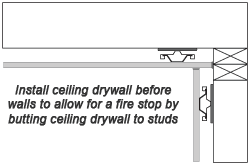
OK, thanks. I appreciate the comments and understand what you're saying. Regarding whether the amount of soundproofing will be sufficient for my needs; I understand a room within a room would be the ideal construction method, but I'm committed to using the Whisper clips, hat track and double layer of sheet rock with GG on the ceiling, which I believe will be sufficient for my needs. The walls therefore, only need to be as effective as the ceiling is at soundproofing. The study you suggested is a great idea, but more then I can bite off right now. I also believe the 10" cement walls I have to work will provide sufficient soundproofing, as long as I don't do something to subvert their performance. So my main concern remains the best way to construct the walls. I don't have any budget left to isolate a stud wall from the cement with clips and hat track. Hence my thinking that the rubber strip I had mentioned in my first post, would at least dampen the vibrations where the stud wall meets the cement, and could only help, not hinder my cause. I'm still not sure I'm wrong about that.. :?: I don't believe flanking will be an issue, since I intend to construct as illustrated below, except that the walls will be stud directly affixed to cement, instead of clip and hat channel.
Recovered from web.archive.org — originally hosted at http://www.greengluecompany.com/images/clip_installation/corner.gif
So I guess my remaining questions are to ask again whether the rubber strips I proposed will be beneficial or not. And also whether it would be preferable to attach furring strips directly to the cement (for a very rigid wall), or to build the stud wall as a unit (on the ground), then just attach it to the cement (and floor) in a few places (for a more flexible wall).
Welcome Randy! You have two geat people helping you. The rubber by itself will probabably do something good, ala Sharp's point mounting, but without testing, forget getting any support for the idea. Stuart is right on with the concrete walls MAYBE providing enough isolation. He provided a simple way to measure what you need in isolation. If you do not build it right, can you afford to tear it down and do it again? :D You wrote that you are working on tight budget, yet are using Green Glue and Whisper Clips. Tight budget and those items do not go together. We (John's disciples) want you do it right and get the best value. Andre
I'm not an advocate of the rubber under the bottom plate, either. If the ceiling drywall extends to and is sealed against the foundation, then you effectively have a lid on the room and the walls can be simply decorative.