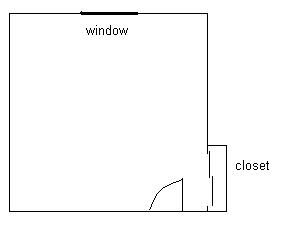
Finally closed on my new home and my control room fits the worst case scenario fairly well. Its a 10'x10' room with 8' ceiling. I made a quick and dirty layout of the room. I already have a mix desk that is 72"x30". I also have a couch that I had from prior to purchasing the home that is roughly 6'x3' that I would like to put in there for artists to sit on while I mix for them. What are my options for treating what little space is left and, purhaps more importantly, what will be a waste of money in this situation?
Being that it is a square room, you will want to install absorption mostly on all walls. Make it dead...it's your best bet...it's your only solution really, for such a small square space.
Steve, being that the room is already very small and the equipment and furniture going in it are already occupying so much space I don't see the room within a room method working for me if that's what you were eluding too.
In such a small space I assume that angling the two side walls would be more costly and wouldn't yield significant results over deadening the walls with panels given I don’t have much room to angle the walls. Is this correct?
In this scenario would you guys advise to use 703 or 705 or the mineral equivalent and how thick should the absorption material be? 2" or 4" or more if possible?
Awesome! Thanks for linking that for me xSpace. Now if I build angled slot resonators on either side of the mix desk, narrowing as they near the back of the room, what angle should I aim for the best possible results or would it be better to build multiple small slot resonators at varying angles, and frequencies to meet the rooms needs, to further diffuse the sound and help break up any parallel surfaces? Would you recommend doing this across the entire surface of the parallel side walls or perhaps something more “random” like a checkerboard pattern with varying angles and each absorber being about 2'x'4' and every other 2'x4' section would just be a standard panel absorber? I’m guessing you will tell me one resonator per wall due to the need for symmetry in a control room. From my understanding diffusion is something you typically only need on the rear wall of a control room, assuming your walls aren’t parallel like mine, whereas in a live room random diffusion is a requirement on all walls to some degree. Since my room is so small I would assume that it would be better to completely deaden the rear wall and not mess with diffusing it. Right?
Whatever John says in the linked post is what I would do, which is kinda why I presented it.
As to diffusion in a room with a ten foot wall length, it will not help. It is just too small a room to do anything that will yield any valid acoustic response, especially with diffusion.
You need absorption mostly and especially to counteract the modal buildup.
Quick question... IIG 1280 mineral wool is the only acoustic type insulation I've been able to find within a reasonable distance, or within the state. Being that my main problem is going to be the bass frequencies do you think that this should be fine to use for all the traps in my control room? I'm planning on having a cloud covering half the area of the ceiling with 6" of insulation and a 4" gap. Does this sound like a solid plan for taming some of the low frequencies a little better?
here or the coeffients (stolen) from http://www.bobgolds.com/AbsorptionCoefficients.htm for the IIG product
MinWool-1200 Industrial Board 1280 2" (51mm) 8 pcf (128 kg/m^3) 125hz-0.32 250hz-0.90 500hz-1.11 1000hz-1.07 2000hz-1.01 4000hz-1.05 NRC-1.00
Judging from that site it should be twice as effective as 705 at 125hz and 20% more effective at 250hz. From there on they are about equal throughout the remainder of the listed range give or take.