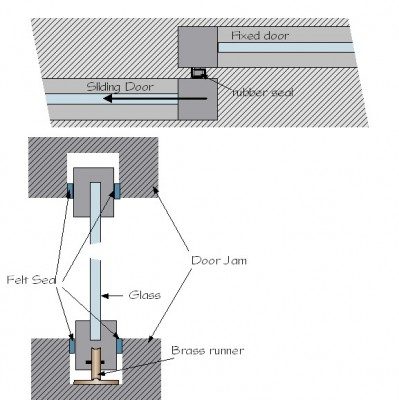
Just wondering if anyone has ever had a go building wooden sliding doors.
I dont mean installing them rather bulding from scratch 2 pairs of glass sliding doors.
Ive been thinking about it cause i need to install some soon but cant afford to go the prebuilt route.
I would love if anyone had plans for them as i can build pretty much anything quite well in an industrial woodshop.
Anyone??? :D
I'm not sure why you'd want glass doors or why you'd want them sliding? Have you read Rod Gervais book at all? Budget? Room size/design? You need big mass and you've got to be anal about weatherstripping on the door and everything else has to be in order too. No matter how good your door is, if other things in your room have leaks or weaknesses in the construction, you will be wasting your time and money for nothing.
You're definitely not the first to do sliding glass doors, though doing glass doors yourself and expecting good results is IMHO, nearly impossible. The only room I've seen with sliding glass doors and I'm not all that impressed with the sound reduction. It's made by soundjapan and is VERY VERY expensive and heavy with airplane quality door sealing system and anal attention to detail. You watch the video and tell me if it's worth it. These cost TONS of money and you be the judge of the results:
http://www.youtube.com/watch?v=n5C4BeY18Gghttp://www.youtube.com/watch?v=HK3Fcr19M5g
If this is the best they can do, with engineers and guys with Ph.D's, I am not sure how you can top that. Without the bass drums, the sound reduction is better, but it all depends on what your use is, your budget, etc:
http://www.youtube.com/watch?v=frQACdHLm04http://www.youtube.com/watch?v=tKl9xEyn ... re=related
There is really no cheap way to do this. I wish sound was as cheap to block as light, but it is not. Actually the cheapest way would be to find someplace far away from neighbors where you don't have to worry about soundproofing in the first place.
Thanks for that whitelion but i see in various different builds on the site, folks using two pairs of sliding glass doors to soundproof an entry /exit to a room.
I have already built two super (type) doors for cr and vox booth... seals and all.
My problem is thus...
In my soon to be live room there is an archway leading out to a conservatory (see pic below)
The conservatory has a palstic roof and when it rains (which being the west of ireland is almost every day) it produces a lot of noise.
I need to isolate this noise from my live room.
The obvious solution is to build a wall here and just totally kill the archway, however, after discussion with my partner this unfortunatly is not an option. It would also make a room that currently has floods of natural light and fresh air very dull and cramped.
This archway allows people to move about our house in a complete circle.
through the arch way into the conservatory into a hall into the kitchen into the dining room into the living room into another hall back into the live room and through the archway again.
In my whole build so far this is the only thing my partner has asked for, that i leave natural light and access through this arch by using the double glass door method.
Problem is i cant afford double glass doors, so now i gotta make them.
This aint a problem either as i have access to an industrial woodshop loaded with tools and machines i would just rather make them to a proven design rather than attempting to design a pair from scratch..
HMMMM
peace
df
The arch in question and some congas and senagalese dundun drums.
Ok it wont let me upload the photos but they are up on one of my other posts go here viewtopic.php?f=1&t=11717&start=15
to see what i mean.
"glaziers do it all the time!"
Right, but they don't do SOUNDPROOF sliding glass doors all the time. That's the rub. Finding someone to do ordinary sliding glass doors is no problem, but telling someone who has no acoustical training to design one for you to block a substantial amount of sound with proper sealing/closure around the door will be next to impossible. Doing it yourself and getting good results (like an STC of over 60-70) is equally unlikely as the best Overly doors are around 50-57 STC. The best pre-made Overly sliding door gets STC 51, which is sliding METAL door, not glass (may have some glass in it, but I'm not sure), and on low frequencies, the performance is not that great (like 39 STC). So if you want to block lots of low frequencies, these are not what you want. Maybe if you put two of these together you can get a better STC, but you'd have to contact Overly about this (or maybe they can even build a custom solution for you if you have the money):
http://www.overly.com/door/index.cfm?cu ... er=docType
You could do the sliding glass doors, but they will be a weak point in your whole assembly, I'm afraid. It would be a pity to do everything else right and spend tons of time/effort on everything else only to have weak doors, which makes the entire assembly weak. My say is to forget about it.
"You could do the sliding glass doors, but they will be a weak point in your whole assembly, I'm afraid. It would be a pity to do everything else right and spend tons of time/effort on everything else only to have weak doors,
In a DIY environment it is common place.
Yeah, thats what i thought , everybody being negative!!!
You see this is kind of a different purpose door, its purpose isnt to keep sound inside the building,
I just want to get rid of the noise of the rain hitting the plastic roof of the conservatory on the other side of the archway, its loud but not a low bassy sound. Its a mid to high mid type of sound and it must be gotten rid of.Like i said before however, i do have access to an industrial wood shop where i can make things as good, if not better than your average glazier could do and i dont see it as being a hugely complicated affair to build what is basically just some large sliding windows, but i need a plan.
Otherwise what i am left with is to pay a glazier about €3000 (which i would need to borrow from credit union) to do the job for me and hope upon hope that he gets it right.
Knowing Irish builders/glaziers/plumbers etc etc as i do, i seriously doubt they will get it correct.
I have been looking out for secondhand ones but they seem something of a rarity around the west of Ireland.
Few questions.
1, if i build them myself do they need to be double glazed or lam glass?
2, Does anyone have proven plans for them?
3, Is it actually possible for glass doors to give 100% or close enough to it isolation?
4, Has anyone built doors like this themselves??
I really am starting to get quite worried about this and need some ideas.
come on folks get the thinking hats on and see what we can do here.
If we spent some time to get a workable plan for doors like these it would be of huge benifit and not to mention savings to everyone on the site, there has gotta be a way...
cheers
df
donal_finn,
(a) You have still have not told us WHY you want glass doors? (Do you absolutely need the glass or would a heavy solid core wood door with lead on the outside suffice)?
(b) WHY do you need a sliding door and not a regular door? (a regular door would be much cheaper and less problematic to install and there ARE proven plans for these like the one in Rod Gervais' book)
"1, if i build them myself do they need to be double glazed or lam glass?
2, Does anyone have proven plans for them?
3, Is it actually possible for glass doors to give 100% or close enough to it isolation?
4, Has anyone built doors like this themselves??"
Firstly, the shop I am employed at has built doors. It is not really a DIY job.
It requires more to build a wooden door (talent, tools and the ability to use both), than it does to go out and buy them.
1. laminate is the only option
2. a proven plan is to build the carcass and install the laminate.
3. 100% doesn't exist.
4. we have done exterior doors with laminated glass.
It's not as easy as you are wanting to make it out to be.
"Knowing Irish builders/glaziers/plumbers etc etc as i do, i seriously doubt they will get it correct."
Now who is being negative:) ?
Thanks John,
Thats exactly what i needed!!
The rest of the factors involved are pretty straightforward.
It was the seals and runners that were my main concerns.
Folks maybe i am being foolish and will reconsider, but as it stands now
i think i will give it a go to build these myself in the new year.
Xspace, My lil bro is a fantastic cabinet maker,
he builds high end furniture once offs and i know his skill will come into play building these.
food for thought, Nice!!! :D
I will draw some up any way and see where we can get with the designs for a start
and then look at the price of them, i Will continue to post any info on these doors on this thread
rather than on my original thread.
Just getting some trimmings and painting done over the next few days and got carpets coming on sat!
Getting there!!
peace
df
Yeah, my joiner calls them "Volkswagen doors", referring to the VW van/people carrier door systems. They do not come cheap, though. And if you really want a sound isolation with them, you should do double double-glazed doors with very thick glasses and at least 7-8 inches of air space between them, or even more if you want to go further down on the frequency spectrum. Just one so-called "airtight" sliding door unfortunately falls way short of the clients expectations in terms of isolation. They can't even cut man voice good enough.
B.
This is a really old thread, but there's a lot of misinformed commentary in it that needs correcting. I came across it while searching for something else, and felt the need to update it with correct info:
I'm not sure why you'd want glass doors or why you'd want them sliding?
Sliding glass doors are very common in studios, and can indeed be built to provide good isolation, as John points out. People want them because the provide wonderful sight lines, which are important for musicians, and simply for nice aesthetics.
You need big mass
Glass is more than three times the density of drywall. It is plenty massive to do the job. The glass can be just one third the total thickness of your drywall and still provide roughly the same level of isolation.
doing glass doors yourself and expecting good results is IMHO, nearly impossible.
On the other hand, John has done it, and so have others. In fact, even a pair of typical "Home Depot" style patio sliding doors can get you good isolation, if you beef up the seals a bit.
You watch the video and tell me if it's worth it.
How do you know that the doors are the problem here? It seems far more likely that there's another issue, not the doors. For example, just to the left of the doors I see an HVAC register...
There is really no cheap way to do this.
Yes there is. (As John pointed out) As long as you do the calculations right, and take proper precautions, you can indeed DIY studio doors with very good isolation.
Right, but they don't do SOUNDPROOF sliding glass doors all the time.
That's probably because there's no such thing as "soundproof" anyway. Studio designers, acousticians, and others tend to avoid that word, because it is misleading at best, and means different things to different people. We tend to talk about "isolation" and "transmission loss", not "soundproofing".
Finding someone to do ordinary sliding glass doors is no problem, but telling someone who has no acoustical training to design one for you to block a substantial amount of sound with proper sealing/closure around the door will be next to impossible.
I don't agree. Adding the seals that John mentioned is not a big deal. Anyone who builds similar doors already, can easily add those.
Doing it yourself and getting good results (like an STC of over 60-70)
I'm not sure where you are getting your information from, but an isolation level of 70 dB is way out of the league of home studio builders anyway. It's pretty much at the flanking limit for a concrete slab on grade! Most home studio builders aim for isolation in the 50-something range, which is already very good.
The best pre-made Overly sliding door gets STC 51,
... which would be more than good for a typical home studio. Plenty.
which is sliding METAL door, not glass
Irrelevant. Mass is mass. Using metal instead of glass simply allows the door to be thinner, that's all. The critical factor in any sliding door is the seals, not how you made up the mass. You could put a quarter inch of steel, or an inch of glass, or 4 inches of drywall, and the door would weight the same and perform the same. It's the mass that matters.
and on low frequencies, the performance is not that great (like 39 STC).
:shock::roll::?: Well, that statement indicates a fundamental misunderstanding of what STC is: There is no such things as measuring "39 STC in the low end". STC is a single-number rating system that refers to how well a barrier attenuates sound overall. There is no such thing as "STC for the mid range" and "STC for the low end " and "STC for the high end". STC simply refers to a set of pre-defined curves on graph paper. To determine the STC rating for a wall, door, window, or whatever, you start by measuring the actual transmission loss at 16 specific frequencies between 125 Hz and 4kHz. You do not measure anything above or below that range, and you do not measure anything in between those 16 points. Just those 16, and nothing else. Then you plot those 16 points on a graph, and do some fudging and nudging with the numbers and the curve, until it fits in below one of the standard STC curves. Then you read off the number of that specific curve, and that number is your STC rating. STC numbers refer to isolation curves, and ONLY cover the range from 125 Hz t0 4 kHz. There is no such things as "39 STC for low frequencies", because STC does not measure low frequencies at all! And it is just the index number of a graph, not a measure of how well a wall isolates a specific frequency.
So if you want to block lots of low frequencies, these are not what you want.
Yes they are. Their low frequency performance is quite acceptable. Of course, you'd have to look at the actual TL curves to understand that, not the STC rating, which tells you nothing at all about low frequency performance.
Maybe if you put two of these together you can get a better STC, but you'd have to contact Overly about this
No you would not. You would just need to use the standard equations and the data they publish for their doors, and you can calculate for yourself how well a pair of those would work. It's not rocket science, and there's no mystery or secrecy.
You could do the sliding glass doors, but they will be a weak point in your whole assembly,
No they wont, if you build them correctly. Many studios do exactly that, and get good isolation.
(a) You have still have not told us WHY you want glass doors? (Do you absolutely need the glass or would a heavy solid core wood door with lead on the outside suffice)?
Because musicians do tend to perform much better when they can see each other, and tracking sessions go a lot more smoothly when the engineer and musicians can see each other, and because studio aesthetics and "vibe" are nearly as important as studio acoustics.
(b) WHY do you need a sliding door and not a regular door?
See above. Same answer. Plus regular hinged doors take up a LOT of space, since they swing open over a wide area: you cannot have any instruments, people, equipment, mic stands, or even storage close to regular doors. You can with sliding doors. They make much more efficient use of space.
----------
Conclusion: you can, indeed, get good isolation from sliding glass doors, they are, indeed, a good idea, and they are, in fact, rather common in studios. And you can, in fact, DIY them.
- Stuart -