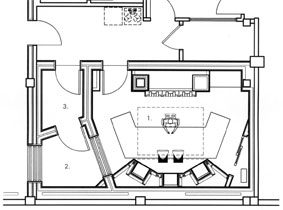
Hi All,
Found this while searching for german studios. I am reading this forum for a while now and what i have learned is that diffusion on the back is only useful when the back is at least four or five meters behind you.But now look at this.Its designed by Walters Storyk Design Group http://www.wsdg.com.Never heard of them before but seems to be a pro,at least they say.The back is only one ore two meters behind the seat.Why the hell did they put diffusors by RPG there ?
Got some pics of that too....
Recovered from web.archive.org — originally hosted at http://www.klangfaktur.ch/pictures/bau/thumbnails/drawing250.jpg
I am reading this forum for a while now and what i have learned is that diffusion on the back is only useful when the back is at least four or five meters behind you.But now look at this.Its designed by Walters Storyk Design Group www.wsdg.com.Never heard of them before but seems to be a pro,at least they say.The back is only one ore two meters behind the seat.Why the hell did they put diffusors by RPG there ?
The evolution of acoustics has been quite rapid since the use of ideas first used by Chips Davis in what became known as LEDE control rooms and diffusers based upon the work of Manfred Schroeder. Initially the idea of the back wall was to help provide ambiance without effecting the sound character of the direct sound. By using diffusers the character of the late reflections was made more diffuse and hence spacious, for lack of a better word. To avoid coloring the direct sound the rear wall was placed so that there was about a 20 ms delay before the reflections from the rear wall arrived at the listeners position. These two factors (ambient space and no early reflections) are the commonly accepted reasons for using diffusers.
If a sound is delayed by a small amount of time (less than around 20 -30 ms) and combined with original at a similar level there will be comb filtering caused by the phase difference between the two signals. Especially in small rooms, in order to try and get better sound quality, a lot of absorption is used. More than many people would like, because of the reduction of the ambiance. If the level of the reflected sound is reduced, then the comb filtering effect is reduced. This is why several technical documents (eg EBU t3276, available on their website) specify that early reflections be at least 10 dB lower than the direct sound.
The diffused refections from diffusers are reduced in level. In effective ranges, at least by 10 dB.
The back wall diffusers reduce the level of the early reflections, without adding more absorption to the room. This use of diffusers is often not understood by many people learning acoustics. Meaning people that know just enough to understand the basics, but not enough to know how much they do not know.
I am still waking up. so I probably missed a point or two, but I hope that is clear enough to answer your question about the diffusers so close to the listening position.
Yes WSDG is a pro group. They are one the best.
Andre
"The diffused refections from diffusers are reduced in level. In effective ranges, at least by 10 dB" - Perhaps a better wording (I know, I'm picking on you while you're still half asleep, sorry :=) would have been, "The SCATTERED refections from diffusers are reduced in level. In effective ranges, at least by 10 dB" -
It's only been recently that I learned of this reason people can "get away with" diffusors on short dimensions - and not too long before that, the reasons at least some designers (WSDG included) recommend facing the short way in smaller rooms (longer ER paths) - I personally think that I'm at a level where I have at least a general idea of what I don't know - however, I'm continually upgrading the magnitude of that ignorance as I learn. If I live long enough, my goal is to become so knowledgeable on acoustics that I become a complete idiot...
There is a fortunate side in my case to having to wait a few years before building my second (and last) personal studio - perhaps it will give me enough time to hear a few rooms from each school of thought (long vs. wide, diffused (scattered) vs. absorbed, etc.) - if I can do that BEFORE I build next time, maybe I'll be happier with the result than I was last time.
Andre, once again you stimulate thought, thank you... Steve
"The diffused refections from diffusers are reduced in level. In effective ranges, at least by 10 dB" - Perhaps a better wording (I know, I'm picking on you while you're still half asleep, sorry :=) would have been, "The SCATTERED refections from diffusers are reduced in level. In effective ranges, at least by 10 dB" -
Hmm... seems that this is a very difficult aspect of designing a studio.But what comes in mind now...
This LEDE design would be far better for people who have not much space for the control room.And with LEDE Design u dont need that much space behind listening position.But is it far more difficult to calculate and build a working LEDE design than a RFZ design which is more commonly here ? I ask because i have to build a studio soon,but i dont have that much knowledge in calculating an acoustically working environment.I am already happy that i understood how a RFZ design is generally working :-)
I think it would be better to build a RFZ design and knowing mostly what to do than trying to to a LEDE design and not exactly knowing if it will work.
Is it only another way to build a studio in LEDE design beside the common RFZ design ? Does it have some more advantages beside the need of less space ?
btw : Are these diffusiors for LEDE different than the ones used on the back of Large RFZ rooms ? How do they lower the sound level ? They look like every other diffusior i saw :-)
best regards,
Heiko
I think it would be better to build a RFZ design and knowing mostly what to do than trying to to a LEDE design and not exactly knowing if it will work
The RFZ design concept is a direct evolution of the LEDE design. Some people might refer to it as the next generation. Rooms designed strictly to LEDE design concepts are almost never made these days. RFZ concepts, which are derived LEDE design concepts are the most usual design.
Are these diffusiors for LEDE different than the ones used on the back of Large RFZ rooms ? How do they lower the sound level ? They look like every other diffusior i saw
The diffusers are the same. RFZ is a refinement of LEDE.
The scattered (note Steve :D ) reflection is spread across the plane or hemisphere in front of the diffuser. Since no energy is added and the sound wave is now spreading out over 180° the sound pressure level is lower because the same amount of energy is spread over a greater area.
Andre
I don't know of ANY recent LEDE rooms, they were found to be generally too dead. This makes them too exhausting to work in for more than an hour or two without a break, which is a lot of why things evolved.
With the advent of surround, even RFZ won't cut the mustard in its pure form - the front reflective splayed walls/ceilings are fine for stereo, if the rear wall is close it is generally absorbed and if further away can be diffused. Some like diffusion even with short rear gap in the room. However, with the addition of surround speakers we get early reflections from the rear surround speakers bouncing off the front, splayed, live soffits/walls. Most 5.1 rooms are being built with absorption all around, then ambience is replaced digitally. There is almost no other way to do this that I'm aware of. I think that part of why this works is that the typical living room is pretty dead, so mixes translate between CR and living room fairly close... Steve
Most 5.1 rooms are being built with absorption all around, then ambience is replaced digitally. There is almost no other way to do this that I'm aware of. I think that part of why this works is that the typical living room is pretty dead, so mixes translate between CR and living room fairly close...
Most small living rooms have the same listening problems as small studios. LF, early reflections. The audio enthusiasts talk about the same room problems as the studio builders, as do folk serious about their home theatres.
That's why I've been reading these discussion boards. :D
My new living room sounds bad compared to the previous ones and I've found the discussion here very helpful because I have the same acoustical problems to solve.
Best regards,
Frank
I think it would be better to build a RFZ design and knowing mostly what to do than trying to to a LEDE design and not exactly knowing if it will work.
Well I think you answered your own question. :D And that's the same conclusion I came to, when I was doing psuedo LEDE and was even thinking of some haas kickers in the rear corners, for my small CR. I abandoned the LEDE, took out the absoptive wall behind free standing monitors and soffited some new monitors. I had to try it. Slots, absorptive rear wall, hangers, bass panel traps -- I like it!
Best of Luck,
Dave