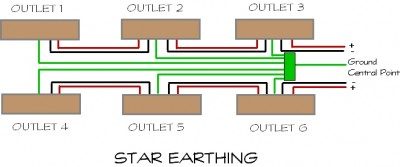
for a few days i have been reading about star grounding. this seems like it would be easy but i have found it pretty confusing. i'm going to put forth what i think star grounding is about. hopefully someone can tell me where i am right and wrong.
1) there are 2 types of grounds we are talking about here. there is a safety ground. this is connected to the box or some other exposed metal part. it protects you from being a potential ground yourself if the hot wire accidentally comes in contact with the box. the second type of ground is a ground used as a ground reference for your gear.
2) star grounding at it's most basic is about all your connected gear have the same reference ground. this may not be zero volts, but it should be consistent whatever the value.
3) in practice there will be 4 wires in an outlet. one hot, one return/neutral (back to power company and connected to earth ground at your house), one safety ground, and one reference ground for your gear. the safety ground will never be making a connection unless something bad has happened such as the hot wire touching the metal box. the reference ground will be connected to nuetral/ground at the panel. all ground wires are connected back to panel neutral/return which is also connected to a physical ground...post in earth..water pipe.
4) i wonder why the return/neutral (returning to power company) is connected to a ground rod also. all i can figure is another safety measure. i assume the path back to the power company has much less resistance and not much current flows into the ground around my house.
5) now, if this reference ground just has to be the same potential (voltage) for all your gear...why the home runs? why not just do them in series? well, i can't quite figure this one. maybe when done in series you are creating slightly different voltages along the ground wire. each ground from gear feeds in and the voltage increases downstream. thoughts?
6) without star grounding here is what i think happens. the outlets are wired a bit different. the safety ground and reference ground for gear are connected. and they are wired in series...no home runs.
am i getting this stuff?
No - The idea of star earthing is that each power outlet has it's own direct back to the power board earth wire so each outlet sees ground directly, not viia the adjacent outlet.
it sounds like you are saying just use a regular outlet and do home runs for the grounds. that's super easy.
so what's the fuss about isolated ground receptacles?
there is: here's one.
http://www.lowes.com/lowes/lkn?action=h ... Gnd.html#3
there are wiring instructions on same page. they talk about 4 wires....one hot, one nuetral, one grounding the box, and an isolated ground.
same thing with rod gervais' book. diagram page 105. but what you say appears to be right. there are only 3 wires connected on standard and star grounding.
standard:
1) hot. wired in series
2) nuetral (back to power company also bonded to earth ground near house) also wired in series.
3) ground (back to power company also bonded to earth ground near house). in this case both the nuetral 3rd prong and box. wired in series.
star:
1) hot. wired in series
2) nuetral (back to power company also bonded to earth ground near house) also wired in series.
3) ground (back to power company also bonded to earth ground near house). only connected to 3rd prong. not wired in series. each outlet has it's own home run.
4) safety ground. this is just connected to the box and never completes a circuit unless the hot wire comes off and contacts the box. bad.
sorry, i realize this is a very popular topic. i think what i'm grapling with here is the theory behind star ground. i believe it's pretty simple. but i seem to be missing parts of the puzzle. i have read through that pdf you sent before. and some other white papers. the trouble i have is they explain quite a bit of other stuff as well.
but i think i'm getting the idea.
Just a few thoughts on North American style AC power wires:
a) All ground wires are safety ground wires.
b) Isolated grounds are useful when the power lines come to the room through metal conduit. Because you have no control on what other power circuits the metal may touch. If your equipment power wires are Romex, or non-metallic NM or in plastic conduit then you don't need an isolated ground system.
c) Star ground is one of many wiring methods like home-run and daisy-chain. Star grounds can be used in both normal and isolated ground systems.
I think there many be some places/states/country that won't allow you too run the earth seperate.
But it doesn't have to be that hard. Just run a individual 3 wire cable to each point. No linking.
ok yes. they are all for safety. but i wanted to make a distinction between grounding the box and grounding gear in the star system. i guess this would be called star grounding with isolated ground receptacles. as i understand it these IGR do not connect the box with the ground prong. yes?
b) Isolated grounds are useful when the power lines come to the room through metal conduit. Because you have no control on what other power circuits the metal may touch. If your equipment power wires are Romex, or non-metallic NM or in plastic conduit then you don't need an isolated ground system.
ah...i'm beginning to see. the conduit may be grounding other circuits as well as your gear circuit. so you couldn't isolate your gear grounds. good point.
i have a conduit only because it runs underground from house to studio. one circuit, 2 wires. when they pull the new wires they could use romex etc
c) Star ground is one of many wiring methods like home-run and daisy-chain. Star grounds can be used in both normal and isolated ground systems.
so you could have star grounding for both regular outlets and IGR? is that what you mean? in both cases each outlet would have it's own ground path back to the main. but in the case of IGR the 3rd prong and box would not be connected. yes.
so star grounding - homes runs for ground on each outlet?
isolated - box and ground prong not bonded?
kill me now.
Remember that an Isolated AC receptacle has it's ground pin isolated from the mounting tangs.
www.passandseymour.com/pdf/G08-G09.pdf
If your running single wires you'll have a black (-) ,white (+) and a green for the ground on the plug. If your using sheathed cable you use a 3-wire cable where the white goes to (+), black to (-), red to the iso ground on the receptacle and the bare copper goes to the ground connection of the box itself. It all depends on the building codes and what they state you have to run the cable in for fire and electrical codes for your area ie, single wires in PVC,EMT or sheathed cable (Romex as you guys call it) or BX cable.
standard:
1) hot. wired in series
2) nuetral (back to power company also bonded to earth ground near house) also wired in series.
3) ground (back to power company also bonded to earth ground near house). in this case both the nuetral 3rd prong and box. wired in series.
star:
1) hot. wired in series
2) nuetral (back to power company also bonded to earth ground near house) also wired in series.
3) ground (back to power company also bonded to earth ground near house). only connected to 3rd prong. not wired in series. each outlet has it's own home run.
Electrical receptacles are not connected in series. They are all connected in parallel. If everything was connected in series you would need all of your equipment or lights turned on so that one light or piece of equipment in one room would work. So, Just remember that all electrical connections are made in parallel.
The neutral is the current path back to the transformer which completes the circuit. The reason the neutral is bonded to the ground so that when there is a short circuit across the hot and neutral the circuit breaker can detect it.
Ground protects YOU. The user of the equipment. It doesn't do anything for the equipment. All ground does is protect you from stray electrical currents going through your body.
The star grounding topology deals with the audio grounding in and of itself. To do star grounding with electrical would be inefficient and totally unnecessary, because of the additional wiring necessary. The improvement of computer power supplies renders the necessity of individual ground runs unnecessary. Which was the original reason for the isolated grounding receptacles.
In this case, the in series statement means from unit to unit. The hot wire from the panel goes to unit (1) then the hot wire goes to unit (2) and so on. This is some times called "daisy chaining". All the receptacles have 120 Volt output. All the hot wires are connected to hot terminals or hot pigtails.
The star grounding topology deals with the audio grounding in and of itself. To do star grounding with electrical would be inefficient and totally unnecessary, because of the additional wiring necessary. The improvement of computer power supplies renders the necessity of individual ground runs unnecessary. Which was the original reason for the isolated grounding receptacles.
Is this true?????????????????????????????????????
Star grounding with electrical is totally unnecessary???
But it doesn't have to be that hard. Just run a individual 3 wire cable to each point. No linking.
[/quote]
No linking at all? Each on its own breaker?
Or say from one breaker to a junction box and then 3 cables from the junction to 3 different outlets.
Would that be star-grounded?
my take on it... and i almost wish i hadn't asked....
the point is that each outlet should have it's own wire back to the ground/nuetral bar.
you could do this by running all wires to each outlet. no daisy chaining.
or you could wire everything daisy chained except grounds. again each outlet would have it's own ground back to ground/nuetral.
then there are isolated recepticals that separate the "safty" or box ground from the 3rd prong ground if you know what i mean. so one extra wire.
i have't yet found an explanation of why star grounding does what it does in basic electrical terms such as ohms, amps, voltage, and circuits. i know it's about getting the same potential/ground for all gear but how star ground does this i don't know.
anyway, it's going in tomorrow.
Just some more random thoughts:
From the breaker panel to an outlet. The Hot, Neutral & Ground must follow the same route, in close proximity to each other.
One breaker can serve a reasonable number of outlets (the rule for this number vary). To do this in a "star" or "home run" system. Split the Hot wire at or near the panel. Then run the Hot, Neutral & Ground wires to the outlet. At the panel end, connect the Neutral wire to the Neutral bus and the Ground wire to the Ground bus.
Unusual for a North American AC power wiring system. Seems more like a G.B. system. 5 core cable rated for building wiring is not readily available in N.A.
Not it is not true. Star grounding is designed to prevent AC ground loops, which most certainly do cause major hum issues if allowed to happen. I see it all the time in video post facilities, and also whenever I have to run live sound at events. All it needs is one idiot musician plugging in some piece of equipment to a "convenient" outlet instead of to the power strips I provide, and its "hum city". Whoever said that you don't need it does not have a clue what they are talking about, and has never worked in the real world of live sound or post facilities.
The issue has NOTHING AT ALL to do with computer power supplies. It has everything in the world to do with ground loop current finding its way through AUDIO SIGNAL cables between two items of equipment that are plugged into different grounds. Even a small AC current flowing through the shield of a mic or instrument cable can induce hum. That's the issue. There's a reason you find those "ground lift" switches all over good quality direct boxes, stage boxes, etc. The manufacturers don't just put them in for fun...
Star grounding with electrical is totally unnecessary???
It is most certainly very necessary. Like I said, I run into it issues with it all the time, both in installed systems and in location systems. Ignore star grounding and get bitten! Believe me, you will be very sorry you ignored it. It isn't that much more expensive or difficult to do than normal daisy-chained grounding. Do it right from the start, and you won't even notice the extra cost. But fixing it afterwards is a major cost, and a major PITA. (Ask some of the clients for whom I've had to fix non-star grounded issues, and they'll tell you all about it.)
Unusual for a North American AC power wiring system. Seems more like a G.B. system. 5 core cable rated for building wiring is not readily available in N.A.
It occurred to me that roadies sometimes use cables similar to this for stage productions. So maybe some spare cable was available or just that he was familiar with this type of cable.