Ah, reality. You always get me.
Let's start with a declarative statement.
A two-leaf system is superior to a three-leaf system with the same overall thickness.
Here's a pic of the room in question. http://hotelmorrell.com/studio/Basement02.jpg
I have glass block windows in my basement. They're set 14" back from the surface of the interior wall. If I put another sheet of glass inside, I now have a three leaf system.
Here's the question - would this be worse than the existing two-leaf glass block, or better because it's 14" deeper?
Thanks! I'll be posting more soon - Rod's book comes today; I'm sure I'll have more questions.
Tim
A two-leaf system is superior to a three-leaf system with the same overall thickness.
I'm not sure that I agree with that statement! I kind of think "mass" comes into play, too!
Imagine a 2-leaf wall that is a total of 12 inches thick, and consists of nothing more than a single layer of 8mm drywall on each side of double studs, with an air gap. As far as I can see, there is no way that wall will ever be superior to a 3-leaf wall, also 12 inches thick, but built from three leaves of 80 mm thick lead plate on three sets of steel studs!
I think thickness is a part of it, but mass is rather important too. So is damping.
- Stuart -
If I put another sheet of glass inside, I now have a three leaf system.
I'm not sure that I agree with that statement either, although I'm a lot less certain about this one. As far as I know, glass blocks basically have a fairly deep vacuum inside, due to the way they are manufactured. Sound cannot travel through a vacuum at all. So you have an evacuated hollow space which does not carry sound at all (or practically nill), surrounded on all sides by a thick, massive and stiff glass envelope that DOES conduct sound, in the same way as normal mass. I'm not at all sure if that qualifies as one leaf or two, but I strongly suspect that it would act as a single leaf, since the "cavity" just isn't there, as far as sound is concerned. I think!
Is Andre around? Maybe he'd be the one to comment on that. Or Rod.
- Stuart -
I'm not sure that I agree with that statement! I kind of think "mass" comes into play, too!
Fair enough.
Your explanation of the glass block makes sense, it's actually what I had originally assumed until I started overthinking things.
So perhaps putting another sheet of glass up is a good thing?
Tim
So perhaps putting another sheet of glass up is a good thing?
I want to say "Yes", but I'm still not 100% certain that my analysis is correct. I'm hoping one of the real acoustic experts can chip in with their take on glass blocks.
Do you need more isolation? What kind of isolation are you getting right now, with just hte blocks? Have you measured it with a meter?
- Stuart -
Well, I haven't measured it, because the blocks are definitely not the worst culprit. That would be the dryer vent :)
I'm in the planning stages of a vocal booth for the studio, and was thinking of putting it up against the wall that has these windows. Then (potentially) the windows are the weak point, at least to the exterior.
I'll be posting about the whole thing once I think I have all the questions to ask...I just got Rod's book (I'm up to chapter 10!) and now I'm waffling a bit - I know I can't do it "right" because of money and space considerations, so I'm trying to rephrase all my questions in my head to do it "the best I can".
Tim
A two-leaf system is superior to a three-leaf system with the same overall thickness.
Actually, this isn't quite true either. A 2-leaf system, with less mass, can outperform a 3-leaf system.
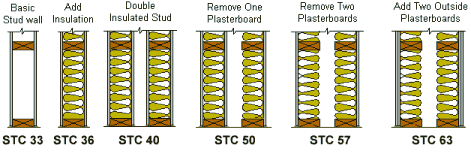
There is a drawing in Rod's book very similar to the one attached below. Look at it carefully. The 3rd from the left is a double wall, built conventionally (drywall on both sides) and it gives 40dB of iso. Remove 2 of of the sheets of drywall, and with less mass you get 57dB of isolation, a HUGE 17dB increase. This compares a 4-leaf to a 2-leaf, but even a 3-leaf (STC50) has 7db less iso, with more mass.
Recovered from web.archive.org — originally hosted at http://www.ethanwiner.com/misc-content/walls.gif
Right - when I said 'thickness' I meant the physical dimension from the outer face of the first leaf to the outer face of the other side of the finished product.
So, like in Rod's book, a 12" wall that's 2 leaves is better than a 12" wall with 3.
So...now that we've agreed on my sentence structure...
What about my original question?
Would installing an additional leaf inside the glass block reduce the effectiveness, or increase it?
The sentence should read like this: "A two-leaf system is superior to a three-leaf system".
That pretty much covers it.
I find the whole two-leaf better than three-leaf concept very interesting. Logically it don't make sense to me. Less mass but better isolation?
Does anyone around here know the reasoning / physics behind this anomaly?
Does it relate to the added distance of the leaves? Or does the closed wall act as a drum head and resonant chamber?
Sorry if I'm beating a dead horse... this MUST have been brought up before. But after quite a while searching I have not been able to find an answer that satisfies me.
No real explanations that i have seen. it don't mean there isn't one somewhere. i have tried searching and have spent hours reading all kinds of threads.
I do see that it is the more desired to have 2-leaves, and I don't doubt that it is the best. It is obviously tried and true.
That is a good answer in itself. If two leaf is getting the props and three leaf is not, two leaf it is ;)
To me, a three leaf never made sense in respect to sound isolation, although I have seen it used by well educated and highly regarded firms, although not specifically for music related rooms. Either it has a use, and I am too lazy to be bothered with the frequencies to worry with, or it was a mistake. The latter of the two not likely.
The simple thing, for me, is that mass is what is required to stop sound from penetration. Since I already know that a mass with air and another mass runs the risk of sound leakage between the two mass areas, it's a simple notion to not introduce another air space, which is another potential area for sound to live in.
There are papers with mathematical data that show lose of isolation at the lower and higher(if I recall) ranges of frequency from using a three leaf wall panel. Again, for music related isolation, you do not want any sound to get through, which is why we build things like we do, so this is another strike against the three leaf.
I agree, a three leaf has gotten a bad rap, with not much supporting documentation that the everyday DIYer can understand, but the rap is well deserved.
I have and existing uninsulated basic stud wall, beside which I'm building a rehersal room. I was going to apply insulation directly to it and the build an insulated wall beside it. Basically the 1st wall and half of the last wall below.
Recovered from web.archive.org — originally hosted at http://www.ethanwiner.com/misc-content/walls.gif[/quote]
From what I've read in this thread it seems that in principle I could improve this wall by stripping the inside layer of plasterboard from the 1st wall and insulating it.
Is this right?
Major,
basically you're talking about building the STC 50 wall (in the middle) minus the insulation in the wall to the left (so an STC 47 instead of 50).
Remove the inner core of drywall and it becomes STC 57 (more than twice the isolation) - add 2 more layers to your side of the wall and get double again........
Rod
Rod,
I cannot alter the other side of my existing wall, only the side that faces the proposed rehersal room. Something that I thought on doing was applying an EXTRA layer of plasterboard to the existing inside wall, and then a layer of inslation. This would resemble the 6th wall in the diagram (STC 63) with a single leaf stud wall butted directly onto one side.
What would happen here? It looks like 3 leafs but I wandered wether it might work a bit more like "2 leafs and a bit" - because of the sound being more affected by the higher density of the inner leaf? If that ISN'T the case then that would mean nailing a 2X4 and a layer of plasterboard to any wall would actually decrease its effectiveness, surely not?
Splitting hairs i realise but do you see what I mean?
If you want to see what wall I'm talking about check the subject "Absolute beginner" (wall C in the proposed layout), would put it on here but dont wan to hijack mp's thread. :?
Morgan
New to the forum and am in the midst of performing my due dilligence by going through all the beginner information before asking specific questions....however I was wondering if you all could direct me to the thread where the image that was quoted above originated with regard to the STC ratings for differently designed walls. I'm curious whether it also includes other images of other wall construction techniques (specifically single wall with wood non-staggered stud construction) and thier various affect on STC. A quick illustration of the effect of RC, insulation, double sheetrock, etc. would be really useful to me.
dayday - fraid I can't help with the source of that diagram. I'm new to the site as well.
Major_Morgan wrote:
I cannot alter the other side of my existing wall, only the side that faces the proposed rehersal room. Something that I thought on doing was applying an EXTRA layer of plasterboard to the existing inside wall, and then a layer of inslation. This would resemble the 6th wall in the diagram (STC 63) with a single leaf stud wall butted directly onto one side.
What would happen here? It looks like 3 leafs but I wandered wether it might work a bit more like "2 leafs and a bit" - because of the sound being more affected by the higher density of the inner leaf? If that ISN'T the case then that would mean nailing a 2X4 and a layer of plasterboard to any wall would actually decrease its effectiveness, surely not?
I have looked into this since my last post but still need some help.
Image not preserved: proposed wall c 1,2.jpg
Image not preserved: proposed wall c 3,4.jpg
I now accept that it may be better to actually remove a layer of sheetrock from the existing wall and insulate (3 on diagram) the cavity. - but how would this compare with insulating the outside of the existing wall (2 on diagram)??
Number 4 is what I had planned to do, Would anyone care to hazard a guess at the STC of a wall like this? How would it compare to wall 6 in the other diagram (STC 63)??
What about increasing the size of the air gap? What is the optimum size to negate frequencies below 100Hz?
Pretty stumped here,
Morgan
Number 4 is what I had planned to do, Would anyone care to hazard a guess at the STC of a wall like this? How would it compare to wall 6 in the other diagram (STC 63)??
Morgan
Morgan,
The easiest thing to do is make it easy on yourself. Taking the time to read and get a basic grasp on the mass-air-mass concept is at least essential to your build and as a starting reference, it just keeps on giving ;)
STC is used for the human voice and what the human ear can decipher from that frequency range.
In respect to what a wall can do to contain low frequency, it isn't the best barometer. The TL(transmission loss) is an upgrade and isn't that difficult to get a handle on or find numbers correlating to things like STC, FSTC, OITC and the like.
Yes, this is not what you would want to do.
Pretty simple process. Think "heavy" think "thin" think "heavy" again.
All the combination's will work and work well. The issue is that in the lower frequency range a three leaf design can let it all out, so to speak.
But a 3 leaf is a subjective subject. I have one over my head right now and live with it:)
To build one on purpose[a three leaf] requires a great deal of information and installation history to have any type of knowledge of what to expect.
For the rest of us, we tend to avoid it due to the idea that first it is not helpful in the frequency range we might desire and second it costs more and third it takes up more floor space.