Hi,
Is this as big an issue as I think?
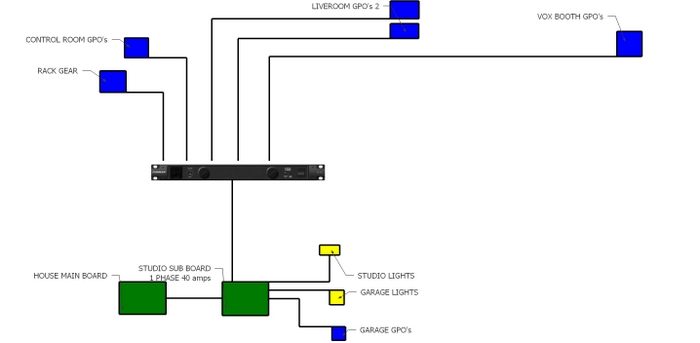
I had the lekkie contractor come to put a sub panel in the studio, which is in a seperate building than the main house.
My plan was to bring both phases across- 1 for lights and General power, 2 for the studio Only GPO's.
BUT to my dismay there is only one 80amp phase coming into the house!
Is that normal?
Will this affect the studio- hum-earthing-noise clicks from fridges and the like?
Or is it what happens after the power reaches the sub panel that I should be worrying about?
lil
That's unusual alright. As to whether or not it will cause you problems, let's just say the risk is high but it's not an absolute guaranteed issue. You won't know for sure until you get everything hooked up and running of course. One thing you could do to combat or minimize any issues is to do some power conditioning on the key components. You might want to do that anyway.
That's normal for Australian households. Your only option is an isolation transformer which is horrendously expensive or a UPS for the computer and gear.
cheers
john
Worst case, if it does turn out to be a big problem then you could install a good on-line UPS that fully isolates output from the input, with a separate ground on the output side, and hook up all your audio gear to that. It might be a bit pricey, though, depending on your load requirements. But it would still probably be cheaper than getting three-phase power installed.
I've put in a application to powercor to add a 2nd phase to the house. It will take 20 days for them to get back to me. I'll keep you posted. But i'm guessing a UPS will be the cheaper option.
thanks guys
So, to add an additional phase from the powerline to the house will only cost a $170 au fee plus the electrical work....or
an addditional underground phase for a cool $1800 au plus trenching work.
I'll get my sparkie back this week to get his quote/opinion.
But I think it has to be an option.
there is nothing worst than hum.
170 bucks ain't to bad! I would have expected more than that. Sounds like a good solution. You'll be totally isolated on your own phase then. Unless your neighbor decides to take up arc welding as a hobby, on the same phase as your studio .... :)
http://www.furmansound.com
So when you guys talk about power conditioners/UPS's would the above be enough to run the studio's recording gear?
Then would I have the issue of the live rooms GPOs?
Even though the power companpies fee is only $170, the cost of two new distribution boards.
Running the new 2 phase throught the roof.
A trench to the studio.
Plus all the studio wiring ( star earthing )
I don't think I can afford it :(
Hey Lilith,
A couple questions for you and maybe I can help some.
You say Single phase 80 amp
To me it means you have two hot legs and one neutral. To us thats normal but most of us have 100 amp to the house
In your neck of the woods this would be two 240 volt leads splitting your panel in two ( at the house) and one neutral. One side 240 volt and the other 240 volt. Each independant breaker being 240 volt.
If you added another hot lead and you already had two this would give you 3 phase. Which you wouldn't need
Is this correct or do you only have one hot lead coming in. Which totally confuses me and I'm clueless.
In my set up I have a 100 amp panel at the house. I installed a 50amp breaker at the house and installed a 50 amp service panel in the studio. (free standing approx. 75' away from the house )
In the studio panel I installed 15 amp breakers
Dedicated two to lights, three to plugs and one solely to the CR. Star grounding.
I have two hot leads coming into the studio each one is 120 volt and one neutral.
The house panel is Earth grounded and the studio panel is earth grounded.
From My AC plug in the CR I have two Furman Conditioners running all the gear.
And maybe I have no idea how the Aussie power works :?
Hope this helped in some form or fashion
Peace
Tom
http://www.furmansound.com
So when you guys talk about power conditioners/UPS's would the above be enough to run the studio's recording gear?
Those are power conditioners, not UPSs. A UPS has large batteries inside (or connected externally). In the best true full-time on-line UPSs, the electrics are split into two independent systems, around the central battery pack. On the input side, you basically have a large "battery charger" that takes AC power in, and turns it into DC that charges the batteries. All that this part of the UPS does in life is to charge the batteries continuously. It does not directly supply power to the load (your gear), so it does not really matter how stable the input supply is: If the voltage varies a lot, or the frequency changes, or there are spikes and drops on the line, all that happens is that the batteries are not charged quite as well as they could be, but that's it. The input variations just become variations in charging current, but that does not have any effect at all on the output.
The second half of the electrics is on the output side, where you have a large inverter that draws DC power from the batteries, and "inverts" it (strange name, not really correct, but whatever...), which basically means that it turns the DC back into something resembling a 110 volt sine wave (or 220 volt sine wave, depending on what you need / where you live) that supplies your load. The inverter creates a clean, stable, regulated output to supply your equipment, regardless of what the input does. If the input power goes outside of design specs (for example, the input voltage drops too low, surges too high, drifts way of frequency, etc.), then the UPS detects that and just turns off the "battery charger" part, and continues to supply clean power to your load, until the batteries run out of juice. That might be anywhere from a couple of minutes to a couple of hours, depending on a number of factors, but most of them have large dollar-signs built in to the equation!! So you'll probably want to go for a UPS that will give you maybe 5 or 10 minutes of power in the event of a complete blackout. Plenty enough time to shut down everything cleanly before the batteries give up.
What your link shows is just a power conditioner: It has no batteries, no charger, and no inverter. Instead, it has power regulators, filters, surge suppressors, and other fancy circuits designed to try to stabilize the output as much as possible. It will certainly help, but depending on how bad your problem is, it might not solve the issue 100%, for two basic reasons: Power conditioners do not disconnect the source from the load, and they cannot make up for "missing" power. With a power conditioner, there is still a direct AC electrical connection from input to output, albeit through circuits that do good things in between. So if you have a noise issue, then a power conditioner won't necessarily fix it (although it probably will). And if the power fails, or varies outside of design specs, then that can get passed through to the output.
In order to be certain of fully isolating your gear from the rest of the world, a true UPS is your best bet, since the only connection between input and output is through the batteries, but they are DC, not AC. The entire AC waveform is first "killed" in the battery charger part, then re-generated cleanly from scratch in the inverter. A UPS cleans, filters, and conditions your power much better than any power conditioner could do by itself, and has the added advantage that it will continue to supply you with power even if you have a total blackout. A power conditioner will not do that.
If you want even better isolation you could use a large isolation transformer, in addition to either a UPS or a power conditioner, and that will also let you isolate the ground. A true isolation transformer (but NOT an auto-transformer!) has two identical windings that have no electrical connection between them at all. The only connection is via the electromagnetic field created by the input coil. So you can ground the neutral side of the output coil to your own totally separate, isolated ground (usually one or more large, thick, long copper rods driven into the ground), and have an absolutely separate clean ground for your gear like that. However, do check your local code to find out what is and is not permitted with grounding, and DO get a qualified electrician to do the work: electricity is dangerous, and it can bite you real hard if you don't to it correctly. I'm just telling you what my code allows here, and what I will be doing, but your situation may be different, and your code might require that input ground and output ground be linked, or it may not allow you to ground your neutral conductor, or whatever (in which case the isolation transformer isn't a lot of use!). so check with a local electrician, to make sure you do it right for YOUR location.
However, an isolation transformer big enough to run your entire studio is not going to be cheap! Lots of dollar signs there too! Good news: Some UPSs allow you to have separate input and output grounds, thus isolating everything as best as possible. Check with the manufacturer to see if you can do that: Not all UPSs are capable of doing that. But even if you don't do that, the UPS is still a much better isolator than a power conditioner.
Now don't get me wrong: power conditioners are still a good idea, and they may well solve your problems, but a UPS is better, and stands a much better chance of killing all your power issues at once. Of course, a good UPS costs a lot more than a good power conditioner, but like most things in life, you get what you pay for!
To answer the question of whether or not a power conditioner is good enough for your needs, maybe you could get someone to lend you a power conditioner first, so you can try it out before you buy?
One final comment on your ACTUAL question: to figure out how big a UPS or power conditioner you need, you'll first have to check the power label (or the manual) on every item of equipment that will go in your studio, to see how much power it consumes. Note down either the "watts" or the "amps" rating from everything.
Then add up all of those numbers (either "watts" or "amps"), and if needed take into account a ball-park power factor for your equipment if you are using VA (probably something like 0.7), take into account a decent margin of safety and future expansion (20% for safety, whatever you feel like for expansion), and then you will now what size conditioner / UPS / isolation transformer.
So, for example, if you figure that all your equipment together draws a total of ten amps, your safety margin would be 2 amps (20%), your expansion margin might be another three amps, so you'd need a power conditioner / UPS / isolation transformer that is capable of handling a continuous load of at least 15 amps.
Excuse the long ramble... I'll bet you are no better off now for deciding on what to get, than you were when you started reading! Probably even more confused than ever!!!
- Stuart -
Yes sorry here some more info-
As you can tell I know nothing about electrics.
I think I have 1 single 40amp phase coming into the house
This house is old, at least 100 years. The board only has a meter (pic)
three fuses and a saftey switch.
The sparkie was talking about placing a filter between the main board and the studio. So that is an option.
You say Single phase 80 amp
To me it means you have two hot legs and one neutral.
If Australia is like Chile (and from memory, it is) then that means one live conductor, one neutral conductor, and one ground conductor. Neutral and ground should be at the same level (within a few dozen millivolts), and live should be 220 volts above that.
The sparkie was talking about placing a filter between the main board and the studio. So that is an option.
A simple filter probably won't help all that much. It won't help at all for surges, dips, transients and frequency issues, for example. It might help to some extent for simple clicks and buzz form the house circuits (EG, florescent lights, dimmers, fridge, things getting turned on and off, etc). But it won't deal with other issues that you might have.
Maybe you need to get your electrician to attach a recording analyzer to your line for a few weeks, to see how bad a problem you have. What that thingy does is to "monitor" all the parameters of your line (voltage, frequency, spikes, etc.) and record "events" that are outside of whatever specification you set on the recorder. It has memory on board to keep track of all the "events", and you can then download the list of events, or print it out. That will give you a good idea of just how bad your problem is, and based on that you can decide what to do about it. I wouldn't make any big $ decisions without first understanding what is wrong with your line. To put it in acoustic terms, this is like saying that "someone told me that I need a Helmholtz resonator tuned to 91 Hz. and 9 square meters of plywood panel trap", but it turns out that you haven't even measured your room yet!
Getting your guy to hang an analyzer on your line for a couple of weeks and give you the data, is equivalent to pumping pink noise into your room, setting up measurement mics in various locations, an plotting pretty wavy lines with ETF. It tells you what is REALLY wrong with the room so you can figure out how to fix it.
- Stuart -
Wow thanks sound man!
The problem is it's not built yet, so how far should I go now with the little $$$$.
I am currently running my entire studio in a spare room off 1 GPO ( and lots of power boards!)
I have no noise, spikes, hum or drop-outs.
My worry is earth hum once I get the live room up.
He he, you keep betting my at the "post" pardon the pun.
I need to investgate a little more.
I buy a power conditioner for my rack gear, and allow during the building process for star grounding- though my guy has no-idea what that is!
OK,
Star grounding question! Sorry
With sinking the earth rod(s)
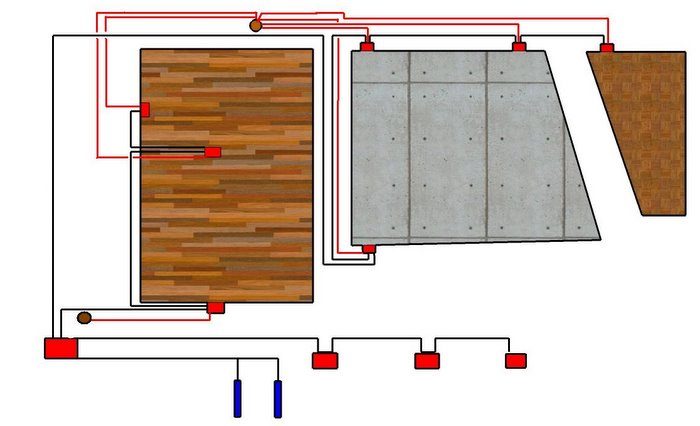
Q-Can I place one rod near the sub panel and one on the other side of the slab.
Dividing up which socket goes to which rod via the easiest route?
Picture shown
This doesn't look like a "Star Ground" to me.
With a "Star Ground" system all the audio equipment grounds should connect together in the circuit breaker box.This is called a "home run" in the States.
All the "Ground Rods" must (that's MUST) be connected together.
The people with the best information on how to wire a system, that is available on the web are:
Bill Whitlock of Jensen Transformer
Jim Brown of Audio System Group
First read Bill Whitlock's Generic Seminar handout
"Understanding, finding, & Eliminating Ground Loops in Audio & Video Systems.
Q-Can I place one rod near the sub panel and one on the other side of the slab.
Dividing up which socket goes to which rod via the easiest route?
Nope! Bad idea! Like Speedskater said, that isn't a star system. It's exactly what you DON'T want.
Think of it like a star: The "points" of the star are your wires running to each individual socket, rack, metal frame, etc.. The "hub" at the center of the star is one single location, and that is where your grounding rod(s) is(are) connected to.
OK, it doesn't have to physically look like a "star"! The geometry is a star, but you can stretch those star "points" out any where you want. As long as you keep the same general geometry, with only one hub, that's all you need.
In other words, you need ONE, and only one, central point where all the ground wires from everything all join together. That is usually inside your main distribution panel for your studio. Usually this is a long metal "bar" with lots of places to attach the individual grounding wires from all over. That "bar" is the central hub of your star.
Then, connected to that same "bar", is a very thick copper wire that runs out to wherever you have your physical grounding rod(s). Sometimes one single grounding rod is enough, but often you'll find more. When I install video post production suites, I usually specify four copper rods, each 2m long, pounded into the earth roughly in a square pattern, and cross linked with thick copper wire. At some point on the cross-link is the connection to the bar. One again, there is only ONE connection from this "grid" to the actual ground bar in the distribution panel. The aim is to get the lowest possible resistance to ground, and you accomplish that by increasing the contact area, hence four copper rods are better than one (although one might be good enough, depending on your soil type and electrical system), and thick copper wire is better than thin, for the same reason: Lower resistance.
If you have two separate grounding rods with the sockets split between them, as in your layout, then you have two grounding points. So you have the potential for those two points to be at different levels, electrically. Another name for "electrical potential difference" is "voltage". In other words, you might find that there is a different "ground" level voltage at those two points, and therefore current will flow through your grounding wires, which is exactly what you do NOT want to happen! In fact, as soon as you have even a slight ground current in one of those copper rods, perhaps due to the eliminating the hum from a well grounded bass amp for example, then you have no created a potential difference, and also theoretically a ground loop.
Now here's where ti gets confusing: your electrician might think that he can just run a wire between those two copper rods, and thus solve the problem: Wrong! that could make it even worse, since each ground signal now has two paths to ground, with different resistances, and those two paths are absolutely connected in the dreaded "ground loop", meaning that current can flow "every-which-way-whenever". Now you have a really bad problem (potentially). From a purely electrical safety point of view, you can have dozens of ground rods all over the place, connected to individual sockets, groups of sockets, etc. That's fine, for electrical safety, which is all that most electricians are concerned about. But it is NOT fine if you want to eliminate hum and noise. Most electricians are not concerned about that, and don't even think of it in designing the system. They just put grounding anywhere that is convenient, easy and cheap. They build safe systems, not systems that are safe AND ALSO noiseless.
"Star grounding" means one single point to which all ground conductors lead. It means one single connection to physical "earth". Anything more is bad.
One other point: If your electrical code allows it, then you should also consider tying your main "neutral" conductor to ground, at the distribution panel. You can only do that with some types of electrical system, so MAKE SURE TO CHECK! DOING IT WITH THE WRONG SYSTEM CAN BE DANGEROUS!! But if you can do it (if code allows it), then do it! It makes your electrical installation safer, and reduces even further the possibility for electrical noise in your studio. And once again, do it at only ONE point, inside your distribution panel, with a single thick copper jumper between your main neutral bus and your ground bus.
- Stuart -
Grounding is as misunderstood as compression is. Both of which, if not done properly can ruin your day.
Nice description on the concept guys. All the green wires connect to the earth, is the way I remembered it.
W
Ok,
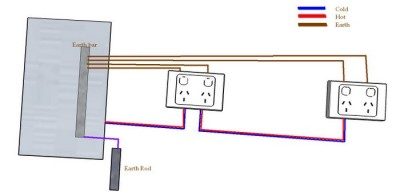
Is this more like it?
1 x 2 core wire daisy chained to eack GPO (hot and Neutral)
1 x 1 core earth return of each individual GPO.
So if I end up with 3 GPO's I will have 3 earth returns?
As I look at your pic I see you have all these grounds coming out and back home.
You run a feed from the panel to...let's say your receptacle for you rack gear and then to the other receptacle in the same rack. Coming in you have your hot cold and ground. You then make another run to you next receptacle. This is all one ground, it just needs to be made continuous by being connected in the first box and connected to the receptacle via a pigtail. The connections in the second box are made directly to the receptacle. So, no extra runs of ground wires back to the panel. I hope I am not confusing you.
You may want to go to your local supply outlet (Home Depot here in the states) and pick up a book on basic wiring. They are very helpful. :)
W