Hey Bryan,
Do get one :) For web pictures, you really don't need to get the 8 megapixel model if you're just going to shrink them down to 600x450 anyways, and between craigslist and ebay, the camera has pretty much paid for itself when I sell stuff.
I think every human who frequents forums like these should have a cheap digi-camera :) I would love to see what you're brewing up in your new space.
BTW, my sheetrock subcontractor FINALLY will be starting tomorrow. . . after a prolonged 1 month delay. Very excited to get closed in.
-'Chung
ok. . . now that the sub-contractor has taken over for a bit, I have some time to think about acoustics for a moment. . . I'm working on learning Archicad still and will come up with a model of the actual room, but for now, let me see if I am understanding various important information I've learned from this forum correctly.
Let's assume my room is roughly
22ft. x 18.5ft. x 11ft.
with a rough estimation of materials entered into the RT60 calculator, I get these numbers with the room raw and untreated.
125Hz 250Hz 500Hz 1000Hz 2000Hz 4000Hz
.52 sec 1 sec 1.44 sec 2.21 sec. 1.76 sec. 1.47 sec.
Here's a picture of my room modes from the calculator.
Here's how I think I might approach treating the room. Please let me know if I'm understanding things right.
I should try to achieve at balanced RT60 over all frequencies in order to have a balanced room. What I do not know is what range that number should sit in for a live room/alternate listening room. Assuming I'm at least going to have to knock everything down to the lowest response time which was .52 sec, I'd need to have some high frequency absorbtion on a substancial surface area. I would also need to provide some trapping from 250-500Hz which could be achieved with slat resonators covering much of the side walls. And get some broadband bass trapping and hangers going for underneath ~250 Hz. . .
When i look at the room modes is this gives me the points in my room where there will be spikes and dips in my frequency response due to sound behaving like pressure zones or something like that. Anyways, if I want to minimize this effect, I should attenuate the peak frequencies, and pay particular attention to where the modes overlap. So, for my room in the model, 51 Hz and 103 Hz will be of particular concern, so I should tune my slot resonators and hangers to hit those mode frequencies. . . or even build some panel absorbers.
The way I understand it, all rooms including mine benefit from broadband absorbers along the corners, and I'll try to do that. Also, I assume from what I see in the forum that it's safer to build rather broadband absorbers as opposed to multiple absorbers targetting specific frequencies. . . you want to kinda center an absorber around a frequency, but spread it's range out a bit to get a more even effect.
Lemme know if I'm on the right track. If so, I'll proceed w/ designs and plans and letyouall know when I have a model or drawing. . . otherwise, please let me know if I'm not understanding something correctly. . . well, before I build something that won't work :)
Before I build anything, I'll go ahead and take some measurements of the pre-treated room and post them to verify and adjust details like slot spacing, hanger size, and such, but I wanted to have a game plan in mind. Guess that's why you guys have developed all these cool tools here.
-'Chung
Hi Chunger and everyone,
I am new here and enjoyed this thread so far... so curious, what is the current status? hows it going? Hope all is well.
Also, I am in the Bay Area and if you ever need help lifting drywall into place or other acoustical analysis or 2nd set of ears let me know... cool...
I have some questions, etc. and am really curious as to the results especially with how you floated the floors and hung the walls on the RC...
But, really just want to know whats up as of 8/25 :-)
Best Regards,
David
Hello Dave,
I could sure use an extra set of hands for drywall just about now. The situation with my subcontractor who was supposed to do all the steel and drywall did not work out. Happens I guess, but I've been working on finishing the RSIC's and resilient channel. As usual, the ceiling for me is complex and took a while to figure out the little details.
Time to get buff and put some drywall up. I waited for my subcontractor for a month to get in there, but now, I think I'm on my own again. Have pictures of progress, but need to get my laptop back to post.
PM me and let's get together and talk about what you've got brewing as well.
-'Chung
Hmm. . .. things have gone down hill a bit in the last couple weeks.
I was wondering if anyone on the forum can recommend a good lawyer to help me sort out my sub-contractor-not-showing-up issues. I believe I have a good case, and I believe he is in violation of 2 sections of California's Business And Professions Code.
But I need to talk with someone who can give legal advise. Please let me know if you have any leads in the San Francisco area.
Thanks,
'Chung
Hello,
Made some progress. . . forgot to take some photos, but I guess it goes like that when you're busy. enjoy!
It's amazing how much smaller the room feels w/ the RSIC's and double 5/8" sheetrock on. I also noticed an issue w/ the RSIC's that y'all might want to consider. The hat track creaks and rattles a bit in the clips. I hadn't thougth of that before, but we will see if this becomes an issue. It is only audible when you pound on the walls, but it is there. At any rate, I don't like it, and I added a fair amount of insulation in parts of the house between the hat track and drywall (contacting the drywall), and this dampened the noise quite a bit.
-'Chung
had a question about a murphy bed. I'm in negotiations with the wife about modifying the murphy bed to function as a bass trap as well. . .
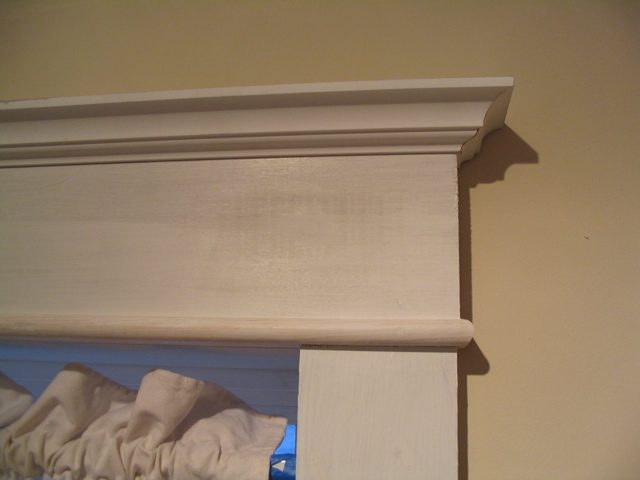
here's what I've come up with. She has a nice piece of embroidered linen that we're going to stretch over an opening, and I'm going to "picture frame" the linen into the face of the folding bed with trim. The depth of the entire bed cabinet is 16".
As it sits, I can use the hole as broadband absorber. . .as much as a mattress/bedding can give me. My question is, will the heimoltz calculator work on this bed cabinet if I fill the hole with 1x2 and 2x2 slats?
Or does the entire volume of space in the cabinet enter into the equation, and the calculator will not work right?
If it does work, I'll have the world's only hemoltz resonator that folds out and you can sleep on it :)
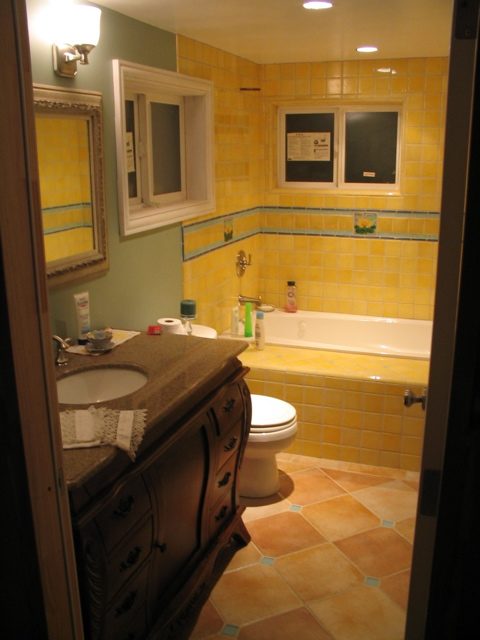
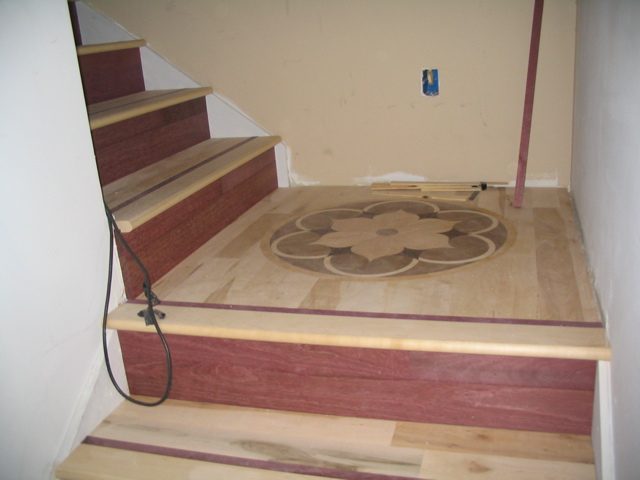
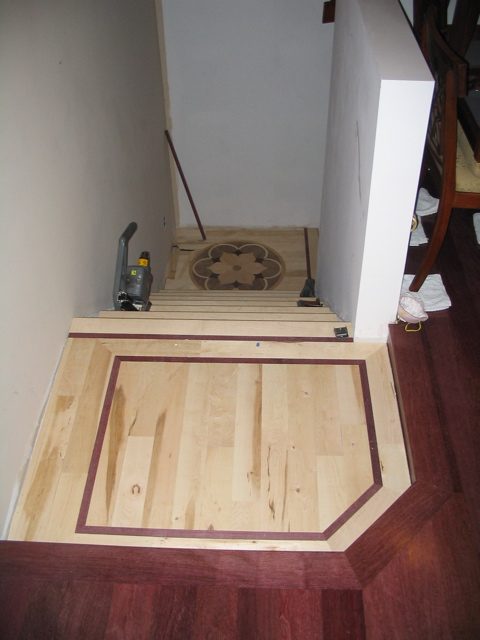
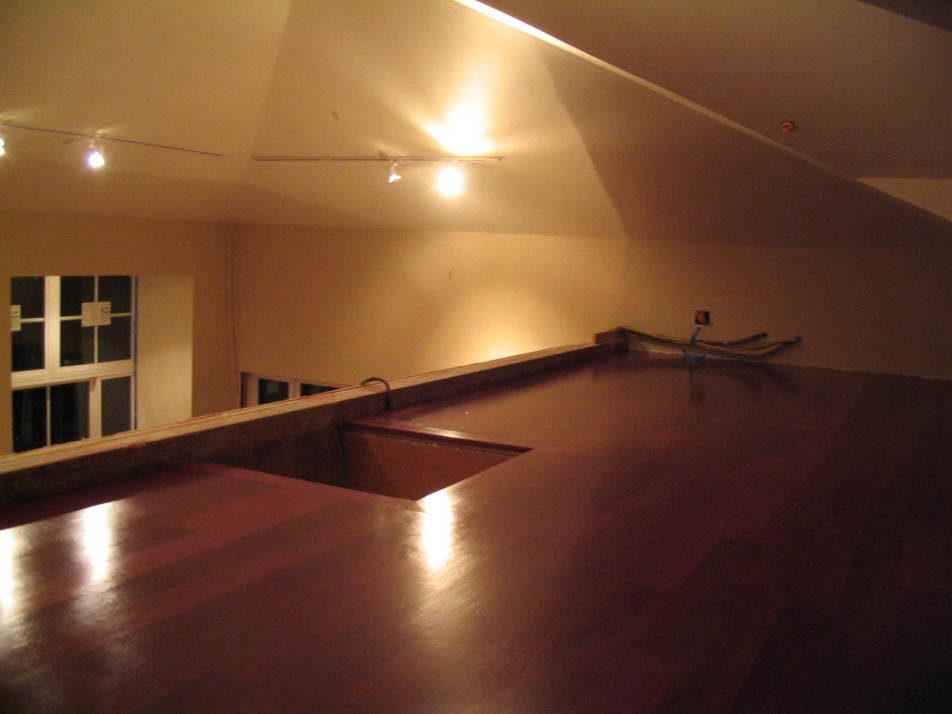
Some more progress
Recovered from web.archive.org — originally hosted at http://i7.photobucket.com/albums/y274/chungsteroonie/IMG_1746.jpgRecovered from web.archive.org — originally hosted at http://i7.photobucket.com/albums/y274/chungsteroonie/IMG_1743.jpgRecovered from web.archive.org — originally hosted at http://i7.photobucket.com/albums/y274/chungsteroonie/loft.jpg
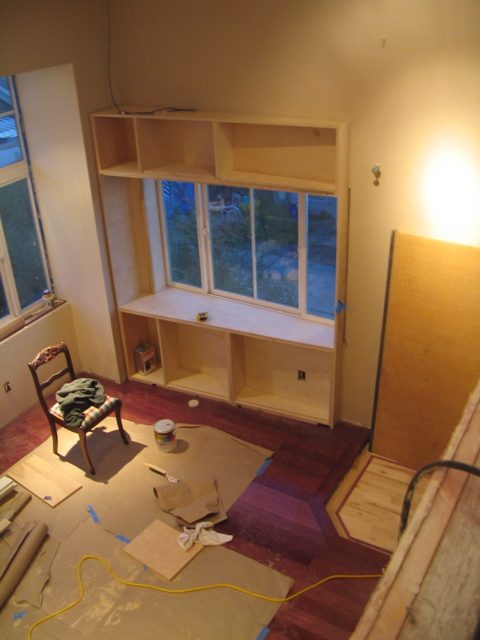
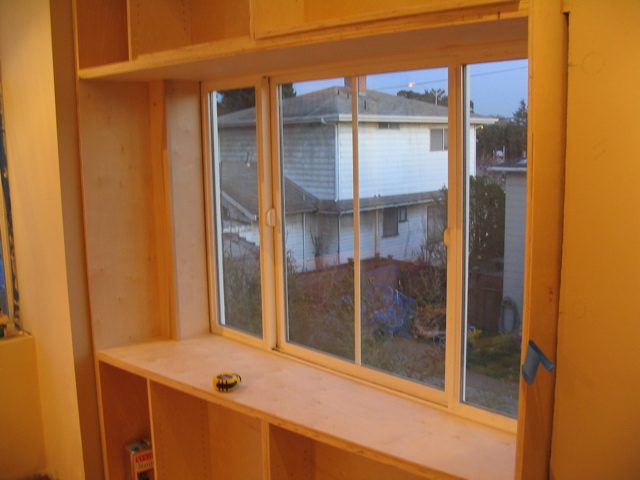
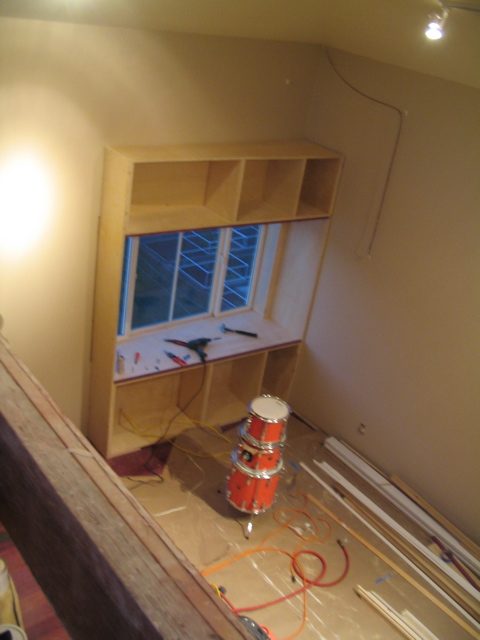
Here's my first attempt at bookcases. . . trapazoidal ones. . . It was difficult trying to figure out a way to address the window without nailing to the framing for both window trims and these built-ins. I figured with these bookcases, I have the option of putting books in, stuffing them with my wife's llinens for full range absorbtion or putting some kind of "slat door" on them to create slat resonators. But this way, I can play in the room, and tweak slowly as needed. . . and I can make any section of the bookcase either full absorb, slat, or books as needed. . . plus be able to use them as real storage. So I can kill 5 birds with one stone. I don't really see a reason why it won't work.
Recovered from web.archive.org — originally hosted at http://i7.photobucket.com/albums/y274/chungsteroonie/IMG_1771.jpgRecovered from web.archive.org — originally hosted at http://i7.photobucket.com/albums/y274/chungsteroonie/IMG_1773.jpgRecovered from web.archive.org — originally hosted at http://i7.photobucket.com/albums/y274/chungsteroonie/IMG_1772.jpgRecovered from web.archive.org — originally hosted at http://i7.photobucket.com/albums/y274/chungsteroonie/IMG_1769.jpg
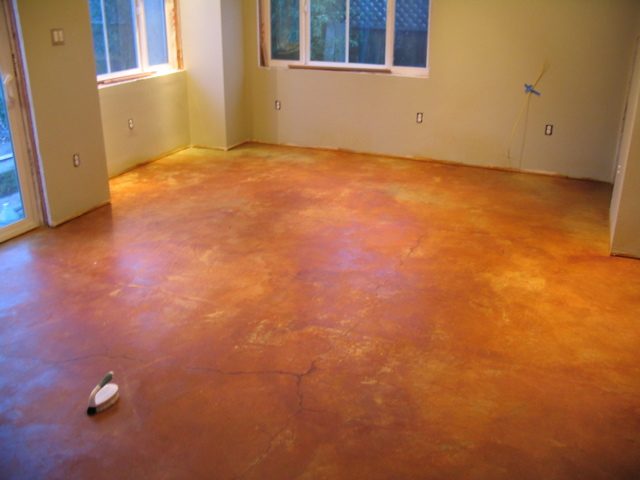
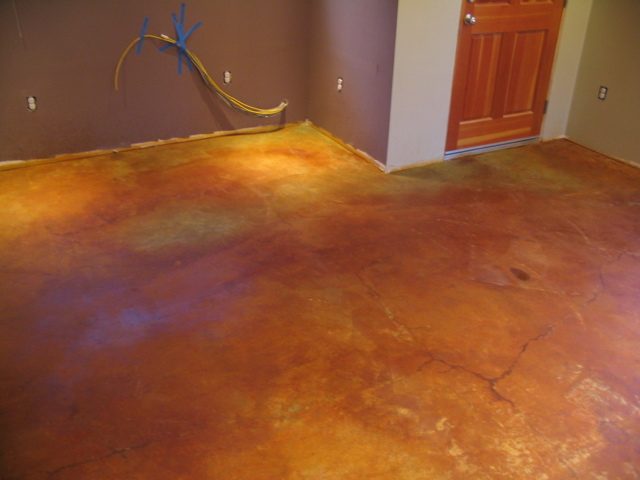
I'm in process of acid staining the concrete floor in downstairs room which will be secondary recording space.
Recovered from web.archive.org — originally hosted at http://i7.photobucket.com/albums/y274/chungsteroonie/concrete2.jpgRecovered from web.archive.org — originally hosted at http://i7.photobucket.com/albums/y274/chungsteroonie/concrete4.jpgStill need to apply sealer, but I found a 2 component polyurea product that's really expensive, but dries in 2 hours and is strong enough to drive forklifts on. I hadn't anticipated staining the concrete, so for a floor that had been worked on, had paint splatter and mud, but I think it cleaned up ok. . . I think acid staining is cool, and it really wasn't all that hard. If using several different colors, I found it easier to smoothly blend if you use a spray bottle to apply the finish instead of brushes.
I've been happy with progress so far. Even without my second windows in, I've been able to play live drums inside without any measureable ambient noise increase outside, and my neighbors whos house is 10 feet away from mine have not heard us even at 2:00 or 3:00am. We do have an ambient noise outside of around 50 - 60 db though all the time from the freeway so that helps me out some.
Aloha chunger,
Hey, long time no see/read! I came on board somewhere about the summer of 2004 and had followed your project since. Beautiful wood working on your your stairway! Was that inlay on the lower landing done by you?
Glad to hear that your isolation results have been acceptable to your neighbors. Thank you for sharing the progress. Have you any progress/pics of your control room?
Looking forward to your updates.
Aloha 8)
Hello,
I just finished the concrete floor in one of my rooms. I thought I'd share some info because I think it turned out great and the products I used worked better than expected.
The color is acid stain from www.scofield.com . . . I used a combination of Padre brown, faded Terra Cotta, and Copper Patina.
Application was simple. . . the contractor I originially hired from craigslist applied with a brush, but I DO NOT suggest doing this. After she botched the 1st stain application, I didn't want her back. There were annoying visible brush marks on the floor. I had to go back over it 2 times with a spray bottle, and that did the trick. Oh, mask your walls so you don't get acid all over your walls like I did :)
Apply the acid stain, and let it sit for 4 hours. Then, mop with water to neutralize the reaction. Then mop and mop and mop until water is clean. I diluted some baking soda in the water to help neutralize the acid. The acid stain can be re-applied as many times as you like prior to sealing until you get the color you want, so it's forgiving.
It was difficult to find a strong sealer that was maintinence free, so after much searching, I found a 2 component Aliphatic Polyurea sealer. It's expensive. 2 gallons costed me $200. Coverage is 225-250 square feet per gallon 1st coat and 325-350 square feet 2nd coat. This stuff is strong enough to use in industrial applications with forklift traffic and is very resistant to chemicals/oils, etc. The amazing thing was it is dry enough to move furniture onto in 2 hours. . .and smells horrible for those 2 hours.
The stuff kicks pretty fast (useless in 30 min), so it was best for me to mix 1 or 2 quart batches throwing away the mixing containers after use. I applied it by pouring directly on the ground and spreading with a paint roller on a stick. It can go 10 mils thick at a time. The 1st coat went on real easy, but absorbsion was a bit weird in 3 or 4 spots. 2nd coat no problems. I should have chemically de-greased my concrete prior to application. I sanded the surface to remove paint and thought that would be good enough. You can get the product from a nice lady named Lindy in Texas. She's been in the industry for years and can answer any questions about prep, applications, product, alternate products, etc.
Lindy A
Lindy (Lynn) Ausburne
GoldenLook International, Inc.
Technical Service Manager
[removed] toll-free/direct line/24-7
[removed]
[removed]
www.goldenlook.com
I'm in process of acid staining the concrete floor in downstairs room which will be secondary recording space
YES That's what I'm planning on doing in my studio!!! Who's stain are you using? I've been thinking of using Kemico.
EDIT: Ok I'm a dumbass, you had another post saying what you used. Anyway, your floors look GRRRREEEAAATTT!!!!
The guy in that picture you posted John used Kemiko. It's interesting to see the results of two different products. To seal his floor he used Kemiko's wax sealant after the stain. chunger used an industrial sealant which probably cost a lot more.
What a great technique for making your concrete floor look like a million dollars.
chunger, was that concrete floor sealed after it was poured? Or did you leave it bare? If it was sealed, what did you use to remove it? I've been told a cleaner called TSP is good for that.
I've also read that applying the stain with a spray bottle is the easiest and most effective method. That's what I plan on doing.
For a slightly easier faux grout line look, instead of cutting the floor up with a saw, check out this site. http://ourcoolhouse.com/images/construc ... idetch.htm I'm pretty impressed. Note: in their updated construction notes they say they actually ran into problems after using an oil-based polyurethane. The concrete can't be 100% sealed because it needs to breath. I guess the poly started to seperate from the crete and they had to strip the floor clean and re-seal it. Use a sealant that's made for this, like Kemiko's wax sealant.