Hello,
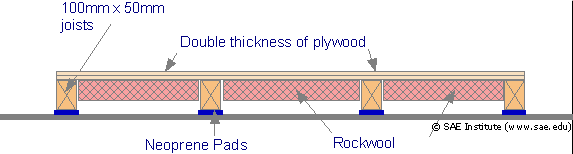
In the below image I wonder: Should the rockwool not be "packed tight" in relation to both the floor and the lower sheet of plywood? As far as I can read in the text, it only states that
- "Rockwool is placed in the cavity between the joists to dampen any resonance."
I belive I found/read a thread here a few weeks ago regarding this. In it someone wrote something like "...make sure to have your insulation packed/compressed in your floors..."
Any opinion would be wonderful, thank you.
/Gash
Recovered from web.archive.org — originally hosted at http://www.saecollege.de/reference_material/images/Floor%201.gif
I've seen similar threads flow by as well. I recall gullfo or rodG (don't quote me on this as an expert at all here!) replying that it was best to have the insulation touching on both sides to reduce resonance on the surface. But that was in response to putting fluffy insulation in a ceiling cavity you outline.
the way I understand it, the optimal thing here would be to have insulation contacting both mass portions with an airspace in between. Similar to a double wall, but I could see how this is not economical.
I have found the thread - touch'em all!
Hello,
In the below image I wonder: Should the rockwool not be "packed tight" in relation to both the floor and the lower sheet of plywood? As far as I can read in the text, it only states that
- "Rockwool is placed in the cavity between the joists to dampen any resonance."
I belive I found/read a thread here a few weeks ago regarding this. In it someone wrote something like "...make sure to have your insulation packed/compressed in your floors..."
Any opinion would be wonderful, thank you.
Gash,
you actualy get slightly better LF TL values with fluffy insulation - BUT - if you have rockwool you do NOT want it packed touching both surfaces- it's too dense as it is and touching both surfaces will create a bridge between the 2 - and thus a flanking path.
Rod
Thank you for your replies. I will build it according to the image.
I had originally planned to use some simple means (thin sheet of plastic or paper attached to the inside of the floor joists) for suspending the rockwool. Instead i will add a more rigid construction on which the insulation can rest without fear of having the supporting material wear down with time (and possibly touch the outer floor) and eventually receive an uneven dampening, or worse, a flanking path.
/Gash
Is that image categorized as a floating floor, or simply just a floor with insulation? With the neoprene pads under the joists, wouldn't that make it technically a floating floor?
I would not presume to know when a floor would fall under the floating category but as far as my personal opinion goes, it's a floating floor.
Maybe one could argue that it would somehow stand in relation to the thickness of the neoprene. In some cases, maybe the selected pads are too thin (or the weight put on the floor is too great) and as such, do not provide the appropriate level of dampening towards the floor structure.
Of course, once again, just my personal thought.
/Gash
one of the bigger problems with hollow floating floors is the potential for creating a booming sounding floor which doesn't provide the desired isolation either... the floor sitting on sleepers w/ some isolation pad under them, may be good for situations where you need air flow under the floor but in practice you're better off fixing a moisture problem before building. having isolation pads directing supporting a massive floor and having appropriate dampening (but without strong coupling as Rod points out) is the more ideal solution for floating a floor. you can go about it a number of ways - the better option is a thick concrete floor with isolation springs properly engineered to support the entire room (and expected loads). another option might be neoprene or KIP pads with soft/semi-rigid insulation for dampening supporting multiple layers of MDF, gypcrete, wonderboard, drywall, and flooring - again engineered to support the weight of the room (and expected other loads) so its resilient but not unstable.
Rod's book goes into a lot of details on floating floor pros/cons including methods for increasing mass of wooden floors using sand etc.
I ordered Ron's book about a week and a half ago and it is yet to arrive. I look forward to reading it and finding the answers to some of my more intricate problems.
/Gash
I received my copy of Rod's book last week. It was indeed well worth the wait, both in relation to being able to do more research and in relation to not rushing to start my build.
The book is truly as non-scientific as one can be, whilst being scientific. Very nice. And printed in black and white, reminds me of some of the best university litterature I ever read.
I was however disappointed to see that the topic of floating wooden floors was over before it even began. In memory of this I will allow myself to use an emoticon. :(
Since I really can not argue with what is being written in the floating floor chapter I guesse I will have to rethink some stuff. I made a post the other day regarding the use and distribution of neoprene in floating floor constructions. I am well on my way to finish my calculation. Maybe it can be useful, we shall see.
/Gash
I received my copy of Rod's book last week. It was indeed well worth the wait, both in relation to being able to do more research and in relation to not rushing to start my build.
I made a post the other day regarding the use and distribution of neoprene in floating floor constructions. I am well on my way to finish my calculation. Maybe it can be useful, we shall see.
Congratulations on receiving the book.
I am looking forward to your post about going for simplified equations for floating floor design in the Acoustics area of this website.
Andre
I received my copy of Rod's book last week. It was indeed well worth the wait, both in relation to being able to do more research and in relation to not rushing to start my build.
The book is truly as non-scientific as one can be, whilst being scientific. Very nice. And printed in black and white, reminds me of some of the best university litterature I ever read.
I was however disappointed to see that the topic of floating wooden floors was over before it even began. In memory of this I will allow myself to use an emoticon. :(
Since I really can not argue with what is being written in the floating floor chapter I guesse I will have to rethink some stuff. I made a post the other day regarding the use and distribution of neoprene in floating floor constructions. I am well on my way to finish my calculation. Maybe it can be useful, we shall see.
/Gash
There are certain areas in the book I wish could be in more depth, but I guess that'll have to be the 2nd edition.
I'm considering putting neoprene under the wooden floor joists too, or maybe rubber pucks. I'd be very interested to see what you come up with.
There are certain areas in the book I wish could be in more depth...
Indeed... the problem with that is of course that Rod had to draw the line somewhere. I am more than certain that he could have kept adding and adding until the book was [insert generic huge number here] pages long. I guesse the over all quality of the book still remains really high.
/Gash