Hi there,
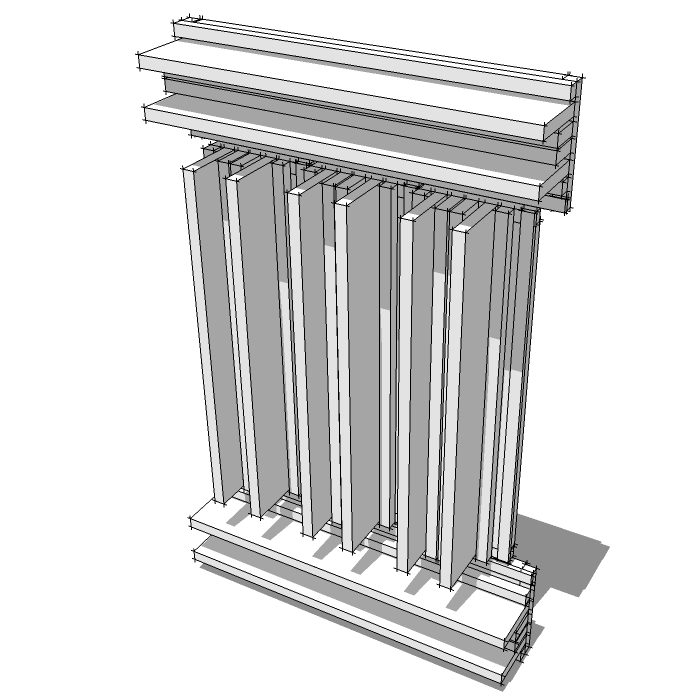
I have decided to go with the "Leftbank" studios design of the inside outside wall as designed and built by J. Sayers.
My C/R is about 4metres wide x 5 metres long x 3.6 at one end and 2.6 and the smaller end.
In terms of the acoustic treatment of my control room how does one know which part of the walls and ceilings do you treat. I am familiar with Johns designs, but am stumped as to do how I apply the treatment to my design, and where do I put the bass traps, low mids high mids, ect ect....?
I have a pic of the floor plan the mixing end of the control room is 2.6 metres high and the end where there is a window is 3.0 metres hight, so there is a 5 degree slope in the roof.
thanks a lot
Mike "ratty_7"
Image not preserved: Floor Plan with Dimensions.jpg
how does one know which part of the walls and ceilings do you treat.
Room treatment is a deep subject, and a complete answer requires far more than will fit into a single reply here. There's a lot of info here in the thousands of posts, and here's the short version. All rooms need:
* Broadband (not tuned) bass traps straddling as many corners as you can manage, including the wall-ceiling corners. More bass traps on the rear wall behind helps even further. You simply cannot have too much bass trapping. Real bass trapping, that is - thin foam and thin fiberglass don't work to a low enough frequency.
* Mid/high frequency absorption at the first reflection points on the side walls and ceiling.
* Some additional amount of mid/high absorption and/or diffusion on any large areas of bare parallel surfaces, such as opposing walls or the ceiling if the floor is reflective. Diffusion on the rear wall behind you is also useful in larger rooms.
For the complete story see my Acoustics FAQ.
There's a lot of additional non-sales technical information on my company's site - articles, videos, test tones and other downloads - linked under my name below.
--Ethan
Just to add to what Ethan said, John's inside-out wall design is well suited to both slot resonators and full absorption. Which design you go with depends on the sound you want, really.
For the diagram you provide, let's take the control room as an example. Personally, I like the look of slot resonators, so I'd be inclined to use them on the angled walls to the left/right of the mix position, as well as at the rear part of the side walls. For the rear wall I'd opt for full absorption.
Also, for the smaller booths, I'd be inclined to go with full absorption all the way around. Possibly a mix of the two in the drum booth. For the larger room, it depends on the sound you want.
Hi Ethen
Thanks for your help and suggestions.
To Jwl
I am glad you replied because I know you have or are engaging in Johns inside outside wall design. In terms of my music I am into Jazz and blues and and a little rock ie Stones, Who, Beatles, Mannfred Mann ect so I need full treatment.
I gather from what you say that the best thing to do is what john said and that is build the wall put the gyprock on the inside put in the insulation then the cloth over that. But how do I know where the slot resonators go and how many and how wide?
As for bass traps I am going to build the ones on Johns SAE site
all the best
Mike
PS How is your studio build going by the way?
Hi there,
As I am building John's inside outside wall design in my control room, live tracking, drum and vocal iso's, can anybody please tell me where do I place the acoustic treatment.
I am a little stuck as Johns inside outside wall design already has the treatment in the inside frame. My problem is where do i actually place the slot resonators and what materials can I cover the rest of the walls and ceilings in.
I have read a lot and have asked various people and JWL has told me that the inside outside design is very efficient in terms of full range treatment.
John has told me that the treatment or the resonators do NOT cover all of the wall surfaces.
However, although I am grateful for all the help given to me, and despite what I have read, I am no where nearer the answer of where and how much I need to treat in my rooms, or how much i need to build in terms of resonators based on my studio dimensions.
So please if anybody can help me I would be very grateful.
Sincerely,
Mike ratty_7
Sorry for the lack of response.... like many around here I've been busy with other things and haven't had time for forums.
There are many approaches. I like absorption, but if you put too much in it will kill the room.
Based on your drawing, in the control room I would put slot resonators in the front half of the room, ie, the front wall, the soffits (if you can incorporate them), and the splayed side walls. The splayed walls will angle the reflections behind you. This room will focus the sound toward the rear.
For that reason, I'd go with absorption in the rear half of the room. Particularly in the back wall and corners, you will want very good absorption with the room you have. I'd consider framing the rear wall with 1x6s just to give you more room for absorption. The thicker you go, the deeper the frequency that is absorbed.
It is possible that this will result in a "too dead" sound. If that's the case, I'd put either diffusors or blank panels (hard and reflective) in various places to liven things up. You will need to experiment.
I would tend to use slot resonators primarily in the big tracking room. Given the room shape I'd probably build the angled slot resonators and aim the sound reflections. I'd have an absorptive ceiling and a hard floor.
I would use absorption exclusively in the smaller booths.
But that's just me....
Thanks for asking about my build. It's officially on hold, I was going to convert my garage. But, I wasn't crazy about the idea and decided to put off the build to think it through. In the meantime, I've gotten a mobile recording rig that I like as well as a fulltime gig in acoustics that keeps me busy.
My new idea is to pour a new foundation entirely, and build from scratch. My house foundation is on a hill, so I'm thinking of digging down behind the house, and pouring a new basement foundation with high ceilings, building the studio (and office) down there. Then, I'd build a deck, a 3 season room, a mudroom, and woodburning stove for the house (maybe even a hottub) on top of that. Currently, I'm dreaming and imagining a 30'x30'x16' building to work with, several recording rooms, etc etc. Time will tell.
Hi Jwl,
Thanks for your quick reply....
In terms of absorption I understand what you mean, and I definately do NOT want to kill my rooms. However, when you said I would have to experiment, isn't there away of working where to put the slot resonators, once the inner frame is built as it already has absorption insulation in it...!!!
As I know the dimensions of my rooms surely there must be another way rather than experimentation?
"I'd consider framing the rear wall with 1x6s just to give you more room for absorption. The thicker you go, the deeper the frequency that is absorbed."
If you look at the rear wall of my rehearsal area, (see drawing below ) you can see where the inner frame is situated. That frame has insulation/absorption already facing inwards as mentioned above. That frame is the Inside wall of Johns design. (Note my sketch up skills are very limited.)
So given the that the absorption is already in the walls for every room. How do I know where to put the resonators?
I already know that the control room will be different, from the rehearsal rooms and drum and vocal Iso's ect, but i am reluctant to leave it all to experimentation given that I have built my studio from scratch.
Here is two pics. One is the control room rear with 1200x1800 window and the other is the front of the control room with the access to the rehearsal area, which will have two double glazed doors.....!!!
anyway thanks for your help so far
all the best from Oz
Mike "ratty_7"
Image not preserved: Mikes Studio April 2008.jpg
Image not preserved: Mikes Studio Front of control with access to Rehearsal.jpg
Image not preserved: Mikes Studio Rear of Control.jpg
If you go with diffusion on the rear wall (a good idea if you can afford it), then you will probably want to line the rear wall, at least as wide as the speakers are apart. Most diffusors are 2'x4' (or 2'x2'), so 4 across the back wall of your control room makes sense to me.....
Thanks Jwl
Thanks for your help,
Like the idea of diffusion as I can build them. I know a little about absorption and diffusion....! But I will try to read more on the subject.
In terms of my back wall I should have told you that I have a 3'6" ft x 4'6" ft window with 4mm glass, which is to one side of the control room wall.
I don't exactly know how this will effect the control room overall, so I'm guessing if I build the diffuses as you say, it will be down to experimentation?
take care mate
Mike in Oz
maybe something with 2x lumber. a prime 7 slat/numeric diffuser (ala John and Barefoot). on the windows - heavy drapes you pull over them when needed...
Image not preserved: example numeric diffuser slat resonator 3.jpg
Image not preserved: example numeric diffuser slat resonator 2.jpg
Hi Guys
Thanks for all your help so far.
In the picture "Control room treatment 2" I have a A and B section. This is the same design for the left side of the control room except on the left side there will be no glass doors.
My question is
1. Should I seal off the section marked B (where the second door will butt up to) and put acoustic hangers in there?
2. leave B as a bare cavity and just put bass traps with sofit mounted speakers in the section marked A.
3. Or should I treat A and B. put hangers in B and bass traps ect in A.
4. Or for something completely different bass trap ect in A and leave section B bare, but on the inside angled wall just put a low/mid slot resonator from the door to the back wall.
Thanks
Mike
Hi guys,
In terms of the acoustic treatment I am doing for my inside outside wall design, does it really matter what type of insulation I put into my live tracking room?
The inner walls are 3" or 70m/m thick and I already have 2'" rockwool in them. Do I need to replace this because I am worried that the fibres will come through the hessian.
Also in terms of the drum booth, vocal booth, and control room, can I use the same 2" rockwool or should I use a more dense insulation. I realise the acoustic treatment will be different for each room, but using the rockwool I have will cut the cost...!!!
Sincerely,
Mike
Rock wool should be fine, or fiberglass. As long as the density is somewhere around 48 kg/m3 (for rockwool), you should be OK. Any lighter than that and it won't be effective. Too much heavier and you are paying a lot more money for only a little more effect. Diminishing returns. But if you have heavier stuff available already, then you might as well use it. Make the best of what you have. But too heavy is counter-productive, as it does not treat the lows so well.
- Stuart -
Rock wool should be fine, or fiberglass. As long as the density is somewhere around 48 kg/m3 (for rockwool), you should be OK. Any lighter than that and it won't be effective. Too much heavier and you are paying a lot more money for only a little more effect. Diminishing returns. But if you have heavier stuff available already, then you might as well use it. Make the best of what you have. But too heavy is counter-productive, as it does not treat the lows so well.
- Stuart -
]
Thanks Stuart,
I have heaps of rock wool and some acoustic polyester insulation that was left over from a job that was for lining the walls of a Village cinema.
Thanks again
Mike
As long as it is the right density stuff, that should work. But there is also low density polyester stuff, that might not be very effective. Where I live, the normal "acoustic polyester insulation" is woefully inadequate, at around 6 kg/m3. It's good thermally, but not so good acoustically. I used some of that stuff a few years ago when I added on an office to the house, in my ignorance before I learned the truth about how acoustics really works, and I was disappointed with the acoustic results. I wish I would have used mineral wool.
The really good thing about it is that it doesn't itch! It's easy to work with, you don't need gloves, protective eyewear, heavy clothing, etc. like you do with fiber glass and mineral wool. But it only makes sense if you have the correct density stuff.
- Stuart -
As long as it is the right density stuff, that should work. But there is also low density polyester stuff, that might not be very effective. Where I live, the normal "acoustic polyester insulation" is woefully inadequate, at around 6 kg/m3. It's good thermally, but not so good acoustically. I used some of that stuff a few years ago when I added on an office to the house, in my ignorance before I learned the truth about how acoustics really works, and I was disappointed with the acoustic results. I wish I would have used mineral wool.
The really good thing about it is that it doesn't itch! It's easy to work with, you don't need gloves, protective eyewear, heavy clothing, etc. like you do with fiber glass and mineral wool. But it only makes sense if you have the correct density stuff.
- Stuart -
Hi Stuart,
This Polyester insulation is a little thicker than 3 " so I am hoping I can use it. Problem might be that I think it will push the hessian out a little making the walls look as though they are bulging ...!!! I'll just have to experiment and see how I go. I might be able to put fishing line across the batts ensuring they don't bulge out ...
Mike
It's not really the thickness that I'm concerned about, Mike: it's the density (and gas flow resistivity). If it isn't the right density then it won't do anything useful for you, so you'd just be wasting your time by installing it. You need to make sure. Check with the manufacturer to find out what the density is. It should be quoted as kilograms per cubic meter, or pounds per cubic foot. For mineral wool, you want something in the range of roughly 48 kg/m3, which is about 3 lbs per cubic foot. For fiberglass, 30 kg/m3. Not sure about polyester.
- Stuart -
It's not really the thickness that I'm concerned about, Mike: it's the density (and gas flow resistivity). If it isn't the right density then it won't do anything useful for you, so you'd just be wasting your time by installing it. You need to make sure. Check with the manufacturer to find out what the density is. It should be quoted as kilograms per cubic meter, or pounds per cubic foot. For mineral wool, you want something in the range of roughly 48 kg/m3, which is about 3 lbs per cubic foot. For fiberglass, 30 kg/m3. Not sure about polyester.
- Stuart -
Hi Stuart
I have found this product hope this is ok as i think this fits the bill ?
POLYROLL WHITE 48kg/m3 25mm Blanket 2400x1200mm $13.20 per sheet
cheers Mike
Hi Guys
I am finally trying to fine tune my control see the older pics page 1. I have taken a bunch of measurements using a Behringer ECM8000 and the REW software.
In the REW calculations I am providing, measurements were taken at the sweet spot, half way down the control room and in the rear corners where I have bass traps.
The control walls are Johns inside out side design and have been sealed.
I have yet to put any slot resonators on the walls, nor is there any rear wall treated diffuser as suggested by Guffo and Jewel as I thought it was time to do some readings first....!!!
In the SWEET SPOT measurements provided I noticed that I have a couple of major nulls at about 80Hz and at 1.1k apart from all the others...!!! So I am hoping some one will be able to help me getting this control room fine tuned.
cheers
Mike
I have taken a bunch of measurements using a Behringer ECM8000 and the REW software.
It's good to see you back again, Mike! :):thu:
But you have a problem. A big problem. Your REW data is not valid, because you have a serious mains hum issue. Take a look at your spectrogram:
Image not preserved: REW-double-hum.jpg
See those spikes? They never die away, or even change in intensity. They are always there, very powerful, continuous.
See the frequencies? Australia is 50 Hz, and your spikes are at 50, 100, 150, 200 etc Hz. All the way up the spectrum. You can see them crystal clear on the waterfall plots too,
Strangely enough, you somehow managed to get 60 Hz hum in there as well! 60, 120, 180, 240 Hz... all of the harmonics are there. I guess you must be running a dual power system, with both 220V/50Hz and also 110V/60 Hz: Not sure why, but both frequency sets are there.
That hash is absolutely overpowering any acoustic data, so the entire data set is no use.
My guess would be that you either have a faulty mic cable, or you have a faulty mic (it wouldn't be the first time I've heard of an ECM-8000 having a ground fault on it: in fact, it seems to be quite common: Behringer quality control and all that, I guess).
So first you need to identify that problem and get it fixed, then you'll have to re-do your REW tests, but you need to do them right this time. I VERY much doubt that you did your tests 140 dBC, as shown by the graphs :ahh::shock: so I'm assuming you did not actually calibrate REW properly with a hand held sound level meter, and you did not set up your system so that each individual speaker produces 80 dBC by itself, which will automatically give you the 86 dBC reference calibration level.
Therefore, after you have found and fixed your massive mains hum problem, calibrate REW using your hand-held sound level meter, then run the tests again. This time, run three tests with the mic positioned precisely in the middle of your head (!), or rather, in the middle of where your head will be when you are mixing, exactly on the room center line, with the tip and exactly 1.2m above the floor, and the mic angled upwards at about 60°. Do one test with just the left speaker, one with just the right speaker, and one with both speakers. Do not adjust anything between tests! Don't even touch the system at all, except to turn of and on the speakers.
Next, your way of looking at the data is not very useful at all: A graph that runs from 2 Hz to 30 kHz and -160 dB to + 180 dB shows you nothing useful about the response of the room. Zilch. You cannot draw any useful conclusions at all from that.
You need to look at the correct parts of the spectrum: First and foremost, 15 Hz to 500 Hz, and 35 dB to 100 dB (assuming you calibrated the system correctly to 86 dB). That will clearly show you how your low end is doing, which is the most critical part of the spectrum. Then you can choose other parts of the spectrum and other ranges.
Your RT60 graph is also pretty useless: You have the range set 1 to 10 seconds, which would be fine if you were measuring the RT-60 time of the space shuttle hanger at NASA, but for a small room you pretty much never need to set the top scale more than 1 second (unless the room is completed untreated, maybe). And while smoothing your RT60 to 1 octave is OK for showing nice flat graphs to impress your friends and neighbors, it does not show you anything useful at all! Set it to 1/3 octave, and 1 second max, range 50 Hz to 10 kHz, to see what the time domain response really looks like.
- Stuart -
Hi Stuart
Thanks mate, glad to be back also thanks for your quick reply...
Mains hum OMG. When my studio was first built the electrician put in a completely new power supply board separate from the house mains with all new fuses for my studio plus I am running the studio thru a UPS so, I will definitely check that out. No 110v here only good ole Aussie volts @ 240V 50hz but now i'm worried...will get back to ya, have a great day
Mike
Ok Stuart this is serious stuff..so thanks
I have read your notes and I did set up my REW software according to the video on YouTube but obviously I didn't do it right for my needs ...sorry
Apart from the ECM 8000 "junkamic". I have a Realistic/RadioShack decibel meter. So I will put that thru my UA 6176 preamp into my mac hows that and if I will follow your directions explicitly I should be ok ?
:shot:
Hi Stuart
It's Mike here with renewed enthusiasm.... :shot:
Here are my new measurements with specs you suggested (see pics) and I hope these are more useful...!!!
1. The mic was 1.2 metres from the control room floor angled at 60 degrees.
2. I measured the volume at the measurement mic with my S/L meter to read 86db
3. The measurements are at the sweet spot first both speakers then the left then right all 15Hz - 500Hz at 86db
and as a bonus no mains spikes :D
I am considering taking more measurements from 500Hz -2K
then 2k-10K
what do you think ?
cheers Mike
I think you should look at your scales! And your test procedure! :)
You have set your scales way beyond the extremes of anything vaguely useful. Your vertical scale runs from about a hundred million times quieter than it would be possible to measure in the most silent test lab on the planet with the most sensitive test gear ever invented, at the low end, up to about one thousand times louder than the loudest sound ever heard on planet Earth! That's probably not a good way to set the levels.... And on the horizontal scale, it runs from a frequency about an octave below the very lowest earthquake wave ever recorded, and up to about an octave above the frequency of a dog whistle.... Also not a useful scale!
To put that in perspective: This is like graphing the speed of your car on a graph marked in inches per millennium at the low end, to mega-miles per microsecond at the other...
You really, really, really need to set your scales to useful, meaningful ranges, such as the typical range of human hearing sensitivity on the vertical scale, and covering the lows, mids, or highs of the human hearing range on the horizontal scale.
I already mentioned this in my last post. This is what I said : "A graph that runs from 2 Hz to 30 kHz and -160 dB to + 180 dB shows you nothing useful about the response of the room. Zilch. You cannot draw any useful conclusions at all from that."
15Hz - 500Hz
I am considering taking more measurements from 500Hz -2K
then 2k-10K
WHY????
Why not just run the test across the entire audible spectrum all at once, from say 17 Hz to 22 kHz? What benefit do you think you'd get from only running a small part of the test at a time? And why skip the top chunk of the spectrum, from 10 kHz to 20 kHz?
The only vaguely plausible reason for running one test from 15-500, one from 500-2k, and one from 2k-10k, would be if you are testing individual speaker drivers that only cover those ranges, and therefore it would be pointless to test them for frequencies that they cannot produce well, or are outside their cross-over range... For example, if you were building a 4-way loudspeaker yourself, and wanted to test the woofer (15-500), low-mid driver (500-2k), and high-mid driver (2k-10k) individually.... (but that doesn't explain why you don't want to test your tweeter (10k-20k)!) Even then, those would be unusual cross-over points for a typical 4-way speaker... But that's not what you are doing anyway! You are just testing your room response, which covers the entire audible frequency range, so that's how you should have REW configured: to test the entire audible frequency range.
Did you read the instruction manual that comes with REW? If not, then it would probably be a good time to do that now, then repeat your tests accordingly.
Also, here's a link to a thread that shows you what typical REW graph settings should look like, to get useful information about the room acoustics:
viewtopic.php?f=2&t=20471
- Stuart -
Hi Stuart
Sorry, yes I agree as it makes sense to test right across the audible range
1. Have set up REW as per requirements from their web site and spoke to an administrator
2. Set the limits from 15Hz to 20k, although they said 25K but i'm sticking to the range of my DynAudios
and the other limits to 45db to 105db
3. Calibrated the system again to 86db
So here are the measurements.... fingers crossed :shot:
Mike