If you had to repair a problem behind an Isolation wall, how would you do it?
I am in the later stages of my build project and organizing my records for dimensions and measurements for things located behind the walls. There are utility pipes in a few places that could develop problems and I'm trying to formulate a plan of attack in the event of a pipe burst or an other type of need for getting behind the layers of wall board.
At first glance -
I believe I would try to cut a small hole at the spot where I want to have access. I would route a square (being careful not to puncture anything of course...), establish how big of a hole I would need for access to the area and then cut out the inner most (room facing) layer of wall board.
This is my key point for how mutli layer drywall would be different --
My point about cutting the innermost layer to a larger size is to provide a flanged (for lack of a better term) seal against the seam I am creating by making this repair. This area would have Green Glue re-applied when it is put together. The seam would also have backerod and caulking to fill any gap or air hole. This would be a slight pain because of the "devil's snot" (GG) which has been previously sandwiched between the layers, but I think it'd be worth the effort.
Standard Repairs -
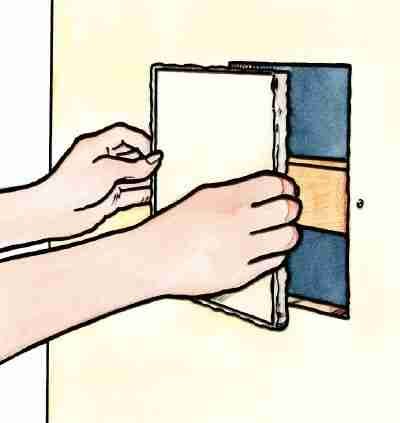
In the past, I have repaired holes created by errant punches, feet and legs falling through the floor and puncturing the 1st floor ceiling and pipe bursts. When I do this I usually back the hole with a thin peice of plywood that is slightly larger than the hole (I work it through at an angle and at times have used two peices. This acts as a place to screw the new peice against and the borders of the existing wallboard. After taping and finishing it off I'm left with a section of wall that's actually stronger than what was previously there.
A quick image search resulted in this diagram - (These are pictures of one peice of plywood - I'd go for two in order to cover the top and bottom seams. )
- or -
Recovered from web.archive.org — originally hosted at http://static.howstuffworks.com/gif/how-to-fix-holes-in-drywall-2.jpgI would also look to utilize this method in repairing anything in my isolation construction.
Thoughts? Experience to share?
I,ve used this method many a time..after having to many drinks or even my fiends( or used to be) putting holes in walls.
Good to see humour in some people...others are so serious!! :lol::lol:
Chucklin
If you had to repair a problem behind an Isolation wall, how would you do it?This is my key point for how mutli layer drywall would be different --
My point about cutting the innermost layer to a larger size is to provide a flanged (for lack of a better term) seal against the seam I am creating by making this repair.
Thoughts? Experience to share?
Pretty much the same way. Keyhole out a hole big enough to get my hand into if required to locate the element of my concern. Once found then the sheetrock out in the room would be cut out, large.
I wouldn't try to skimp on it, cut it out 3' X 3'. 'Course I wouldn't concern myself with squaring it either. Reason being the cutout will only fit back in one specific hole!
Then step in the successive sheetrock cuts 2 inches or so. To offset the joints when re-installing and allow mudding room. Keep on until your in the wall:)
Something inside the wall to attach the first piece of rock to would help, two pieces, one top and one bottom where I come from.
I'd pay attention to the existing screw holes and try to use them for re-installing the following layers.
IF I had to do that:)
Thanks guys..
xSpace - that's about what I imagined. I bet the separation of the layers would be kind of a bitch to manage, but it could be feathered off especially if you had a stud backing the first layer of drywall..
Chucklin - I find humor in all of life. Every last moment.
True enough.
It comes down to do you remember the wall stud layout. If you could do that then you measure to a point that represents the center of a stud. Then locate the next stud 16 inches or 32 inches over, whatever the layout is.
If you have two layers of rock then it would be a simple matter of measuring again 2 inches outside of the stud marks just made. This would be the plumb line for your first cut into the wall.
I didn't say yet, but this is also a good place to use a cordless circular saw or a powered one if that is all you have. So you can cut the first layer without going into the next layer in order to keep those stepped in flanges available.
If you were right and remembered the stud layout correctly, then next cuts would be directly on top of the wall studs.
Pretty good idea, your a lot smarter then you look :)
Cosign to everything above. I have had to repair many holes working in POST construction (more on the elctrical side) and that's how we do it. Then the guy who does taping/mudding comes in and works his magic. As a result, you are left with a smooth wall/ceiling and no one knows the difference.
- or -
Recovered from web.archive.org — originally hosted at http://static.howstuffworks.com/gif/how-to-fix-holes-in-drywall-2.jpgI would also look to utilize this method in repairing anything in my isolation construction.
Thoughts? Experience to share?
I concur with the above posts,an being a professional Drywall Finisher,,,, this is how post job patches are done,,,great pic BTW,,carry on :D
MOSH ON
DAVE
Most of my intent with this was not how to brace the drywall from the back of it, but more to the point - We're dealing with multiple layers so I would do the work to offset the layers with the smallest hole to the back and then cutting a frame around that hole to make the repair without a seam over a seam.
It was how I imagined doing the repair, but wondered if anyone had to work with a studio or hotel, meeting room repair with multiple layers of dryall.
I presume the devil's snot in between the layers (gg) would be tough to feather the two layers apart without damaging the outer most layer.