Page 1 of 1
Acoustic Panels "Spacing"
Posted: Sat Jul 22, 2006 2:59 am
by BradJacob
I'm going to build some acoustic panels to deaden my 12'X12' bedroom studio. They will be 2'x4'.
Do I need them to cover all the wall space?
Should I start by hanging them around waist-high and go up to the ceiling?
And if not, how much space in between is a good starting point?
Any help would be appreciated.
Thanks!
Re: Acoustic Panels "Spacing"
Posted: Sat Jul 22, 2006 4:48 am
by Ethan Winer
Brad,
> Do I need them to cover all the wall space? <
No!

> Should I start by hanging them around waist-high and go up to the ceiling? <
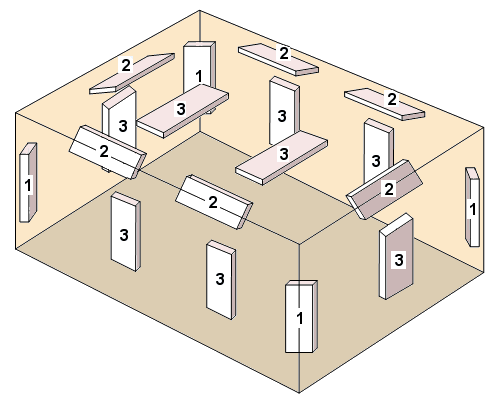
Start in the corners, and that includes the wall-ceiling corners. In the drawing below, the panels marked "1" and "2" are bass traps, and the ones marked "3" treat the first reflection points along the side walls and on the ceiling. This is the best way to start. Your room is smaller than the example shown here, but the basic concept is the same.
--Ethan
Curious
Posted: Sat Jul 22, 2006 10:08 pm
by tmix
Ethan , (or anyone)
Then would covering a larger amount of ceiling or wall space produce too dry of a sound?
I have my main room which is 14 feet by 32 feet with 9 foot walls. The floor is concrete, so I was concerned about the ceiling needing a ton of panels to keep the slap back echo down.
Would spacing a buch of panels about a foot apart covering the ceiling be overkill?
It would be great to not have to hang so many.
Tom
Posted: Sun Jul 23, 2006 3:55 am
by z60611
tmix:
Then would covering a larger amount of ceiling or wall space produce too dry of a sound?
For a
control room quick and dirty estimate of the approximate maximum safe value (treated, but not too dry), try this:
http://www.bobgolds.com/Mode/RoomModes.htm
Enter your room dimensions.
Then, down about 70% of the way on the right hand side you'll find the lines
- Absorbtion to achieve ITU RT60: 756 sabins
- Surface Area Total: 1724 ft^2
The 756 can be interpreted as the number of square feet of coverage of the surface area of the room (walls + floor + ceiling). If you have carpet, subtract the area of that. If you have a couch, subtract the area of that. Basically anything that absorbs, subtract it. What's left is the surface area of the treatment (aka panels etc).
For placement:
a) corners
b) first reflection points
c) early reflection points and SBIR
d) evenly spread throughout the rest of the room.
Thanks!
Posted: Sun Jul 23, 2006 6:33 am
by tmix
I appreciate that link.
I have a hard time interpreting what I see, but I see the 756 sabins. If that represents square feet of absorption, and I have nothing on the floor, I will need,hmmm .. about 95 panels since they are 8 sq/ft each, unless I can count both surfaces if I suspend them 5-6 inches from the walls and ceilings.
So it looks like I AM going to pretty much have to cover the walls and ceilings pretty densly.
Does that sound right?
Thanks for all your help!
Tom
Posted: Sun Jul 23, 2006 9:38 am
by z60611
I will need,hmmm .. about 95 panels
I would have said you can go up to the equivilant total of 95 panels of absorption, rather than need 95 panels.
Also, the area of your walls is (same web page)
Surface Area 4 Walls: 828 ft^2
so if you put them only on the walls you'd fill the walls -- I'll bet that's a bad thing. You want something on the ceiling/floor too.
I can't believe in 448 ft^2 of floor you don't even have a chair. Remember, it's the sum of everything in the room that totals to that 756 sabins.
average Sabins = average absorption coefficient * square footage.
Room sabins for a given frequency = sum of (absorption coefficients for a given frequency for an item * square footage of the item).
This page lists absorption coefficients for things that are really good at absorbing at 4000hz (i.e. 1.0 absorbstion coefficients).
http://www.bobgolds.com/AbsorptionCoefficients.htm
This page lists other things you are likely to have in your room
http://www.bobgolds.com/Sabin.htm
Posted: Sun Jul 23, 2006 11:52 pm
by tmix
Thanks Z
And you are right, I just dont have anything in there yet. The room will be primarily an open room that I use for band practice as well so there wont be any soft chairs, but I'll put down some throw rugs and such plus I guess people and their clothes will absorb.
Thanks for the links!
Tom
Re: Curious
Posted: Mon Jul 24, 2006 12:07 am
by Ethan Winer
Tom,
> would covering a larger amount of ceiling or wall space produce too dry of a sound? <
It depends on the nature of the panels. The traps my company makes are semi-reflective on their front surface. This is done intentionally to let people put a large number of them into a room to truly tame the bass problems, but without sucking all the life out of the room at mid and high frequencies. Conventional rigid fiberglass panels absorb more at higher frequencies, so there is a real risk of over-damping. However, you could cover some (or all) of them with cardboard or heavy paper to reflect the mids and highs.
--Ethan
Re: Curious
Posted: Mon Jul 24, 2006 12:31 am
by tmix
Ethan Winer wrote:Tom,
Conventional rigid fiberglass panels absorb more at higher frequencies, so there is a real risk of over-damping. However, you could cover some (or all) of them with cardboard or heavy paper to reflect the mids and highs.
--Ethan
Excellent.
I wonder,... if I needed to cause some to be more high frequency reflective, should I make them all on the walls but leave the ceiling more dead (since the floor is concrete), or spread them somewhat evenly throughout the room for a more "even" sound?
Thanks for your help.
Tom
Re: Curious
Posted: Tue Jul 25, 2006 4:54 am
by Ethan Winer
Tom,
> should I make them all on the walls but leave the ceiling more dead (since the floor is concrete), or spread them somewhat evenly throughout the room for a more "even" sound? <
You do not want cardboard or paper on any panels at the first reflection points. You probably do want that on panels meant as bass traps that are mounted straddling corners. For all other panels, there's no right and wrong because it depends on the room and how far away you are from the panels. So you need to measure or at least assess it by ear as you go.
--Ethan
Posted: Tue Jul 25, 2006 8:55 am
by tmix
Thanks Ethan,
And all others who have helped!
Off to caulk some more!
Tom