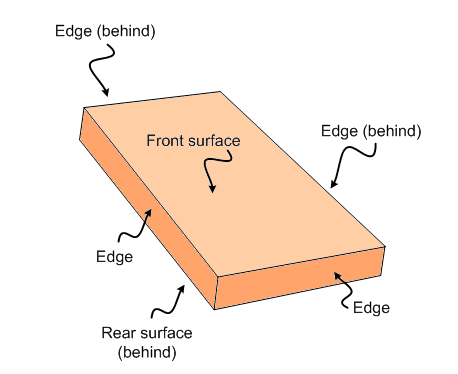
Ethan’s explanation is wrong,
I try to alter this misconception for years already without any succes (trying to correct things is often referred to as causing trouble).
There is no linear relation with the edge surface.
This is a complicated business and related to diffraction and diffusion.
At the edge of a sample the sound field gets scrambled.
Just see it as the Sabine method with difficult to quantify an accepted uncertainties.
Those absorption coefficients, while meant by Sabine as energetic absorption values, which indeed means that 100% should be the maximum, are influenced by a number of 'not so simple' parameters.
This is mostly/often referred to as the edge effect.
But this effect also occurs when those edges are 100% reflective, hence no increase of absorptive surface occurs.
This picture is Copyrighted, leave it where it is.

Important to note is that those boards are framed with a very stable closed metal frame, hence
the free edges, when spreading them out, DID NOT increase whatever edge absorptive surface on those absorbers.
What you see here is that by spreading absorbers out on the floor, hence changing the parameter of the ratio of the perimeter versus the horizontal surface, the absorption increases, but this is a frequency dependent phenomenon.
This picture based on real lab measurements in itself proves the explanation, that it is edge surface related, wrong, because that's a frequency independent constant, and secondly the absorber edges in those measurements aren't absorptive at all.
Also just increasing the diffusity of a room will increase the absorption values. Hence such absorption values are no real fixed constant but dependent on the sound field.
Just accept that those deviations can occur when measuring material in a reverberation room using the Sabine method.
This is really complicated business. Even the ASTM standard does not give exact formulas to calculate from one to the other, and for good reasons.
The most recent ISO standard does apply such calculation if the sample is not screened at the edges, to sanction unjust comparisons between measurements.
A lot of measurements, you'll find on the net, should look quiet different when applying the most recent ISO methods.
But as David said, don't worry too much about it.
David: this isn't only the 3D behavior. Of course absorption is 3D, if it wasn't 3D but 2D it was infinite thin,

which indeed shouldn't absorp very well.
But if I should make rectangular holes in the ground and mount the absorption flush with the bottom, I still should measure edge effect of spread absorbers versus an adjacent patch with the same total surface.
It's the difference in impedance between the reflective and absorptive surface and the relation with the front behavior of waves which causes the soundfield to get scrambled and diffract. And more absorption will help, but is not the main cause and is frequency related.
Don't assume you can extract a formula from this picture. Other comparisons can show a different behavior (depend on wavelengths versus spread etc.). There is a lot written about this, and it shouldn't if the relation was that simple.