myfipie wrote:Eric,
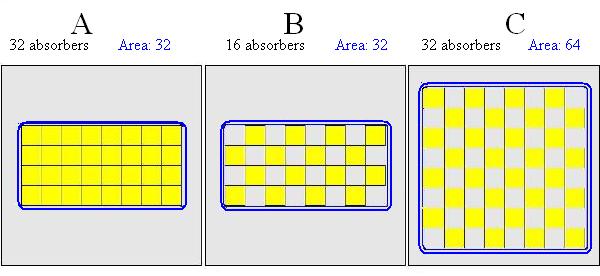
So you are saying that the edges have nothing to do with increasing the absorption coefficient number when the edges are open?
thanks,
Glenn
No I'm not saying that, nor did I said that anywhere in the thread.
Translated by Cadesignr: I
admitted that edges absorb.
Where absorption material is absorption can occur as 1 + 1 = 2 (
but that must be seen within the correct acoustic context), not as: Hé guys, another 1.5 feet to add.
I referred, in relation to Jeff's message that all those phenomena are difficult to distinguish. All, or lot of those things interact.
And I told that my perforated baffles give somewhat higher absorption, but frequency dependent.
I referred to ray acoustics for that part.
Glenn, what I said is in the thread.
If you want a simple rule for a complex phenomenon I can't give you that.
But approximation models to calculate such things do exist. Several authors are referred to. But still then it remains a difficult thing.
Your Tri-corners will show edge effect absorption on those sharp edges as well as on the junction wool/closed top.
This thread was/is about the relationship of, and resulting calculation by EW, in function of a OVER simplified incorrect frequency independent linear relation between edge effect and geometric edge surface, and that's wrong.
Some will know this document:
Please take the time to get the feel:
This was on the net since 2000 or 2001 about.
http://filexoom.com/files/5434/Acoustic ... rption.doc
Ethan Winer knows this doc very well, since it was actively discussed at Yahoo Acoustics (predecessor Studiotips) more specific in function of the high efficiency of corner absorption. (note that this are framed absorbers).
Important in this document:
In fact one can analyze a lot of things from that document.
In this document, also the 2, in this thread questioned measurements are included.
Important in function of Glenn's question and Cadesignr's comment.
When an absorber is measured upstanding, then both sides are 100% exposed to free sound incidence
(expressed in the terms used here, personally I do have question marks with this expression, a panel against a wall for me is as well 2 sided exposed).
Cadesignr:

I very humbly admit that both exposed sides of these absorbers absorb.
I can hardly say they don't. I should be stupid.
But what does that mean?: without putting it in the correct acoustic context: JUST NOTHING.
If you compare the mid and high frequencies on those graphs in this document you'll notice that the absorbers flat on the floor, with only 50 % exposed area to the room versus to the upstanding ones at 100% is roughly comparable.
And the thickness of those absorbers is +/- 6", hence thick enough not to question complicated things in the high frequencies with short wavelengths.
Hence: this so-called both-sided free exposed absorber surface does not translate in even remotely comparable increase in absorption. Those values even remain close together (hardly word bothering to check which curve is which, while the visibly exposed surface is DOUBLE versus one another).
Now you can compare screened upright absorbers versus not screened upright absorbers. The comparison isn't completely correct here.
I just use what I put before on the net already.
Such measurements are executed to study the phenomenon of screening as well as the effect of the measurement method in itself.
The measurements which should be OK for publishing as per official standard are the screened ones, not the free ones.
This screening is 35.4" = ca 3' high. This height influences the room already, but still this are DIFFUSE FIELDS. That sound comes from anywhere.
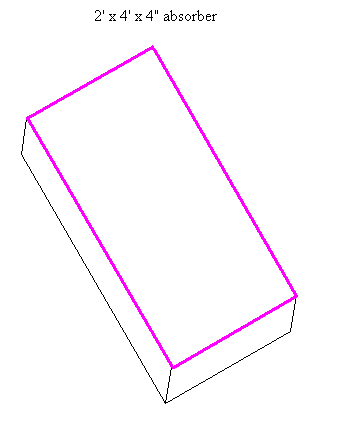
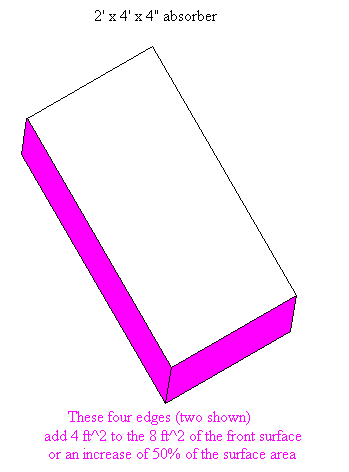
This edge surface (I know this is a limp comparison) is 1.5 times the enclosed area. As per the Ethan Winer reasoning the absorption should increase up to a total of 250% (100% + 150%) versus the screened ones. Check for yourself.
Glenn, I did not say they those edges have no effect with or without frame. Absorption will have. This DOES NOT MEAN THAT YOU JUST CAN PUT AN OVERSIMPLIFIED INCORRECT ALTERNATIVE INSTEAD, as this document shows.
Cultures tried to find things they could give a place in their live for phenomena they didn't understand. Hence they worshipped the sun as a god. You just don't give an explanation because you don't understand something.
I'm busy with this stuff for close to 30 years.
Well I can not compress acoustics in some simple rules of thumbs. And I still wonder about lots of things. And the more I learn, the more I wonder.
While only 13 measurements are shown in this doc. This session included over 50 measurements.
+++++++++++++++++++++++++++++++++++++++++++++++
Some dry facts about corner absorption and the info on the net.
A minor bit of the history is noted in the document linked above.
Unlike Ethan Winer claims Ethan saw the first framed corner absorbers in this very corner absorber.doc, and learned about corner absorption at Yahoo Acoustics the predecessor of Studiotips.
The post is still present where Ethan disputes the value of a fiberglass panel straddling the corner with Scott Foster in favor of his panel traps, which was the product RealTraps was originally established for.
As far as I could find the Acoustics Yahoo group were about the only one promoting this approach.
My corner absorber.doc must be the oldest and first document on the net showing a measurement and explanation about the efficiency and typical behavior of corner absorption.
While used before (limited),
hardly any lab had any idea about this behavior.
Hence it's possible that John used it in the 70ties, but also in Australia a test executed within the last 2 years in an Australian lab, caused the same surprise about this typical behavior with those academics with decades experience.
The same goes for the Labs I know here, and I had contact with David Moyer from Riverbanks (the original Sabine designed lab) also confirming that only the last couple of years such measurements appear.
While Auralex had the LENRDs already, the typical corner behavior wasn't know, which shows from discussions I had with Jeff.
Even the most recent book of Dr. Peter D'Antonio and Trevor Cox, basically says that corner absorption, not based on pressure devices (membrane/panel absorbers), are inefficient devices since corners aren't the right spot for that. Within the year after the appearance of that book the RPG corner foam absorbers appear, in fact contradicting the still existing explanation in the very book with D'Antonio as well as Co-Author and owner of RPG.
Hence the simple logic between bass build up in the corner, hence it works as well for panel traps as open cell absorption isn't that evident at all. And it's still not clear how and which parameters influence this behavior exactly, but which is certainly influenced by the room itself.
Ethan first disputed the Studiotips corner absorption approach and then toke it over.
Hence he CERTAINLY has not the right of blaming other companies, who got their knowledge from exactly the same source as Ethan Winer did.
As well the effect of a cavity, as well the effect of a membrane is explained to Ethan somewhere around of after 2002 (was it 2001? I think 2002, not sure now), when he asked how to interpret absorption value in function of cavities related to absorption lists he was linked to.
This are all dry facts I can prove.
It's a nice contrast with Ethan's comments about the same.
I know a bit the history of that patent and licenses for this corner absorption.
And to be honest, unless I find other data pointing otherwise, I must smile a bit with all those groups acting if it was/is something they knew and understood al along for ages.
This knowledge and real study work has been stuck in Sweden for very long, due to internal relationships within the International Rockwool group, where Rockwool Sweden was separated from and being a competitor of their own former Mother and sister companies abroad, with a product which is more a principle than a product that can be easily protected.
Their was Swedish documentation from for use in Classroom acoustics, auditoria, music purposes and the likes, based on the low frequent qualities. I still have some of those old leaflets, but can't read them well.
As far as I know they never where translated in English, while Rockwool Sweden was very active abroad under the name Ecomax.
If so known, then why are labs all so surprised? Why should D'Antonio & Cox write what they did? One can hardly state that they don't know the studio and sound world. And questioning their knowledge should be a bit strange no? Fact: their not alone ....
The Univ lab, where I did the first measurements (somewhere end eighties ????, can't remember), who have easy access to all papers they like (literature study is standard academic procedure) have spent a significant amount of time trying to figure out this behavior, or find mathematical relationships.
Back then they stopped (more side experiments), + uncertainties caused by frequency design range of labs.
You know that thing which is so logical for Ethan, as per himself, for decades already (numerous related posts prove otherwise).
I'm open for any new info, which gives a better insight in the history of corner absorption and when it was really studied, understood (not the same as using it as a logical complement in a room).
In the following paper I describe a project I did in 1991, and where I integrated corner absorption (I did not work for that Prof., we only published together).
This relates to a TV Studio Complex. The one in the pictures is 18000 m3 = 635664 cft
http://filexoom.com/files/5434/Acoustic ... TS%20b.pdf
Best regards
Eric
PS: David it should be nice if you enter part of that patent you refer where you have it from. The color gradient (+ compression from original monster Tiff) I put in there. That comes from my Word document.


 and he sleeps with drywall and everything related with it) confirm RISC superior to any type of RC, certainly when low frequencies come into the picture, which it always does in this music/audio world.