Broadband absorber behind the speakers?

How to use REW, What is a Bass Trap, a diffuser, the speed of sound, etc.

Moderators: Aaronw, sharward

AVare
Confused, but not senile yet
Posts: 2336
Joined: Thu Feb 05, 2004 1:56 pm
Location: Hanilton, Ontario, Canada

Post by AVare »

Personally in the porous category I scoff at anything less than {6" of 703 with a 4" air gap behind it} as not much of a bass absorber. Even {6" of 703 with a 4" air gap behind it} I would bet wouldn't do much better than:
100hz 0.50
80hz 0.45
63hz 0.40
50hz 0.34
40hz 0.28
32hz 0.23
20hz 0.13
What si the source for this data? The only testing I know of going down to 50 Hz shows the material having an absorption co-efficient equal to or greater than 1 down to 50 Hz!

Curiusly:
Andre
z60611
Posts: 251
Joined: Fri Jun 18, 2004 9:08 am
Location: Ontario, Canada

Post by z60611 »

AVare:
What is the source for this data?
http://www.whealy.com/acoustics/Porous.html is where the numbers came from.
The only testing I know of going down to 50 Hz shows the material having an absorption co-efficient equal to or greater than 1 down to 50 Hz!
Which would that be?
Do you mean 1.00 or 0.01 ?

http://www.bobgolds.com/AbsorptionCoefficients.htm has some results down to 80hz and some others down to 50hz.
http://www.rpginc.com/products/modexcorner/modc_imp.htm
z60611
Posts: 251
Joined: Fri Jun 18, 2004 9:08 am
Location: Ontario, Canada

Post by z60611 »

AVare:

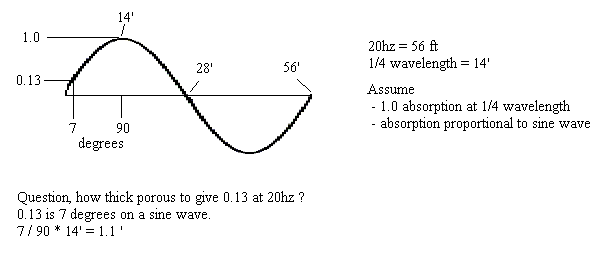
As a double check, sometimes I do this sort of thing (assumes velocity is proportional to absorption, and sine is the velocity).
Image

Since the whealy numbers were based on 6" + 4" = 10", and the double check says it has to be 13" (13" = 1.1 feet) to get 0.13 at 20hz, the double check indicates that the whealy numbers are a little high, but in the ballpark. (Note I may have used the wrong rayls value in whealy.)

The sine double check is usually pessimistic. Give it a try with some of the values on http://www.bobgolds.com/AbsorptionCoefficients.htm and you'll see what I mean. Probably due to diffuse sound field (sound coming in at other than normal incidence, wrecks the 1/4 wavelength equals depth asumption). Behind speakers 'diffuse' is a better model. At the back of the room, perhaps 'normal incidence' is a better model for early/first reflections.

Hence my "I would bet wouldn't do much better than"
AVare
Confused, but not senile yet
Posts: 2336
Joined: Thu Feb 05, 2004 1:56 pm
Location: Hanilton, Ontario, Canada

Post by AVare »

z60611 wrote:AVare:
What is the source for this data?
http://www.whealy.com/acoustics/Porous.html is where the numbers came from.
So they came from the theoretical calculations for normal incidence.

BTW I tried to d/l Chris' files and all I got was not available messages.
The only testing I know of going down to 50 Hz shows the material having an absorption co-efficient equal to or greater than 1 down to 50 Hz!
Which would that be?
Do you mean 1.00 or 0.01 ?
I mean 1.00. The source is BBC RD 1992-10 fig 3, pdf page 8. The one that I am specifically referring to is is for the 280 mm thick material. This is from testing in a reverberation chamber. From what I recall from another BBC RD report, the normal incident absorption rolls off approximately an octave higher. The test data shows basically flat absorption down to 50 Hz, so a reasonable assumption is that the test material is flat down to at least 100 Hz for normal incidence.

Obtusely:
Andre
Ethan Winer
Senior Member
Posts: 1063
Joined: Fri Feb 21, 2003 3:50 am
Location: New Milford, CT, USA
Contact:

Post by Ethan Winer »

Bob,

> As an alternative to front wall treatment we have baffling/soffeting <

Well, okay, but now you're changing gears in the middle of the stream. Or something like that. :)

> Low frequencies wrap around the speaker inversely proportional with frequency <

All the more reason to pull a "Woodlock" and just fill the entire freakin' space with as much insulation as you can possibly fit. I say the heck with 1-inch thick anything.

> In my case it might be good. I don't know. But it's what I'm building. :) <

I'm sure it will be good. And I'm sure you'll have ETF data to prove it.

--Ethan
Ethan Winer
Senior Member
Posts: 1063
Joined: Fri Feb 21, 2003 3:50 am
Location: New Milford, CT, USA
Contact:

Post by Ethan Winer »

Glenn,

> Did the person ever say why bass traps where not useful in a corner? That just seems nuts to me. <

Of course it's nuts. That what happens when you spend all your time in an ivory tower and don't get out enough. In this case it is incredibly easy to prove that corners are the single best place for bass traps. But some folks would rather argue (incorrect) theory than actually test it.

Anyway, that was related to me in a conversation with Dan Nelson. I hadn't heard of that before, but I've heard it again since. I have no idea how a professional acoustician could not understand this, but recall it was only a few years ago that a number of "pros" argued vehemently with me that comb filtering peaks and nulls do not exist in a room at non-modal frequencies. :roll:

--Ethan
Eric_Desart
Senior Member
Posts: 760
Joined: Wed Jun 18, 2003 6:09 pm
Location: Antwerp/Belgium
Contact:

Post by Eric_Desart »

Ethan Winer wrote:Glenn,

> Did the person ever say why bass traps where not useful in a corner? That just seems nuts to me. <

Of course it's nuts. That what happens when you spend all your time in an ivory tower and don't get out enough. In this case it is incredibly easy to prove that corners are the single best place for bass traps. But some folks would rather argue (incorrect) theory than actually test it.

Anyway, that was related to me in a conversation with Dan Nelson. I hadn't heard of that before, but I've heard it again since. I have no idea how a professional acoustician could not understand this, but recall it was only a few years ago that a number of "pros" argued vehemently with me that comb filtering peaks and nulls do not exist in a room at non-modal frequencies. :roll:

--Ethan
Glenn,

Ethan has his own manner to handle truth and context.

Do you know that you call at this very moment Dr Peter D'Antonio and Prof. Dr. Trevor Cox nuts, because that possibly what Dan refers to.
If you call something nuts, 1) you should know the arguments, 2) you should know and be able to explain what and why those arguments are wrong.
Ethan, either refer to related posts of Dan Nelson, or ask him to bring his own words in context. Please tell why you questioned Scott Foster defending 703 mounted in the corners in favour of your panel traps. While for net visitors it feels that your "panels straddling the corner" where always there, we both know that this is all relative recent isn't it? RealTraps was established, not that long ago based on the production and sales of panel traps, not MiniTraps, not "panels straddling the corner".

This kind of talk is children's talk.

BTW: I never saw ANY PRO ACOUSTICIAN on the net tell that peaks and nulls do not exist at non-modal frequencies, which is quite different than telling that peaks and nulls do exist ALWAYS at ALL frequencies, which is what Ethan's point always was and which indeed is wrong.

Ethan you really do believe yourself don't you?

Interference is one of very first concepts anybody who learns acoustics learns about, which is handled in the first chapters of whatever related book.
Best regards - Eric Desart
My posts are never meant to sell whatever incl. myself, neither direct, nor indirect.
z60611
Posts: 251
Joined: Fri Jun 18, 2004 9:08 am
Location: Ontario, Canada

Post by z60611 »

AVare:
I'm able to download
http://www.whealy.com/acoustics/Porous Absorber Calculator V1.51 XL2002.zip
z60611
Posts: 251
Joined: Fri Jun 18, 2004 9:08 am
Location: Ontario, Canada

Post by z60611 »

Ethan:
I say the heck with 1-inch thick anything.
We are of course free to do whatever we want in our own rooms. :)

Another thought about 1" and 1khz is the way the ear works.

Interaural time difference (ITD) works well up to about 743 hz.
Interaural intensity difference (IID) works well above 2.8khz

To say that again the interaural intensity difference is a queue for the direction at high frequencies whereas the interaural time difference is a cue for the direction at low frequencies. In between these two frequencies the ability of our ears to resolve direction is not as good as at other frequencies.

For IID to work, reflections should be killed by 10dB.

ITD is less sensitive to reflections, because it works relative to the time it takes sound to go around your head which is on the order of 673 microseconds (not milliseconds). Reflections off objects less than a head diameter away from the speaker cone should be avoided, but they'd be rare in most places, with the possible exception of a recording console with mini speakers sitting on the back of it.
All the more reason to pull a "Woodlock" and just fill the entire freakin' space with as much insulation as you can possibly fit.
I probably will. :) Maybe some rigid in the back, with SafeNSound in the front.
Initially I thought "Pull a Woodlock" was a good definition and smiled with shared understanding -- but I recall that Paul Woodlock actually thought a lot about sound paths in his room, and there are reflective spots in chosen locations. So the criteria wasn't what "can possibly fit".
z60611
Posts: 251
Joined: Fri Jun 18, 2004 9:08 am
Location: Ontario, Canada

Post by z60611 »

AVare:
The source is BBC RD 1992-10 fig 3, pdf page 8. The one that I am specifically referring to is is for the 280 mm thick material.
I like that.
I think I'll add that to my http://www.bobgolds.com/AbsorptionCoefficients.htm page.


BTW, when I was 8 years old and the newspaper reporter asked me what I wanted to be when I grew up I'm pretty sure I said "Fireman or Architect". I'm certain I didn't say "I want to collect fiberglass absorption coefficients." :) What a hobby. :o
Last edited by z60611 on Thu Sep 14, 2006 4:10 pm, edited 1 time in total.
z60611
Posts: 251
Joined: Fri Jun 18, 2004 9:08 am
Location: Ontario, Canada

Post by z60611 »

Did the person ever say why bass traps where not useful in a corner
I can't recall anyone off hand who's said "bass traps" weren't useful in a corner (all modes active in tri-corners).
But I know Dennis Erskine (who does put "bass traps" in corners and other places) won't put a "Studio Tips Diagonal Corner Absorber" in a corner (he said that), because he doesn't like the absorbtion curve of that device for home theatre (I may be putting words in Dennis Erkines mouth), and he uses other techniques instead to accomplish the same goal (he definately does that).
JCR
Posts: 7
Joined: Fri Sep 08, 2006 3:35 pm

Post by JCR »

Finally I'm back again.

Some of you have mentioned that it's a danger to absorb too much highs with this kind of absorber. I'm aware of it and it's my plan to cover it with paper or plastic foil (or something else) to some extent. I have a measuring microphone so I can experiment a bit.

Actually z60611 described it in his last posting on page 1. I want this absorber also as an alternative to baffling/soffeting. I thought that speakers are measured in a dead room and therefore reflections from this low frequency wrap around are neglected in it's frequency measurement. In other words, I thought it's a goal to get rid of this "wrap around" frequencies (many speakers have room EQs for this) - especially when they bounce back from the wall behind your speakers.

I'm a bit confused now. 8)
Ethan Winer
Senior Member
Posts: 1063
Joined: Fri Feb 21, 2003 3:50 am
Location: New Milford, CT, USA
Contact:

Post by Ethan Winer »

> Ethan has his own manner to handle truth and context ... Ethan you really do believe yourself don't you? <

Eric, in the US we have an expression "The pot is calling the kettle black." It definitely applies here.
barefoot
Moderator
Posts: 554
Joined: Thu Feb 27, 2003 4:49 am
Location: Portland Oregon
Contact:

Post by barefoot »

JCR wrote: The first thing I want to do is to cover all "first reflexion points" and add some basstraps (there is enough information about that in this forum) , but I also want to engage comb filtering and reflections from the wall behind my speakers (LEDE). So the idea is a broadband absorber between the speakers and the wall.
JCR,

The front wall has first reflection points just like the side walls. And you're not going to significantly effect the "bass lift" from the front wall, even with 30cm of absorption. However, you will create a very odd sounding dead space in front of you that will probably be detrimental you good mix translation. If I were you, I would just put the front absorption in the areas around those first reflection points, and not cover the entire wall. This way you help reduce the lower midrange comb filtering effect from the front wall, but you don't create a total dead space.

Ethan Winer wrote: As I see it, that's the third priority for treating. Some people have dipole speakers that send sound equally from the front and rear, so in that special case absorption on the front wall can be useful. Other than that, the first important places are the first reflection points on the side walls and ceiling (and floor). Second in importance is the rear wall behind you, especially if it's less than ten feet away. Then you could consider the front wall.
Ethan,

I think you keep missing the point that normal (non-dipole) speakers radiate a significant amount of sound towards the rear of the speaker (towards the front wall) well up into the midrange. My Wall Bounce Calculator has been downloadable from this forum for quite a while. You should check it out.

Thomas
Thomas Barefoot
Barefoot Sound
Ethan Winer
Senior Member
Posts: 1063
Joined: Fri Feb 21, 2003 3:50 am
Location: New Milford, CT, USA
Contact:

Post by Ethan Winer »

Thomas,

> I think you keep missing the point that normal (non-dipole) speakers radiate a significant amount of sound towards the rear of the speaker (towards the front wall) well up into the midrange. <

I think the general rule of thumb is that once the output is 10 dB down, comb filtering is reduced to an "acceptable" level. Using your own speakers as an example, at what frequency is the rear radiation 10 dB down?

Also, I am not opposed to using absorption on the front wall. It just seems to me far less important than the "primary" first reflection points, and also less important than rear wall reflections when the rear wall is relatively close.

--Ethan
Post Reply